Library · Public domain

Relativity: The Specialand General Theory

Über die spezielle und die allgemeine Relativitätstheorie (Gemeinverständlich)

Cover illustration of the book

Choose your version

The same text, told at every level, in every language and look shown here. Pick, then listen or download.

Listen and watch

The same player the product gives for your own book: the voice, the drawings as they are drawn, the text.

Einstein’s own account of relativity, written in 1916 for readers without higher mathematics: what space, time and motion mean once the speed of light is the same for everyone.

This is a sample: 4 of 29 sections. · Made in 170 min

From the lectures

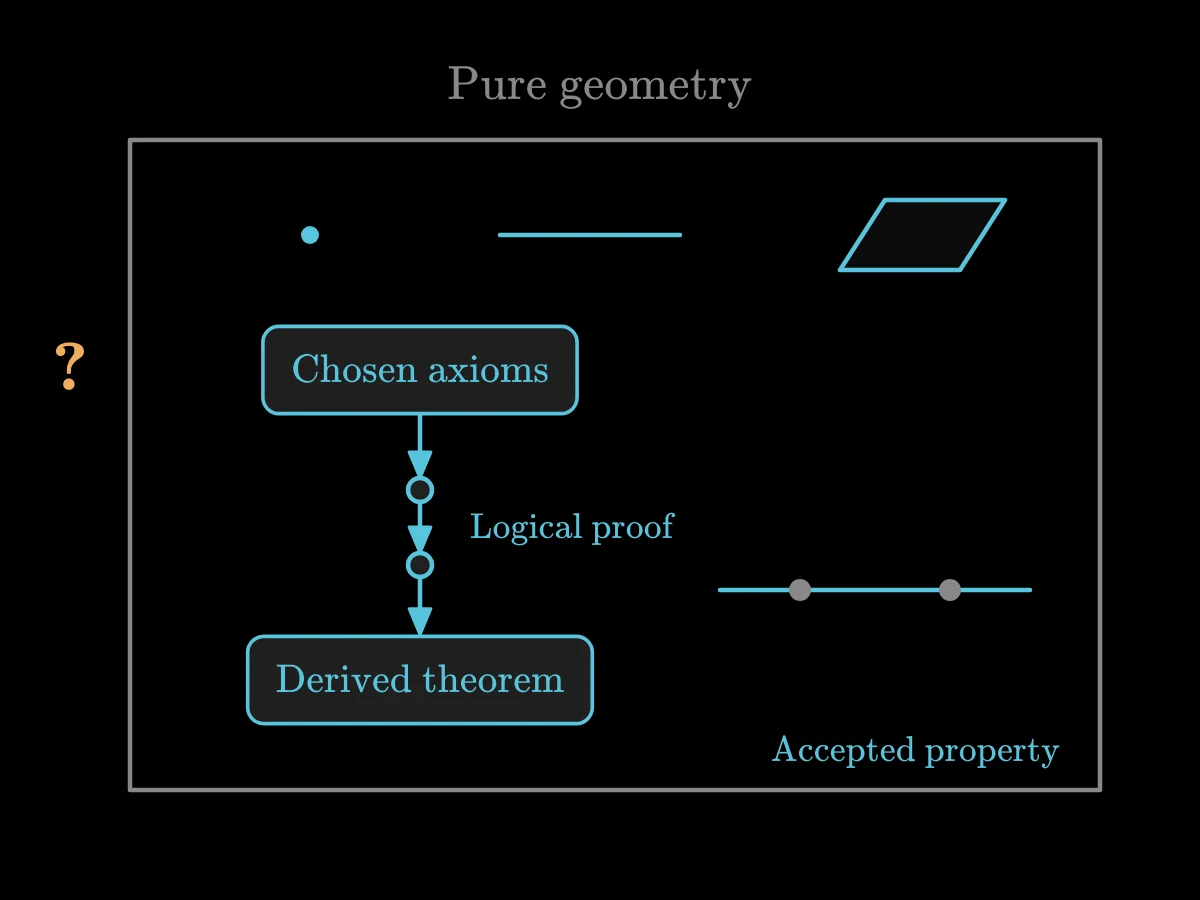
Basic geometric objects and accepted axioms lead through logical steps to a theorem, all within a boundary representing pure geometry.
When Is a Theorem True?

Inside Pure Geometry

Here is how geometry is built. It starts from a few basic notions, such as plane, point and straight line, which we picture more or less clearly, and from a few simple statements about them, the axioms, which we are willing to accept because the pictures make them feel obvious.
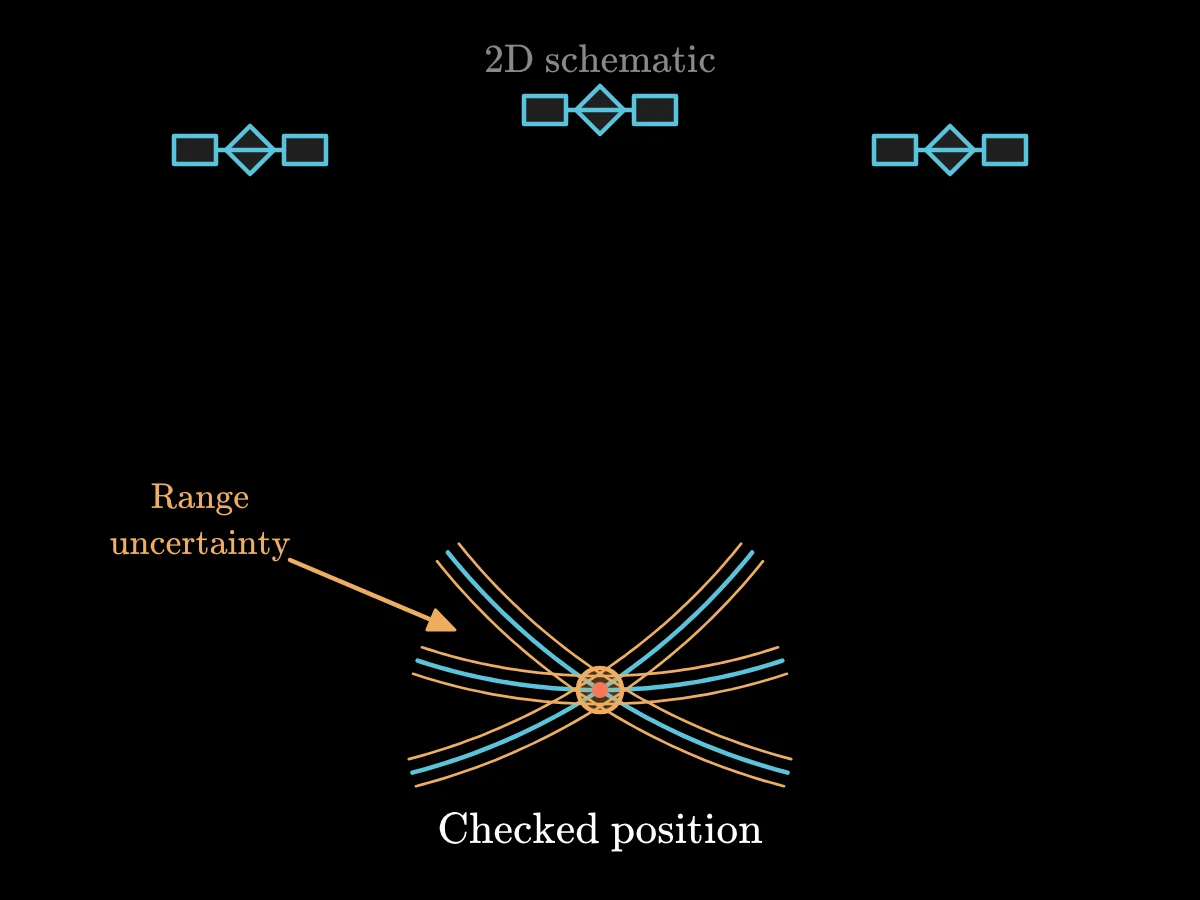
Three schematic distance circles meet at a receiver position, and measurement uncertainty turns their exact crossing into a small region.
When Is a Theorem True?

Distances Locate a Receiver

A satellite navigation receiver measures its distance to several satellites and then applies plain geometry, the same geometry of segments and points, to turn those distances into a place on the map.

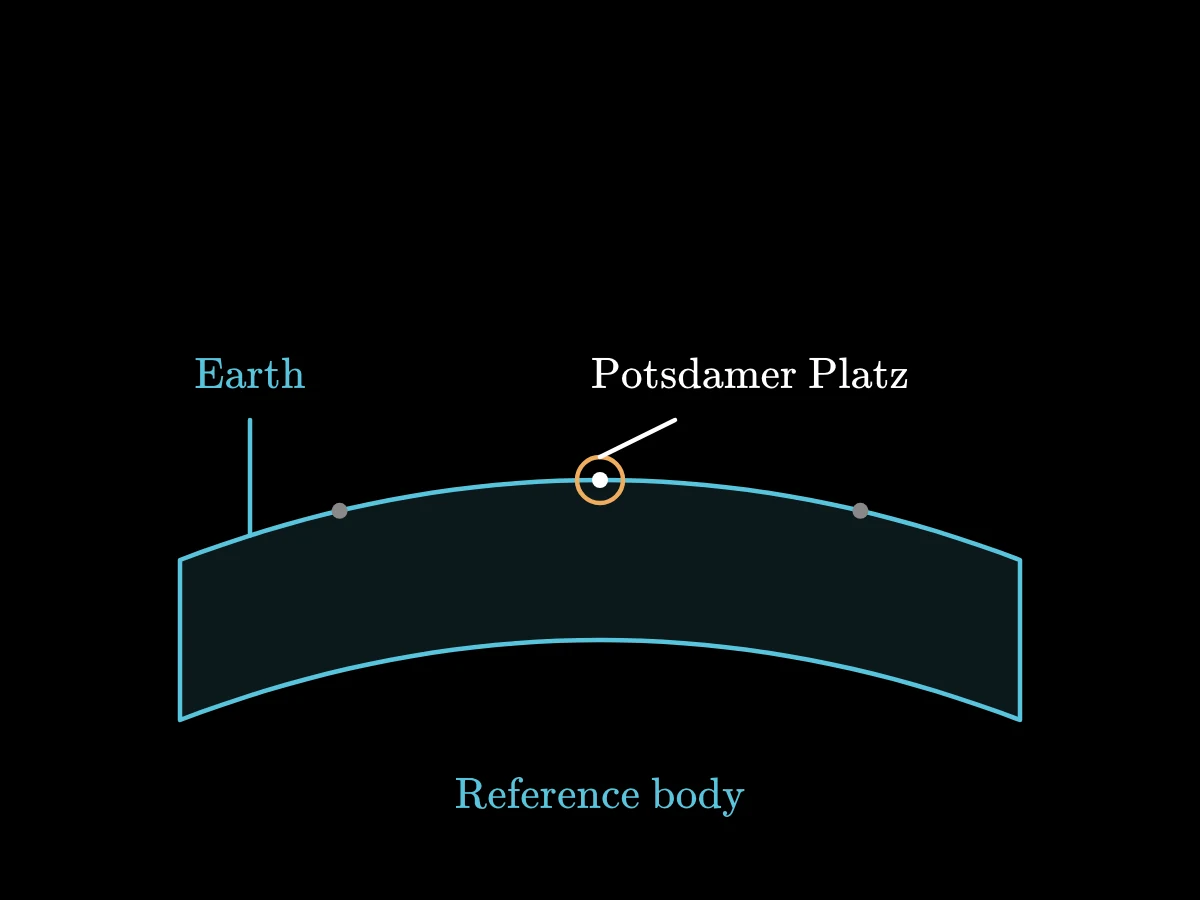
An event coincides with a named point on a reference surface, while other surface points remain unnamed.
Giving a Place Three Numbers

A Place on a Reference Body

Now to the question of where a thing is. Every spatial description of the place of an event or an object, Einstein says, consists in naming the point of a rigid body with which the event coincides. That rigid body is the reference body.

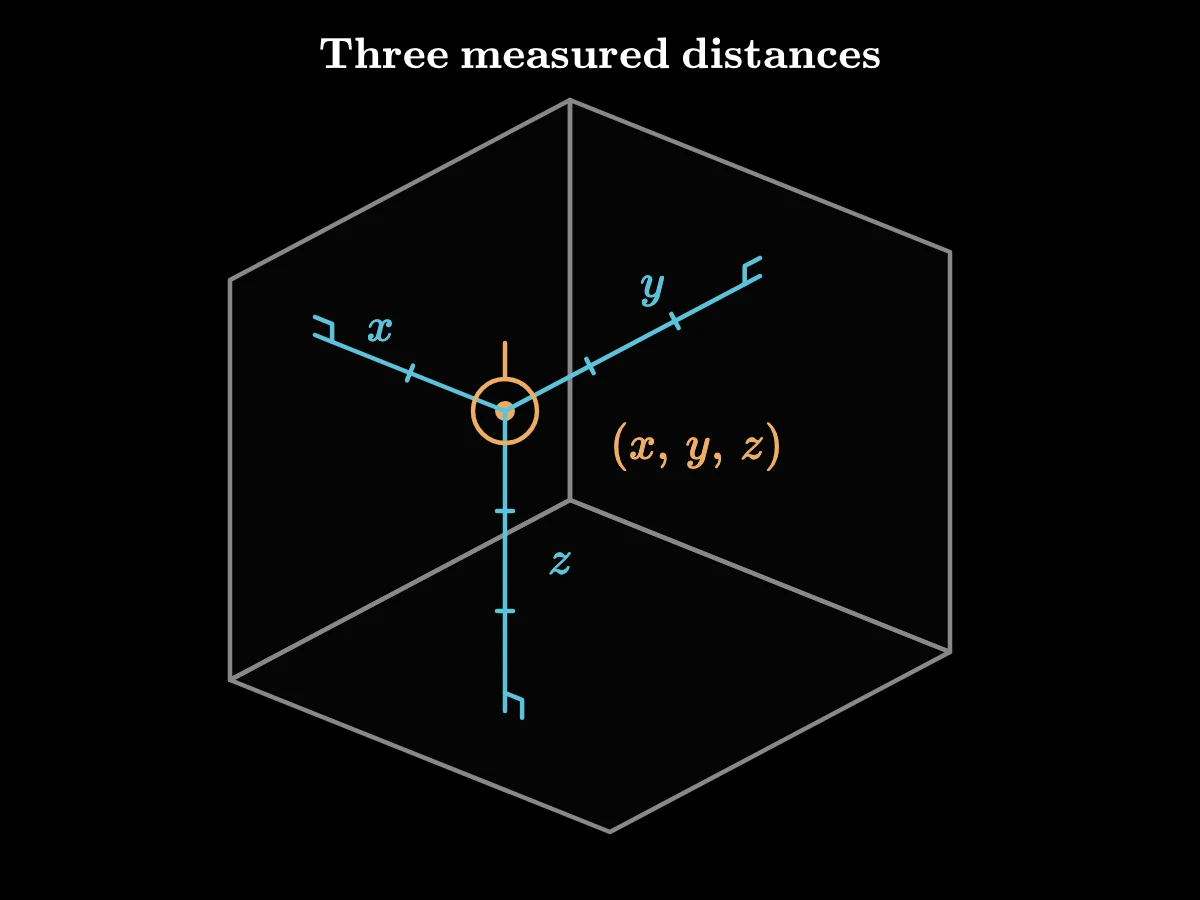
A point inside a three-plane corner has three perpendicular distances labelled x, y, and z, which change when the point moves while the planes remain fixed.
Giving a Place Three Numbers

Three Distances Fix a Place

Measuring physics does this with the Cartesian coordinate system. Picture three rigid flat walls, each perpendicular to the other two, joined into one rigid body, like the two walls and the floor meeting in the corner of a room.

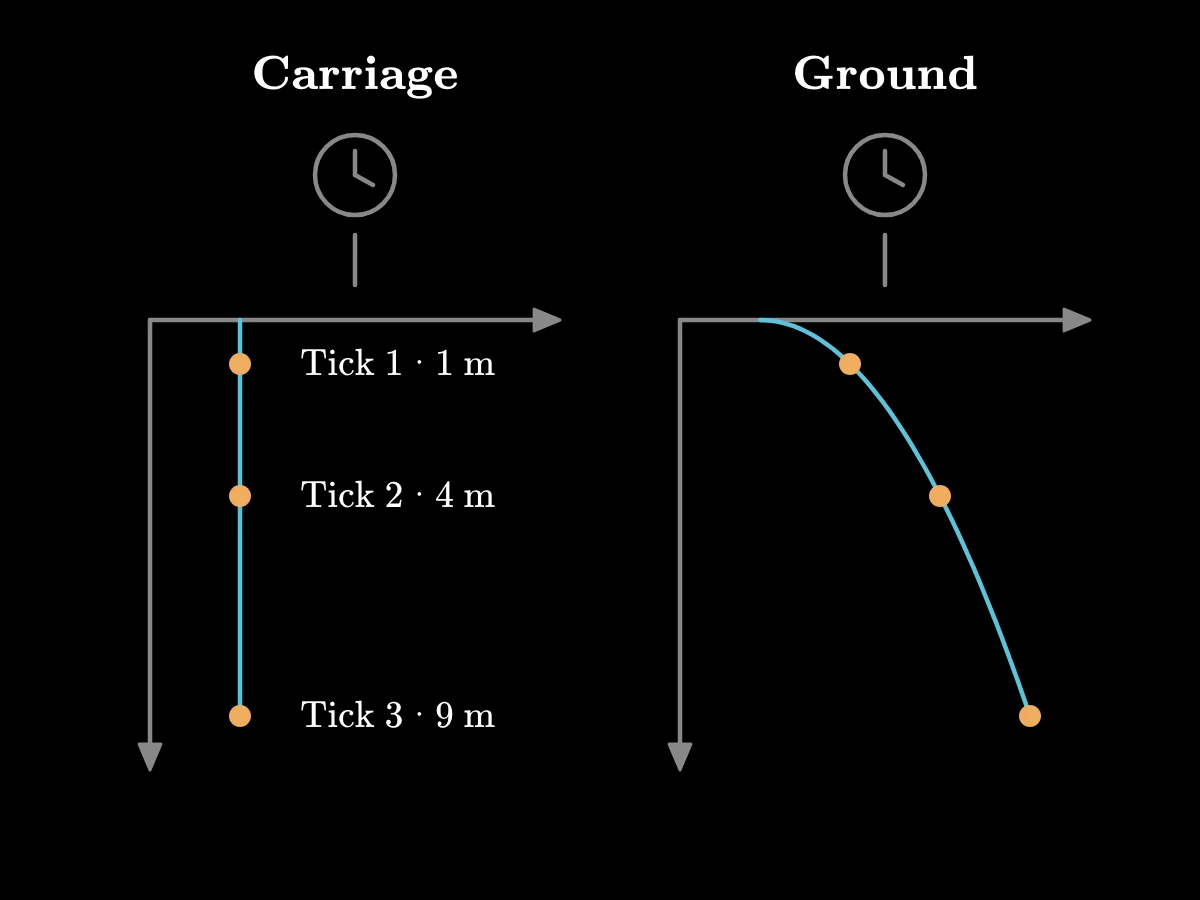
Two coordinate plots pair three equal clock ticks with matching downward distances, producing a vertical path in the carriage and a parabola on the ground.
The Stone That Fell Two Ways

Places Paired With Ticks

But a path, even with its reference body named, is not yet a description of motion. A complete description must say how the body changes its place with time; for every point of the path we must state at what time the body is there.

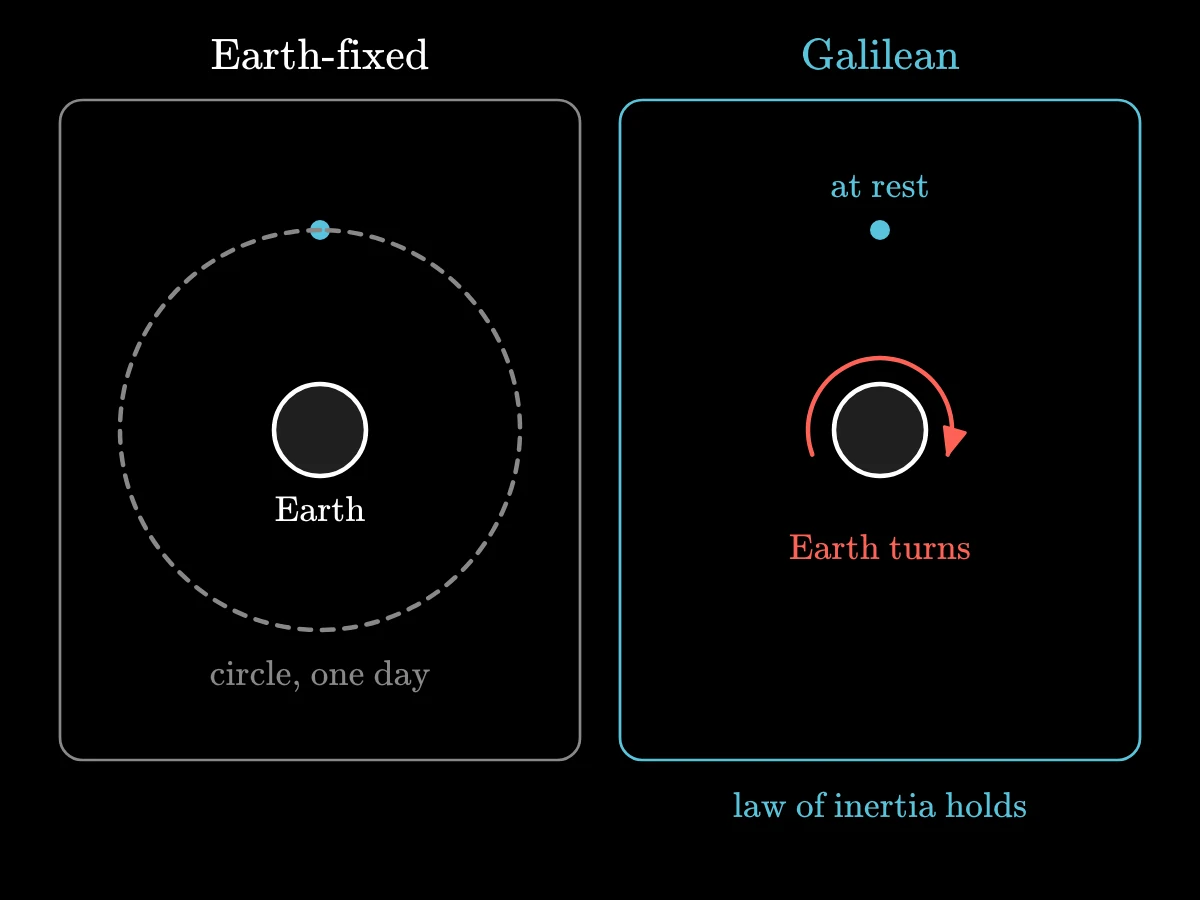
Two panels: on the left a star circles the pole in a frame fixed to the turning Earth, on the right the same star stands still while the small Earth turns in a frame fixed to the stars.
Which Reference Bodies Are Allowed?

Earth-Fixed Versus Galilean

Now put the two together. The visible fixed stars are bodies to which the law of inertia should apply with great accuracy; they are as far removed from everything as any body we can see. Take a coordinate system rigidly attached to the Earth, the three walls of the earlier part, fixed to the ground.

How it was made

Examples for: a curious adult with school physics; add one modern instance per idea, such as GPS satellite clocks

The source

The lectures retell the German text of Project Gutenberg #77850, the 1917 Vieweg edition. The author died in 1955; the work is in the public domain. The retelling, the drawings and the voice are made by AI and checked against the book by a second model; nothing was edited by hand. How AI is used.

The lectures are free to read, share and quote with a link to this page.

Your own hard book, the same way

Upload a textbook or any difficult book. The first five minutes are free.

Upload a book