Library · Public domain

Collected Papers ofSrinivasa Ramanujan

Collected Papers of Srinivasa Ramanujan

Cover illustration of the book

Choose your version

The same text, told at every level, in every language and look shown here. Pick, then listen or download.

Listen and watch

The same player the product gives for your own book: the voice, the drawings as they are drawn, the text.

The first paper the self-taught genius ever published, written in Madras at 23: strange patterns in the Bernoulli numbers, the numbers behind sums of powers. Most of his claims are true, some are guesses, and one is false; the lectures show which is which.

This is a sample: 1 of 37 papers.

From the lectures

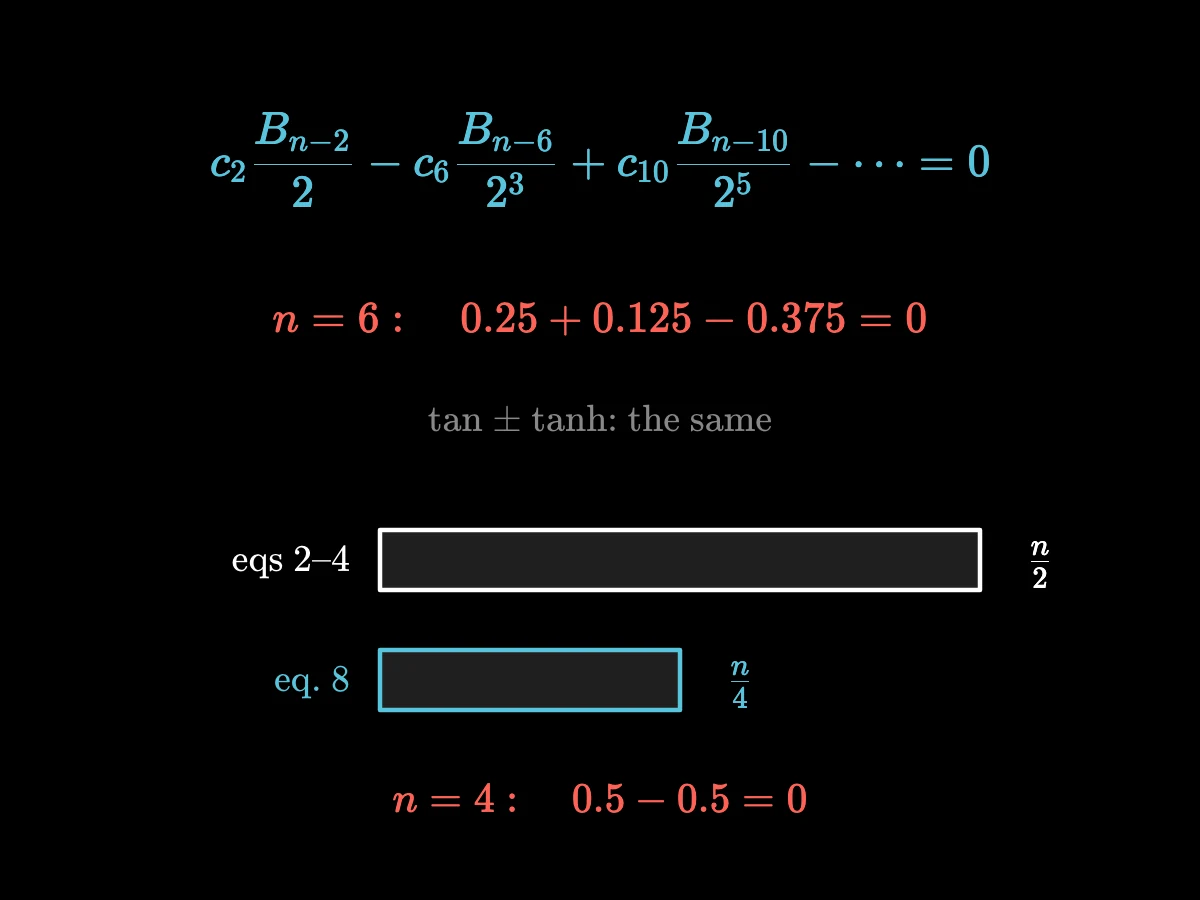
Two bars compare the work: equations two to four with n over two terms, equation eight with about n over four; a check for n = 6 sums to zero.
Making Half the Terms Vanish

Half the terms of before

Matching coefficients as before gives equation eight, for even n greater than 2: c₂Bₙ₋₂/2 − c₆Bₙ₋₆/2³ + c₁₀Bₙ₋₁₀/2⁵ − ⋯ + (n/2^((n+2)/2))(−1)^(n/4) = 0, the sign being (−1)^(n/4) when n is a multiple of 4 and (−1)^((n−2)/4) when n minus 2 is.
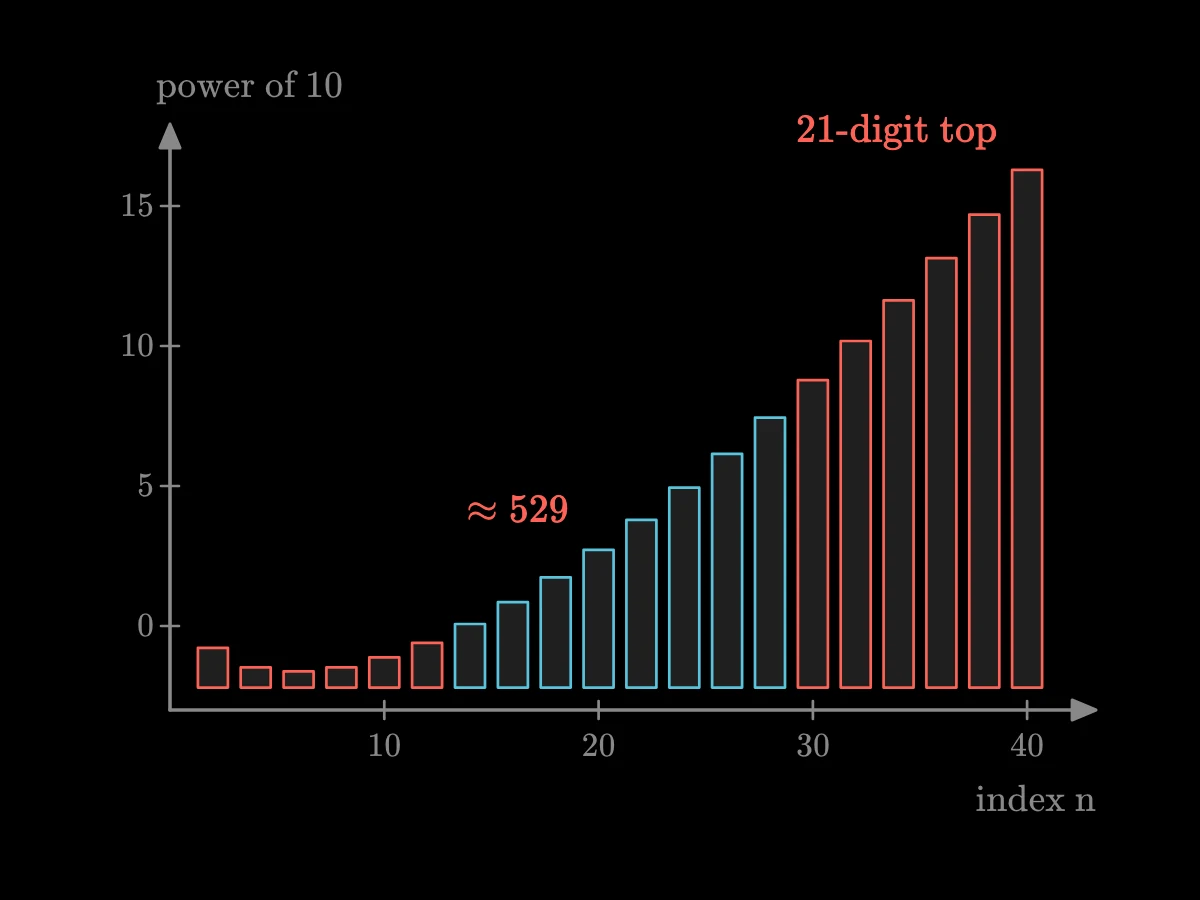
A bar chart of the size of B2 to B40 on a power-of-ten scale: tiny fractions first, about 529 at index 20, then about 2 times 10 to the 16 at index 40.
A Formula to Check the Work, and the Table

Twenty values: small, then enormous

Carrying on this way, he lists twenty values, from B₂ = 1/6 to B₄₀. They stay small at first, B₁₄ = 7/6, then climb fast: B₂₀ = 174611/330, about 529, and B₄₀ has a numerator of 21 digits over a denominator of only 13530.

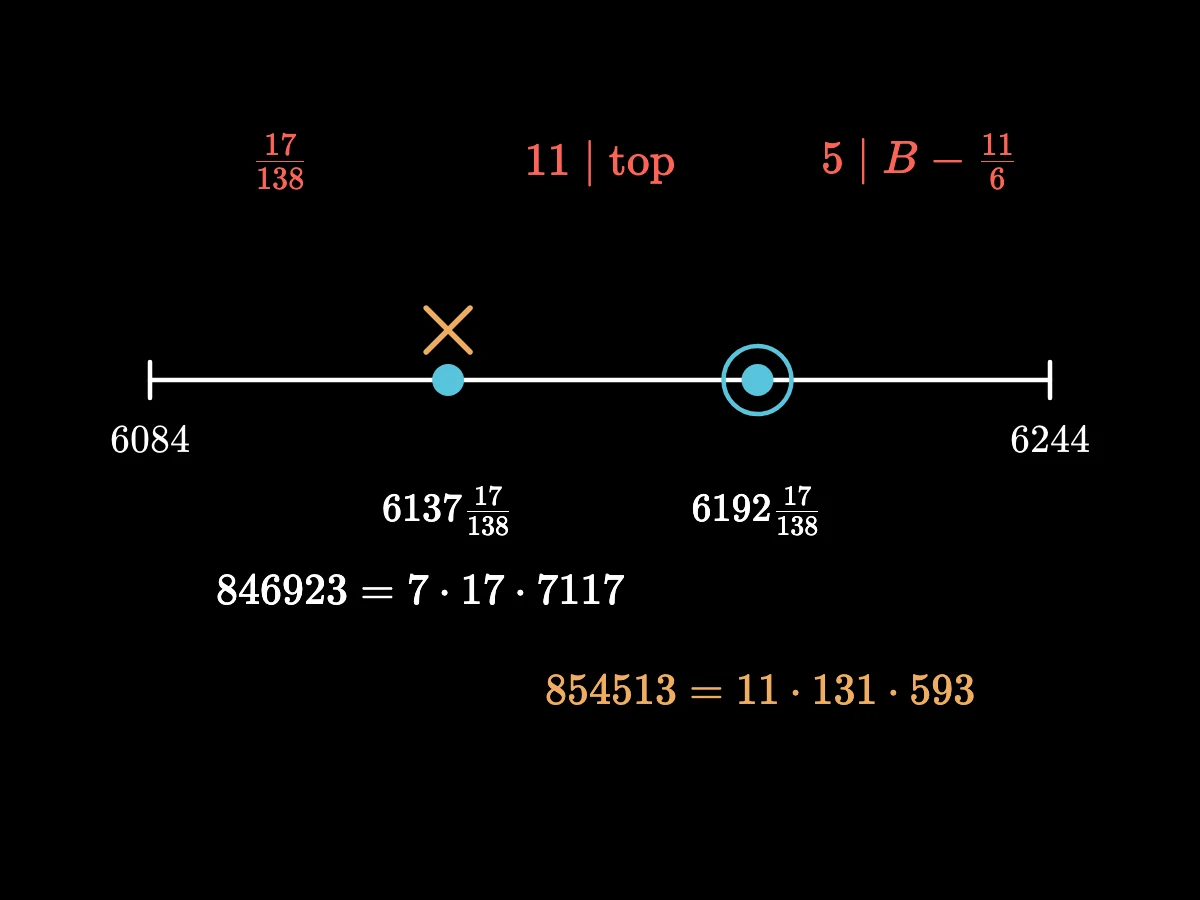
A number line from 6084 to 6244; the clues leave 6137 17/138 and 6192 17/138; 846923 = 7 × 17 × 7117 is rejected; 854513 = 11 × 131 × 593 is kept, though its quotient is not prime.
The Fraction Part, and a Number Pinned From Its Size

Two survivors out of 160

Section ten puts these together. Suppose all you know is that B₂₂ lies between 6084 and 6244. Its fractional part must be 17/138, its numerator must be divisible by 11, and B₂₂ − 11/6 must be divisible by 5. Among the 160 whole numbers in that range only two survive: 6137 17/138 and 6192 17/138.

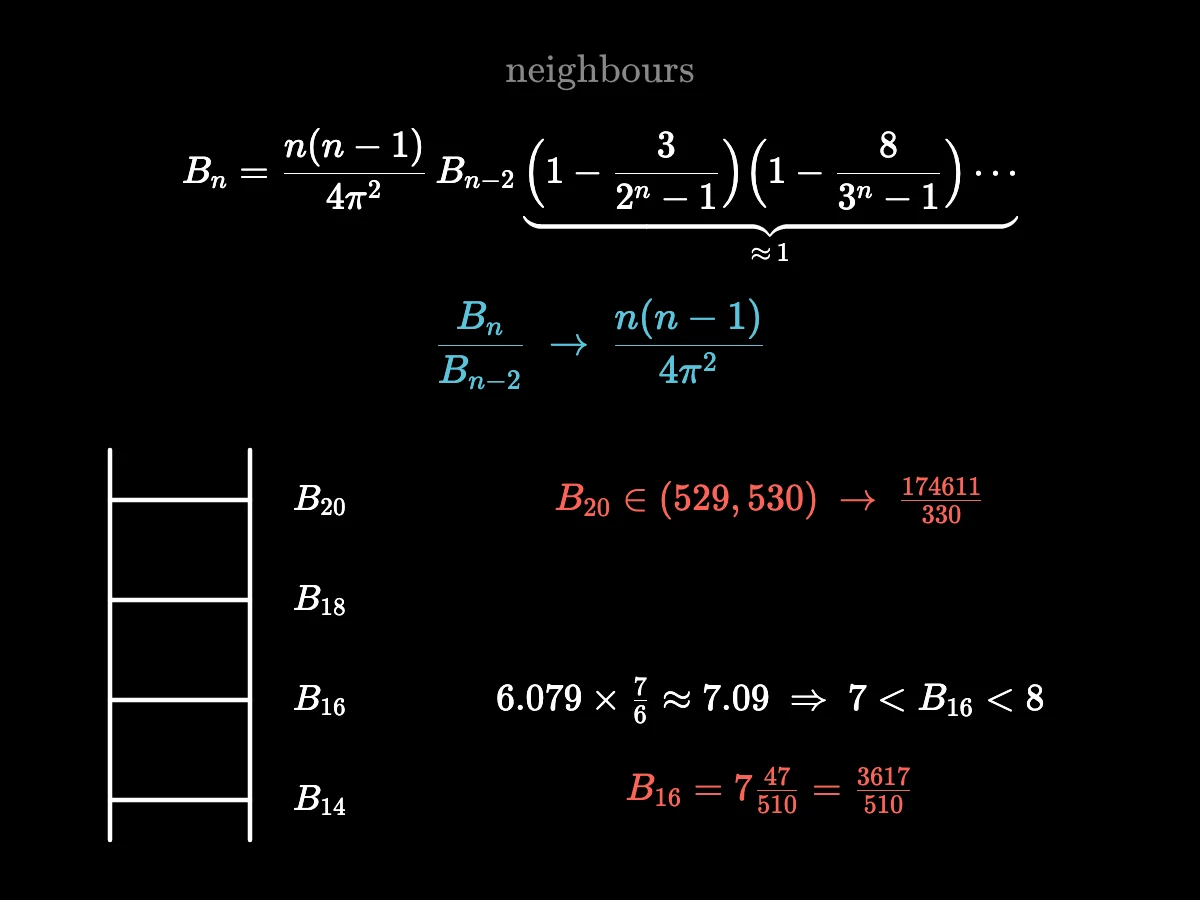
Equation thirty-four: Bₙ = n(n − 1)/(4π²) · Bₙ₋₂ times factors near 1; result thirty-five: the ratio approaches n(n − 1)/(4π²); the ladder: for B₁₆, 6.079 × 7/6 ≈ 7.09, between 7 and 8, plus 47/510 gives 3617/510; up to B₂₀ = 174611/330.
How Many Digits, and the Next Value From the Last

A ladder of ratios

Section fourteen compares neighbours. Dividing equation twenty-four for n by the same for n minus 2 gives equation thirty-four: Bₙ = (n(n − 1)/(4π²)) Bₙ₋₂ (1 − (2² − 1)/(2ⁿ − 1))(1 − (3² − 1)/(3ⁿ − 1))⋯.

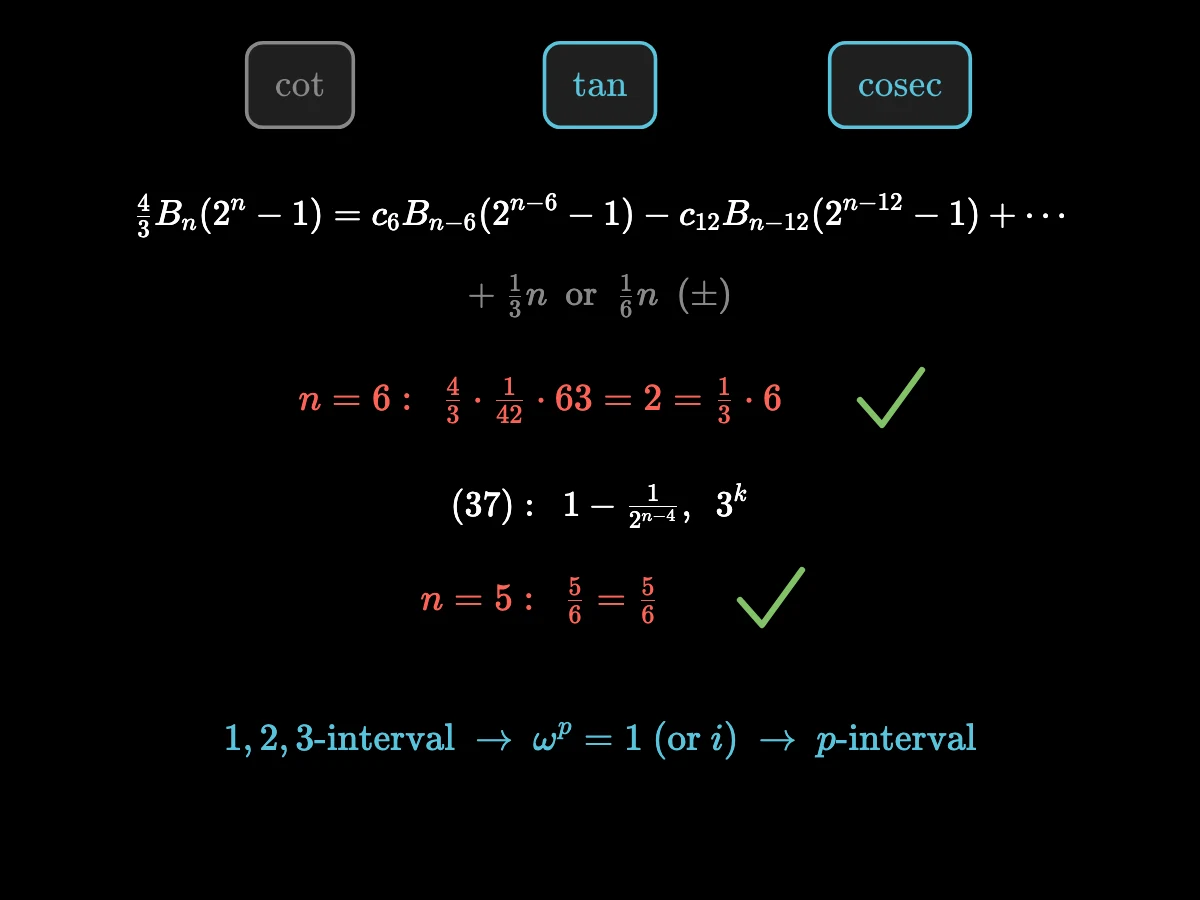
The tangent and cosecant replace the cotangent; equation thirty-six (4/3)Bₙ(2ⁿ − 1) = c₆Bₙ₋₆(2ⁿ⁻⁶ − 1) − ⋯ + ⅓n or ⅙n; at n = 6: (4/3)(1/42)(63) = 2 = ⅓·6; equation thirty-seven at n = 5 gives 5/6 on both sides; one-, two-, three-interval formulas, and p-th roots give p-interval formulas.
A Giant Described, and Five-Way Sieves

Tangent, cosecant, intervals

Section sixteen notes that the tangent and the cosecant can replace the cotangent. One result is equation thirty-six: (4/3)Bₙ(2ⁿ − 1) = c₆Bₙ₋₆(2ⁿ⁻⁶ − 1) − c₁₂Bₙ₋₁₂(2ⁿ⁻¹² − 1) + ⋯, plus a last term ⅓n or ⅙n with a sign. For n equal to 6: (4/3) × (1/42) × 63 = 2, and the last term is ⅓ × 6 = 2.

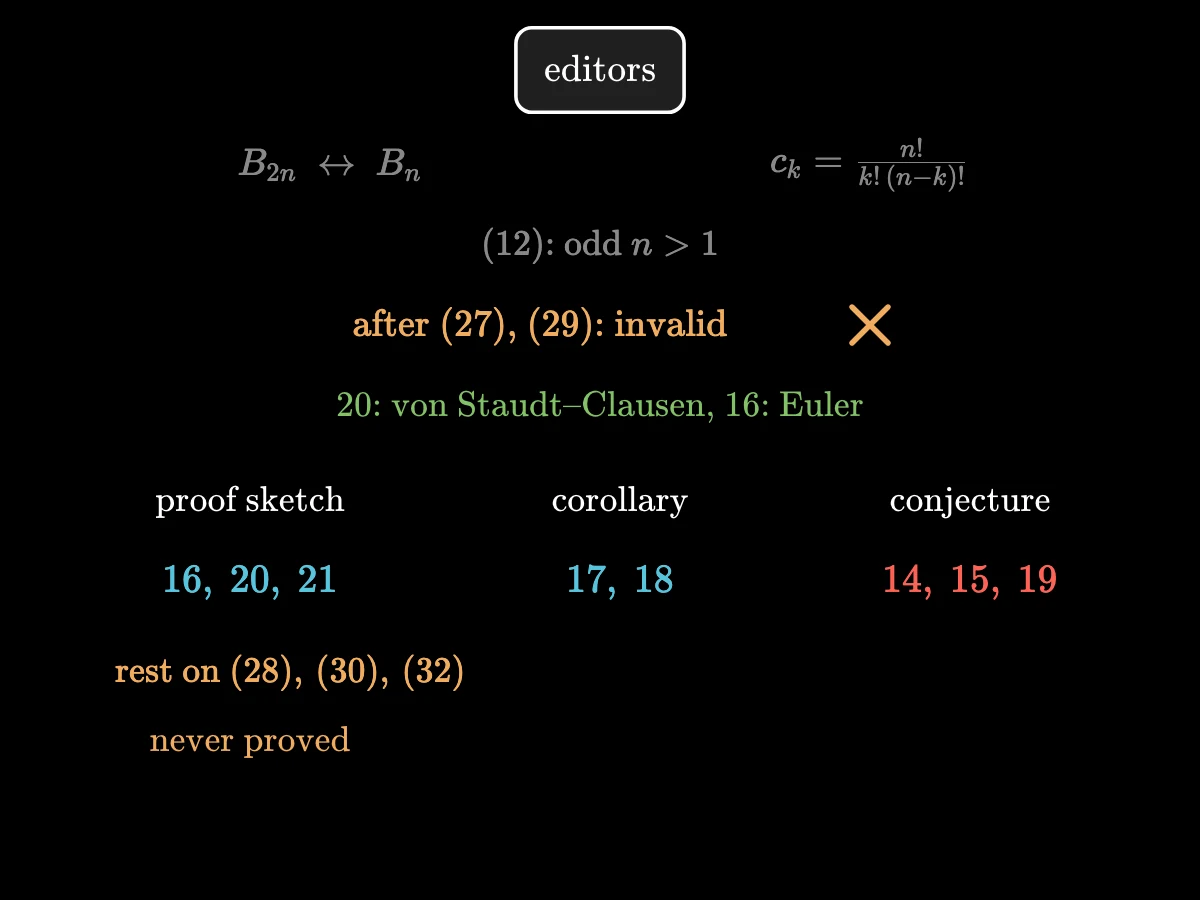
The editors' note: B₂ₙ for the usual Bₙ, cₖ the binomial coefficient, equation twelve for odd n > 1; the derivations after (27) and (29) are invalid because a series diverges; statement twenty is von Staudt–Clausen and sixteen was known to Euler; statements 16, 20, 21 have proofs resting on unproved (28), (30), (32); 17 and 18 are corollaries; 14, 15 and 19 are conjectures.
Four-Way Sieves, and the Editors' Verdict

The editors sort the claims

The book then adds a note from the editors of the collected papers, and it is worth reading closely, because it sorts everything we have met by its status. First, small clarifications: Ramanujan writes B₂ₙ where most books write Bₙ, and cₖ is the binomial coefficient n!/(k!(n − k)!).

How it was made

Examples for: a curious adult with school maths who likes number puzzles and knows Ramanujan's story; add one modern instance per idea, such as a calculator, computer algebra or cryptography

The source

The lectures retell the English text of the Cambridge 1927 edition (Internet Archive pli.kerala.rare.28155). The author died in 1920; the work is in the public domain. The retelling, the drawings and the voice are made by AI and checked against the book by a second model; nothing was edited by hand. How AI is used.

The lectures are free to read, share and quote with a link to this page.

Your own hard book, the same way

Upload a textbook or any difficult book. The first five minutes are free.

Upload a book