Library · Public domain

Collected Papers ofSrinivasa Ramanujan

Collected Papers of Srinivasa Ramanujan

Cover illustration of the book

Choose your version

The same text, told at every level, in every language and look shown here. Pick, then listen or download.

Listen and watch

The same player the product gives for your own book: the voice, the drawings as they are drawn, the text.

The first paper the self-taught genius ever published, written in Madras at 23: strange patterns in the Bernoulli numbers, the numbers behind sums of powers. Most of his claims are true, some are guesses, and one is false; the lectures show which is which.

This is a sample: 1 of 37 papers.

From the lectures

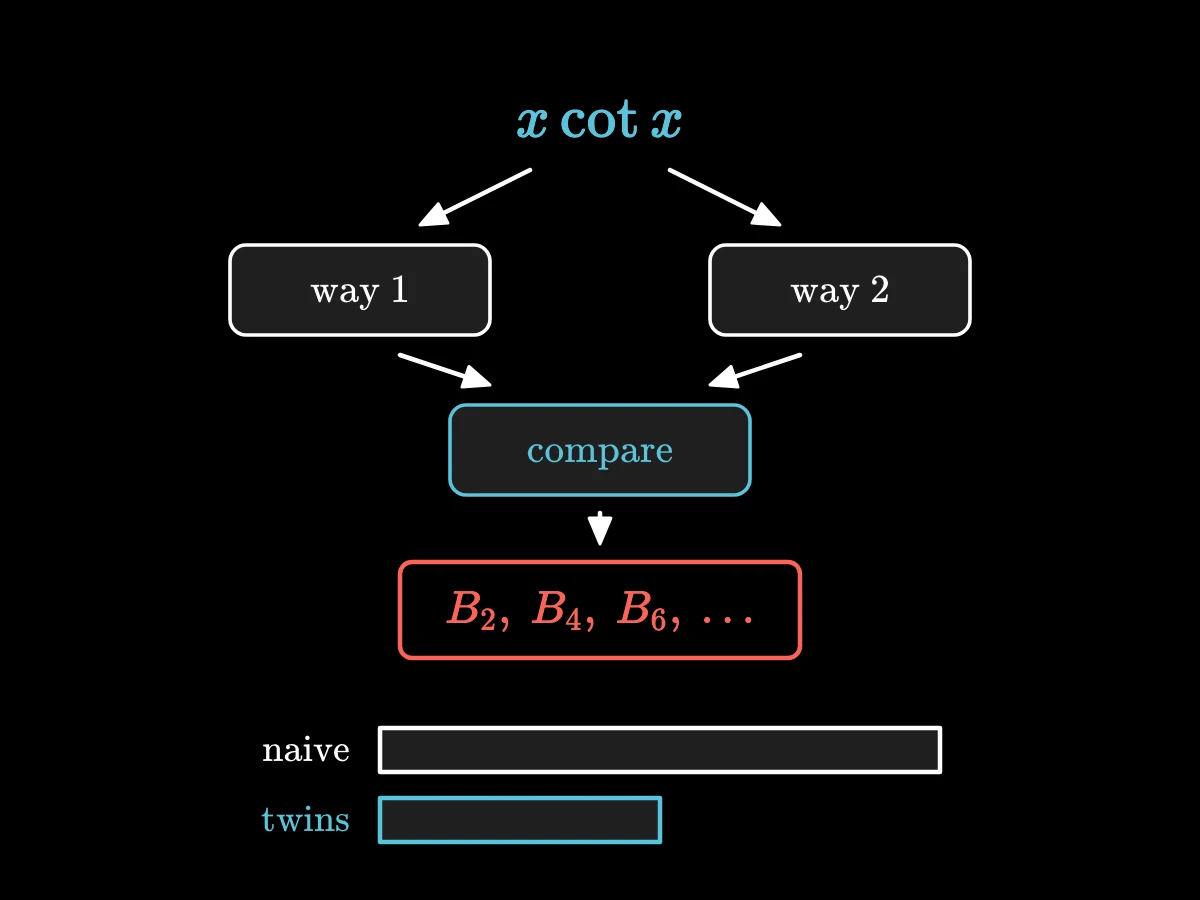
The function x cot x is written two ways, compared term by term in a box, which hands out the numbers; then a bar half as long shows the work saved by pairing with its twin.
Where the Bernoulli Numbers Live

Write it twice, compare

That function is the cotangent from school trigonometry, multiplied by the angle. Written out near zero as a long sum of powers, its successive terms carry the Bernoulli numbers one after another; Ramanujan takes them all as positive and calls the zeroth one minus one so that the first term fits.
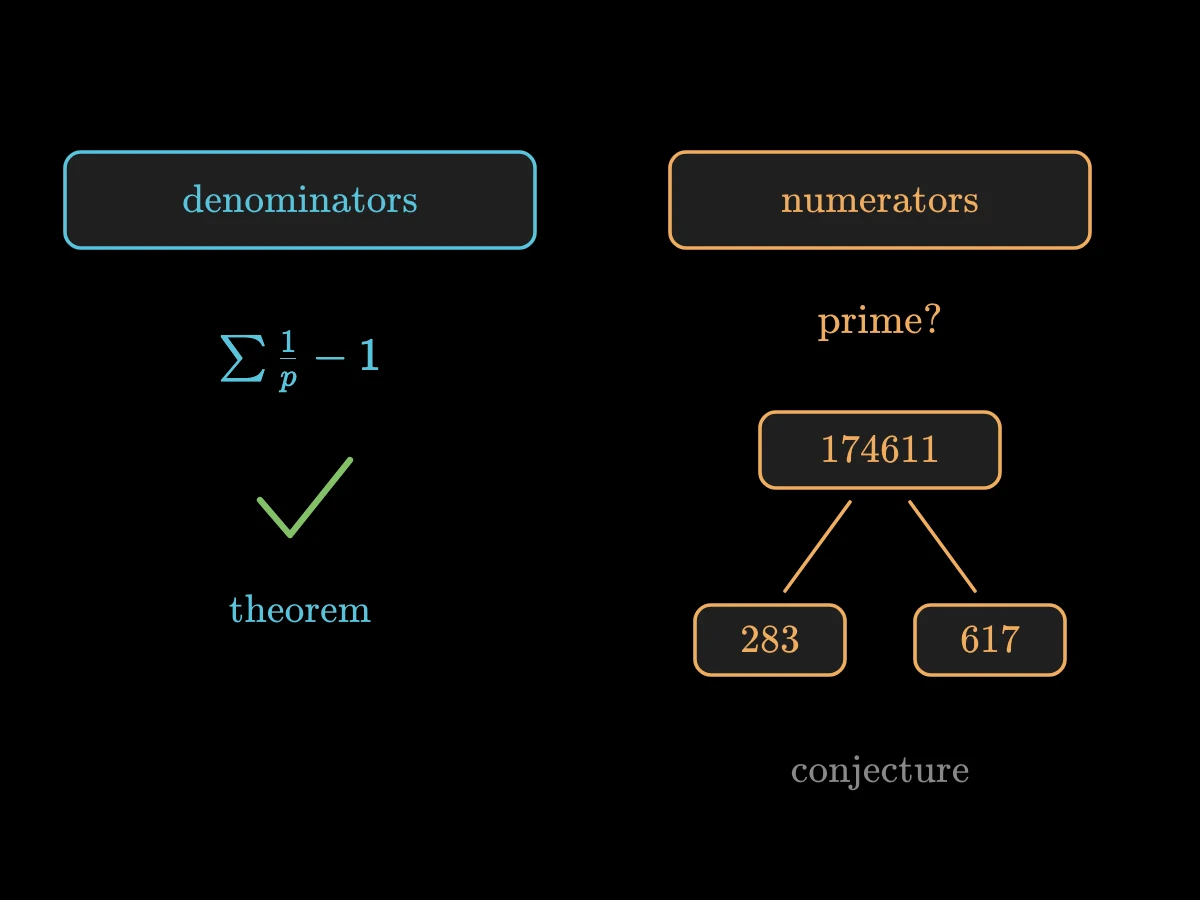
On the left, the denominator rule marked as a true theorem of Clausen and von Staudt; on the right, the prime-numerator guess broken by 174611 = 283 × 617.
Reading Laws From the Specimens

True rule, failed guess

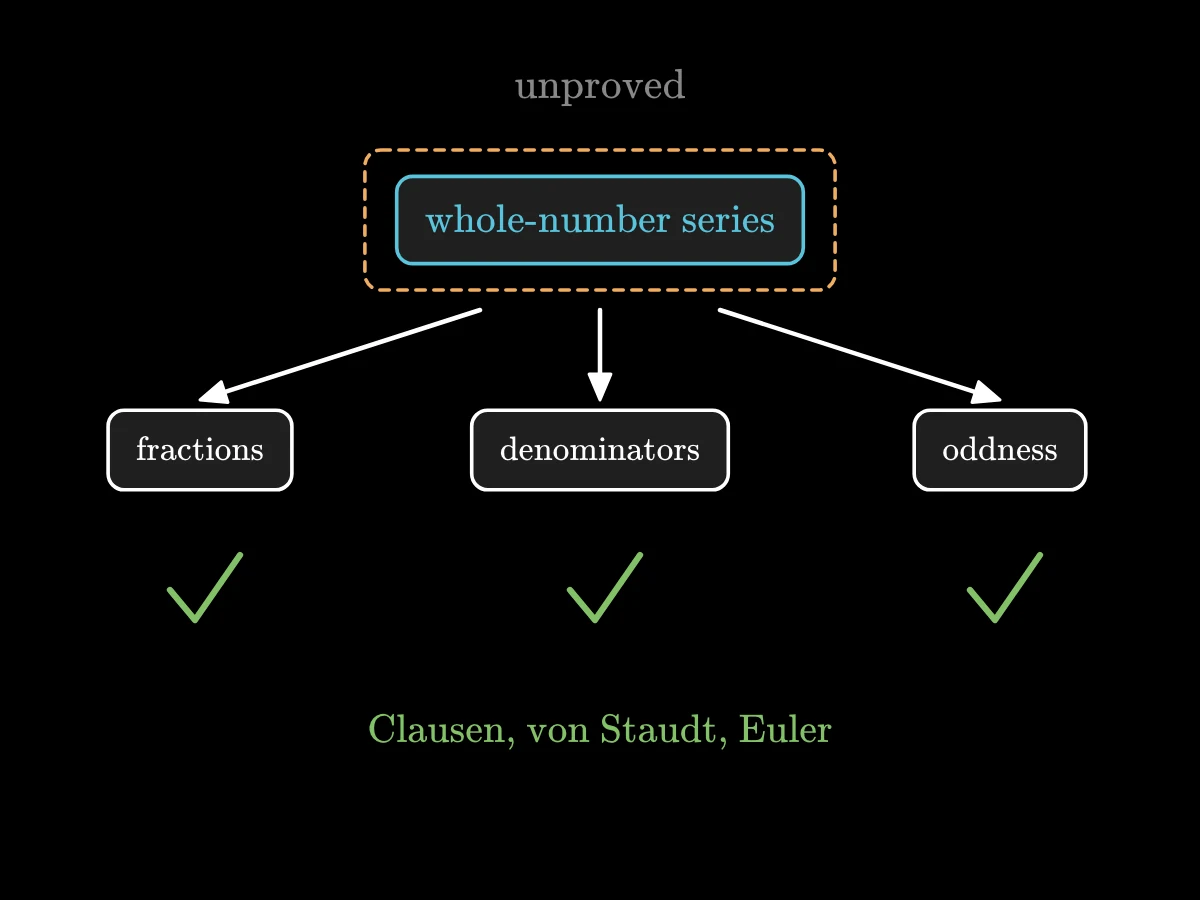
A close cousin of the rule says that the part of each Bernoulli number after its whole part is made of one over each of those primes, added up, minus one.

A single box, whole-number series, with arrows to three results it would give: fractional parts, equal denominators, oddness; the box is marked unproved, while the three results are marked true.
From Rough Size to Exact Value, and Proofs Left Open

One unproved claim

Then he tries to prove his own patterns. His plan is to show that certain infinite sums, built from one over the squares of shifted whole numbers and from the primes above three, can be rewritten as series whose coefficients are all whole numbers.

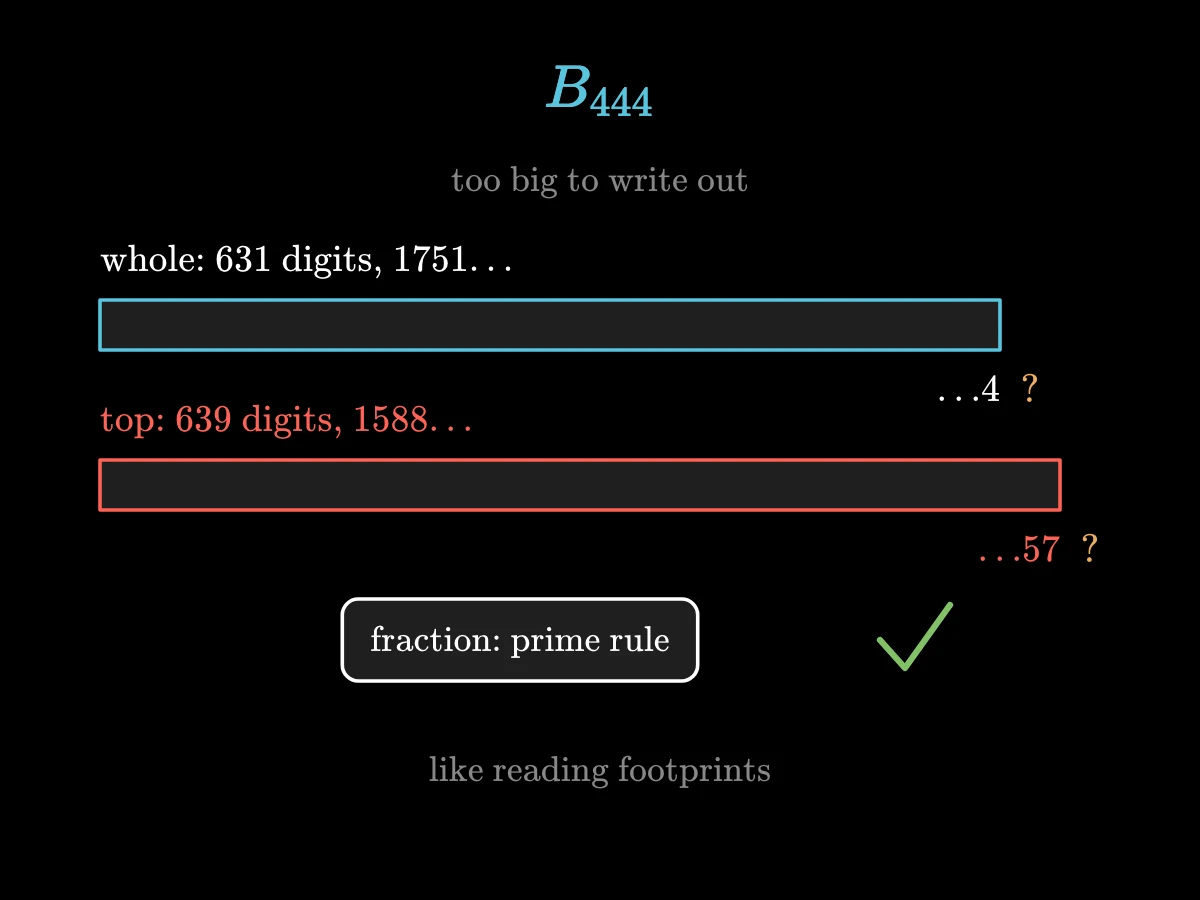
The Bernoulli number with index 444: a fraction from the prime rule, a whole part of 631 digits starting 1751, a numerator of 639 digits starting 1588, and known last digits; part of it rests on the unproved prime guess.
How Big, and What It Ends With

The giant B444

Third, the showpiece: the Bernoulli number with index four hundred and forty-four. In 1911 writing it out by hand was out of the question, yet Ramanujan describes it in detail.

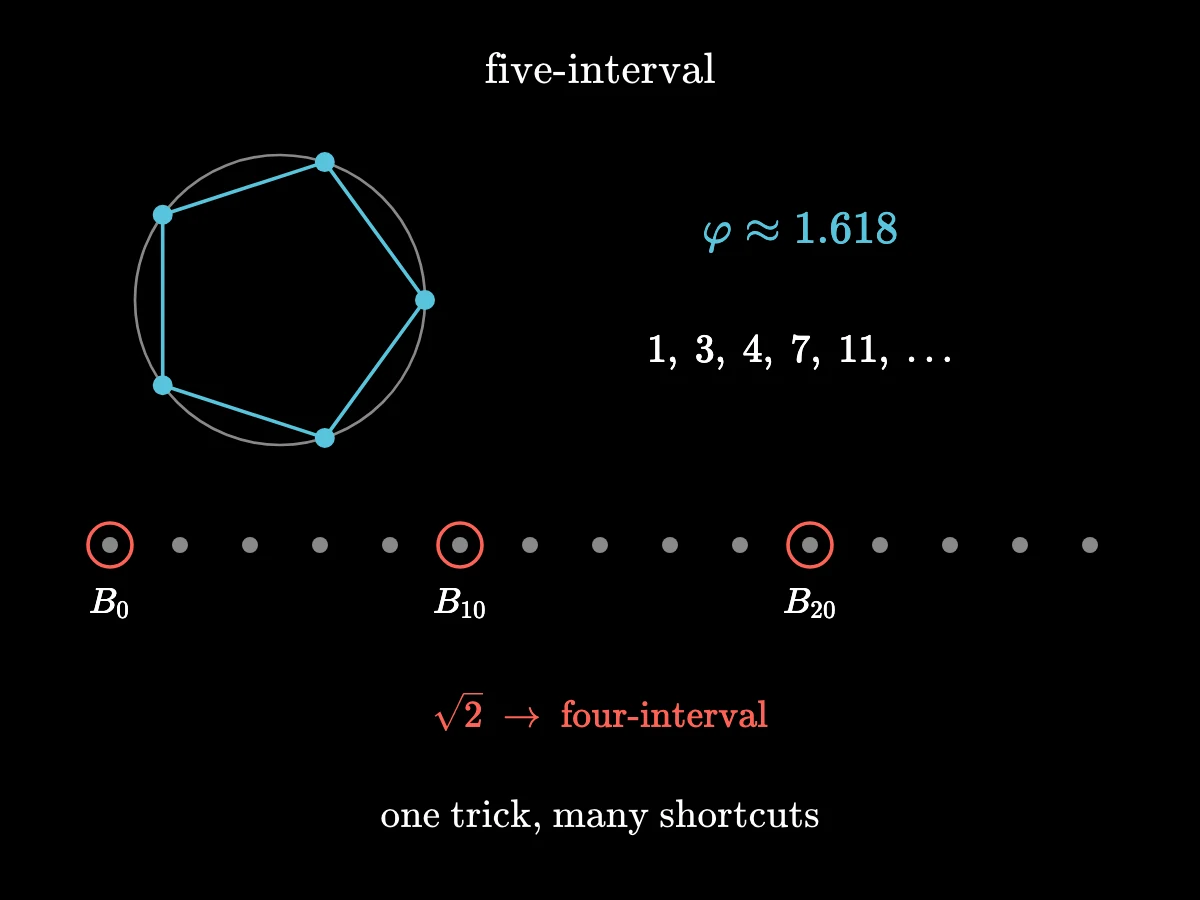
The fifth roots of one on a pentagon bring in the golden ratio ≈ 1.618 and whole numbers 1, 3, 4, 7, 11; each five-interval formula keeps Bernoulli numbers spaced ten apart; the four-interval case uses √2; one trick, many shortcuts.
The General Pattern, and What the Editors Said

Pentagon and golden ratio

To show it working, he carries out the five-interval case. The fifth roots of one bring in the golden ratio, the number about one point six one eight that appears in sunflowers, in the Fibonacci numbers and in classical architecture.

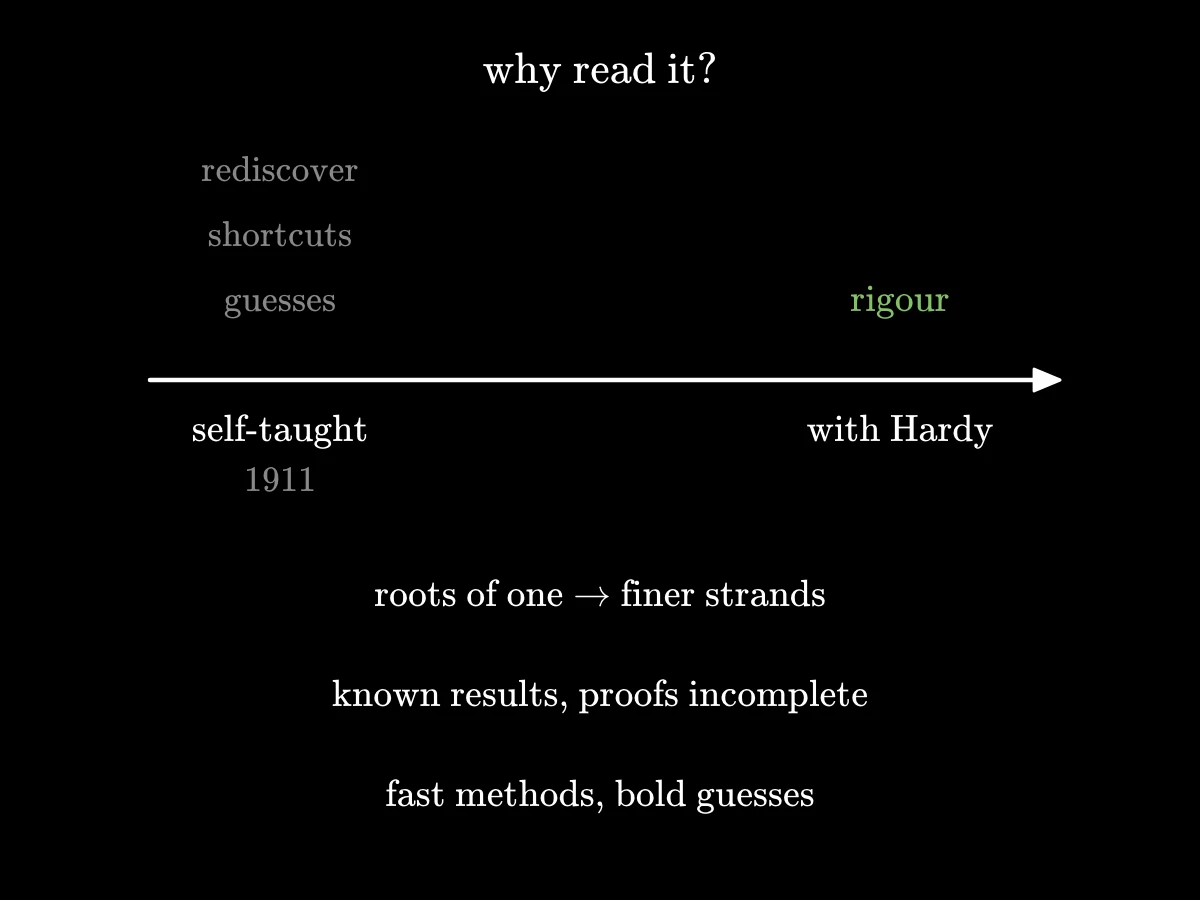
Why read it: a self-taught mind rediscovering a theorem, finding shortcuts, guessing patterns; later with Hardy he adds rigour; recap of the interval formulas, the verdict and his earliest manner.
The General Pattern, and What the Editors Said

Before the rigour

Why is this still worth reading? Because it shows a mathematical mind at the very start: self-taught, without access to the literature, rediscovering a famous theorem, finding fast computational shortcuts, and guessing patterns from data with a sure instinct for which ones matter.

How it was made

Examples for: a curious adult with school maths who likes number puzzles and knows Ramanujan's story; add one modern instance per idea, such as a calculator, computer algebra or cryptography

The source

The lectures retell the English text of the Cambridge 1927 edition (Internet Archive pli.kerala.rare.28155). The author died in 1920; the work is in the public domain. The retelling, the drawings and the voice are made by AI and checked against the book by a second model; nothing was edited by hand. How AI is used.

The lectures are free to read, share and quote with a link to this page.

Your own hard book, the same way

Upload a textbook or any difficult book. The first five minutes are free.

Upload a book