Library · Public domain

Collected Papers ofSrinivasa Ramanujan

Collected Papers of Srinivasa Ramanujan

Cover illustration of the book

Choose your version

The same text, told at every level, in every language and look shown here. Pick, then listen or download.

Listen and watch

The same player the product gives for your own book: the voice, the drawings as they are drawn, the text.

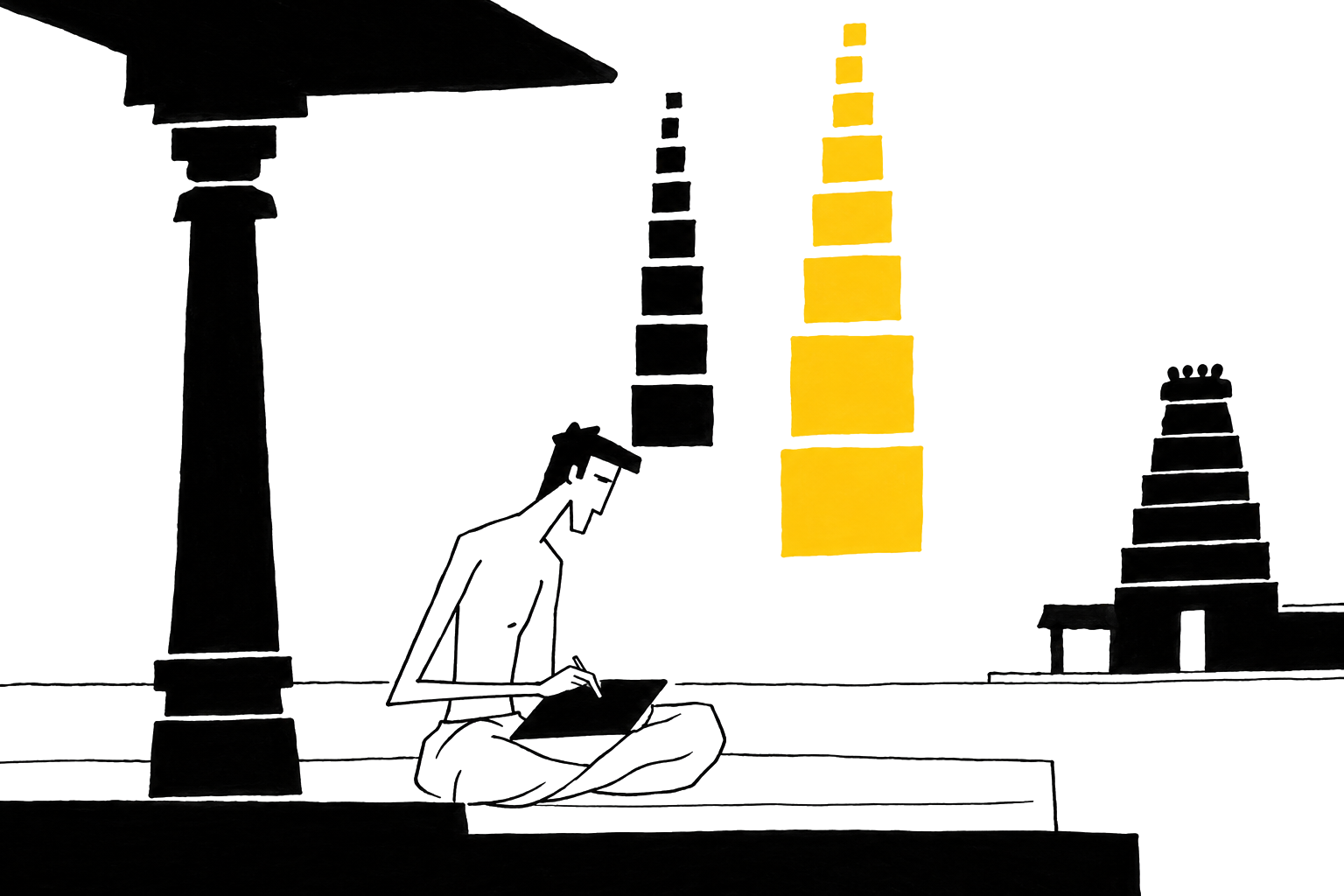
The first paper the self-taught genius ever published, written in Madras at 23: strange patterns in the Bernoulli numbers, the numbers behind sums of powers. Most of his claims are true, some are guesses, and one is false; the lectures show which is which.

This is a sample: 1 of 37 papers.

From the lectures

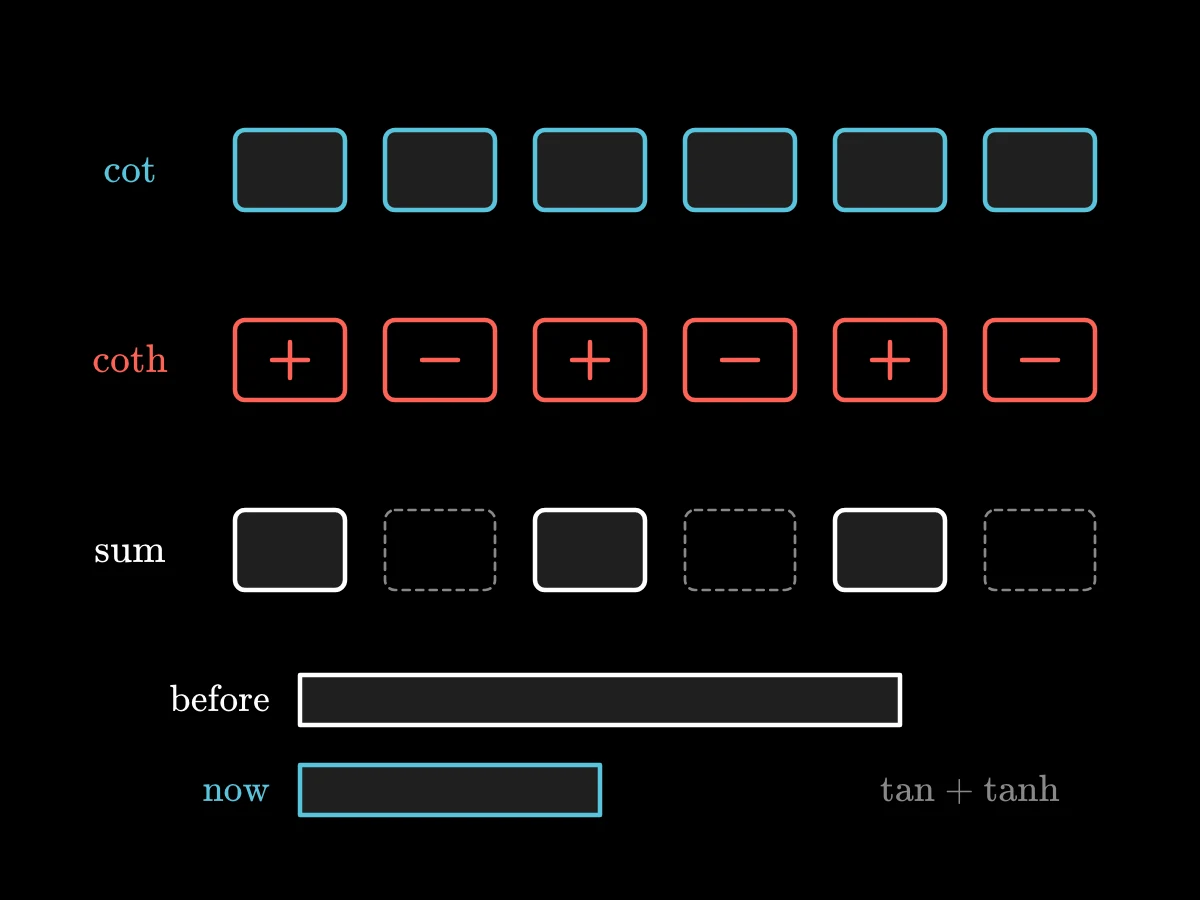
Two rows of layer boxes, the cotangent and its hyperbolic twin; added together, every second box vanishes, and a bar half as long shows the halved work.
The Recipe Inside the Cotangent

Twins that cancel

The second shortcut is more cunning. The cotangent has a twin, the hyperbolic cotangent, which you get by feeding the same function an imaginary angle. When you add the two, every second layer cancels out, the way two waves can cancel each other; when you subtract them, the other half cancels.
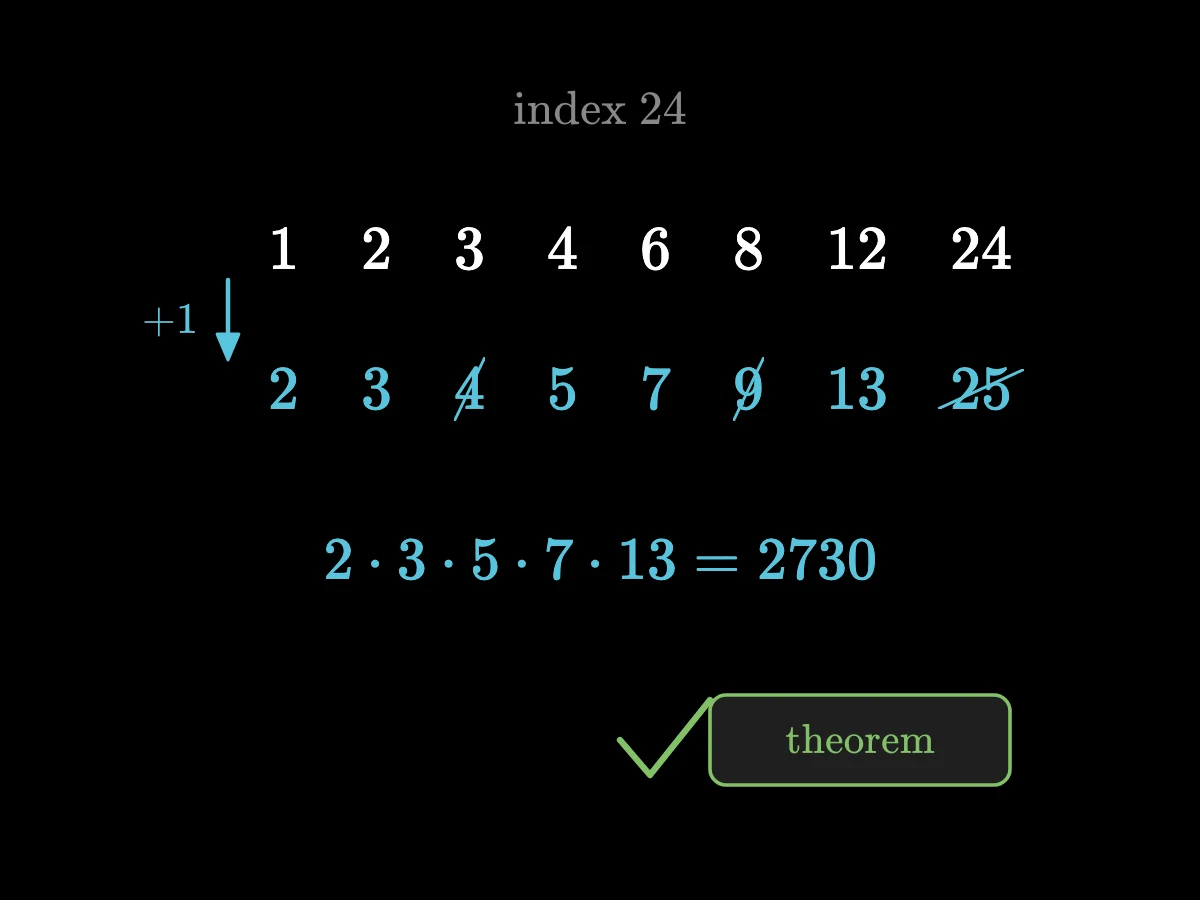
The divisors of 24 each get one added; the composites are crossed out; the primes 2, 3, 5, 7, 13 multiply to 2730, the bottom of the fraction; the rule is a theorem.
Guessing the Rules From the Table

The pencil game

For the bottoms he finds a rule so simple it could be a pencil game. You take the index of the Bernoulli number, list everything that divides it, add one to each, keep only the primes, and multiply them: that is the bottom of the fraction. It matches every entry in his table.

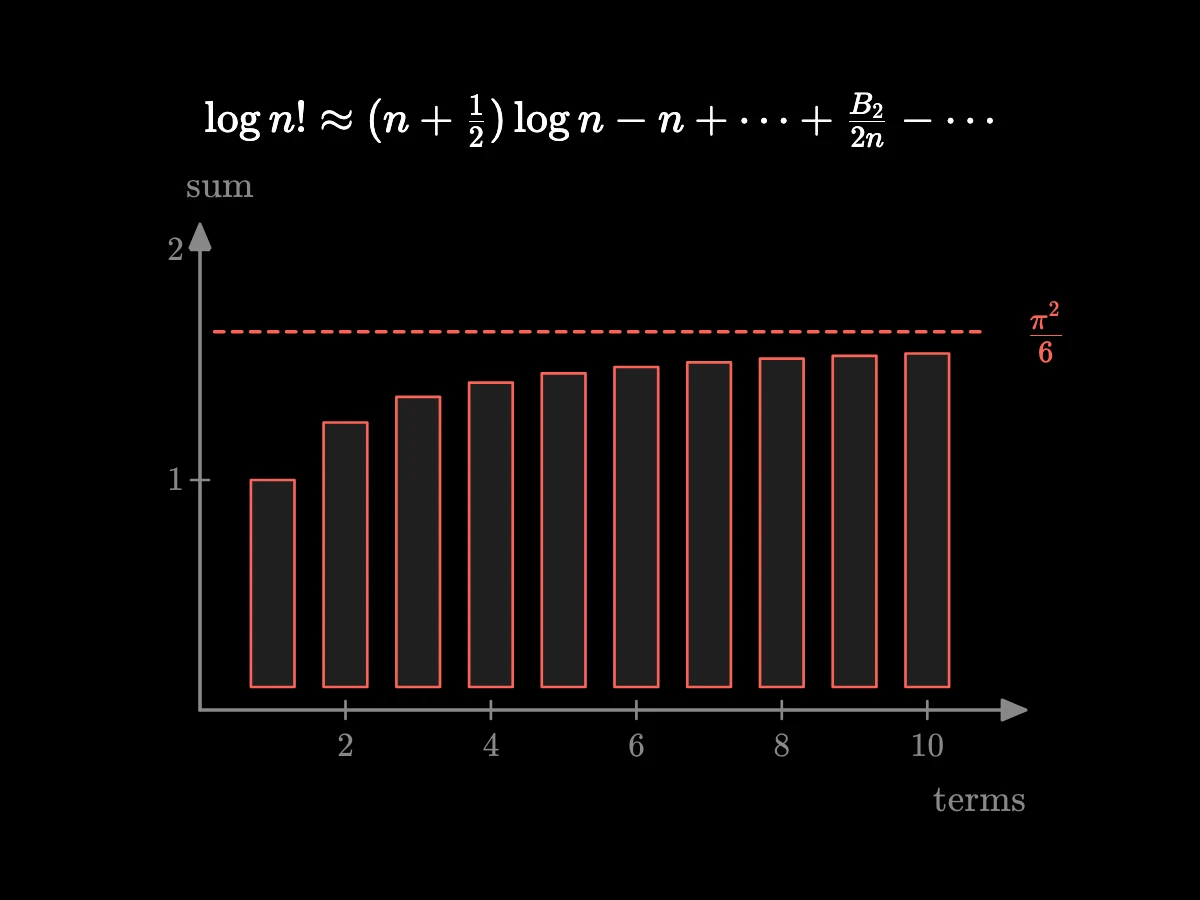
Bars for the partial sums of one over the squares climb and settle at pi squared over six, about 1.645; the bridge to factorials and powers of two pi follows.
Detective Work, and a Proof Left Hanging

A sum that settles

Where do the rough limits come from in the first place? Here he borrows a classical bridge. There is a famous sum: add one over every whole number squared, or cubed, or raised to any even power, and you get a definite number; for squares it is pi squared divided by six.

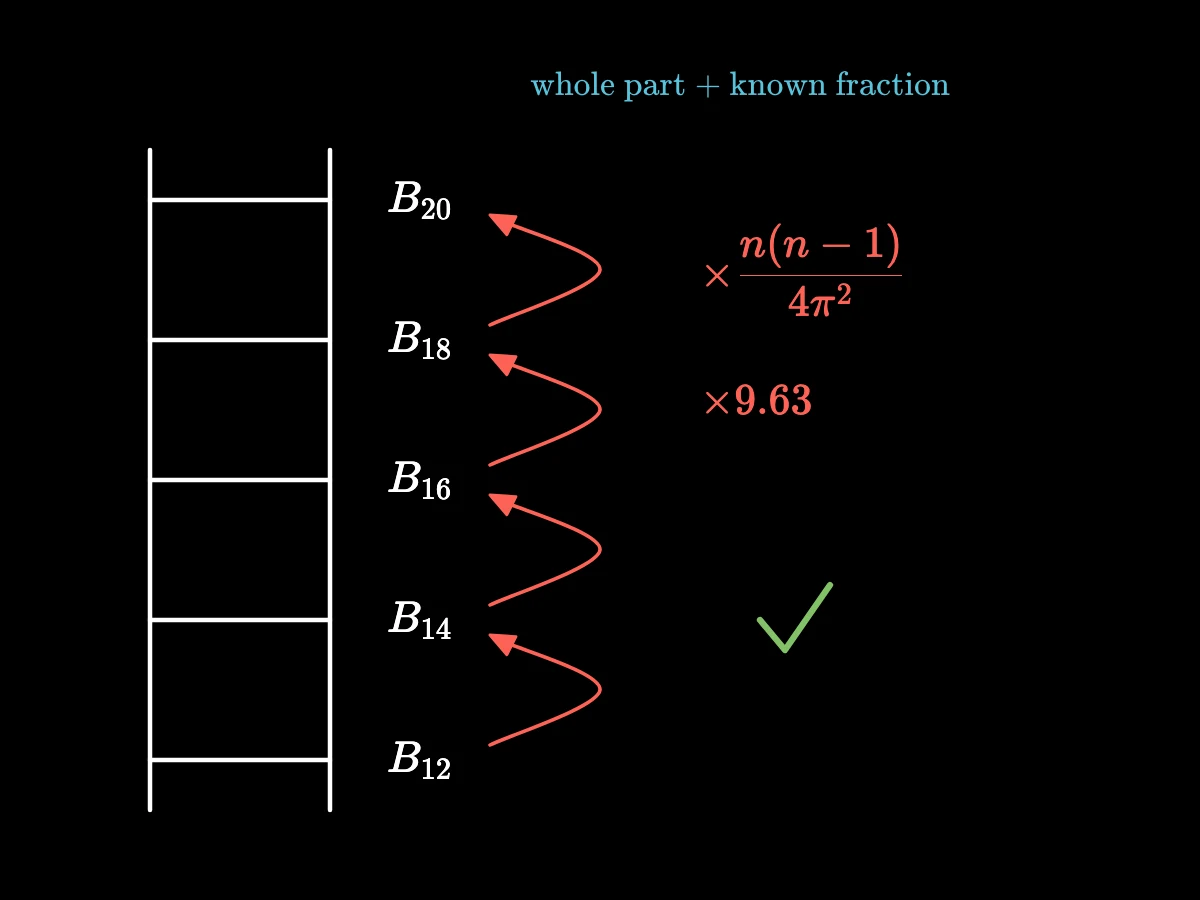
A ladder of rungs B12, B14, B16, B18, B20, each reached from the one two places below by multiplying by n(n − 1)/(4π²); from 18 to 20 the factor is about 9.63.
Measuring Giants From Afar

A ladder of neighbours

His second instrument compares neighbours. Each Bernoulli number turns out to be very nearly the one two places before it, multiplied by a simple factor built from the index and pi. The approximation becomes excellent very quickly as the numbers grow.

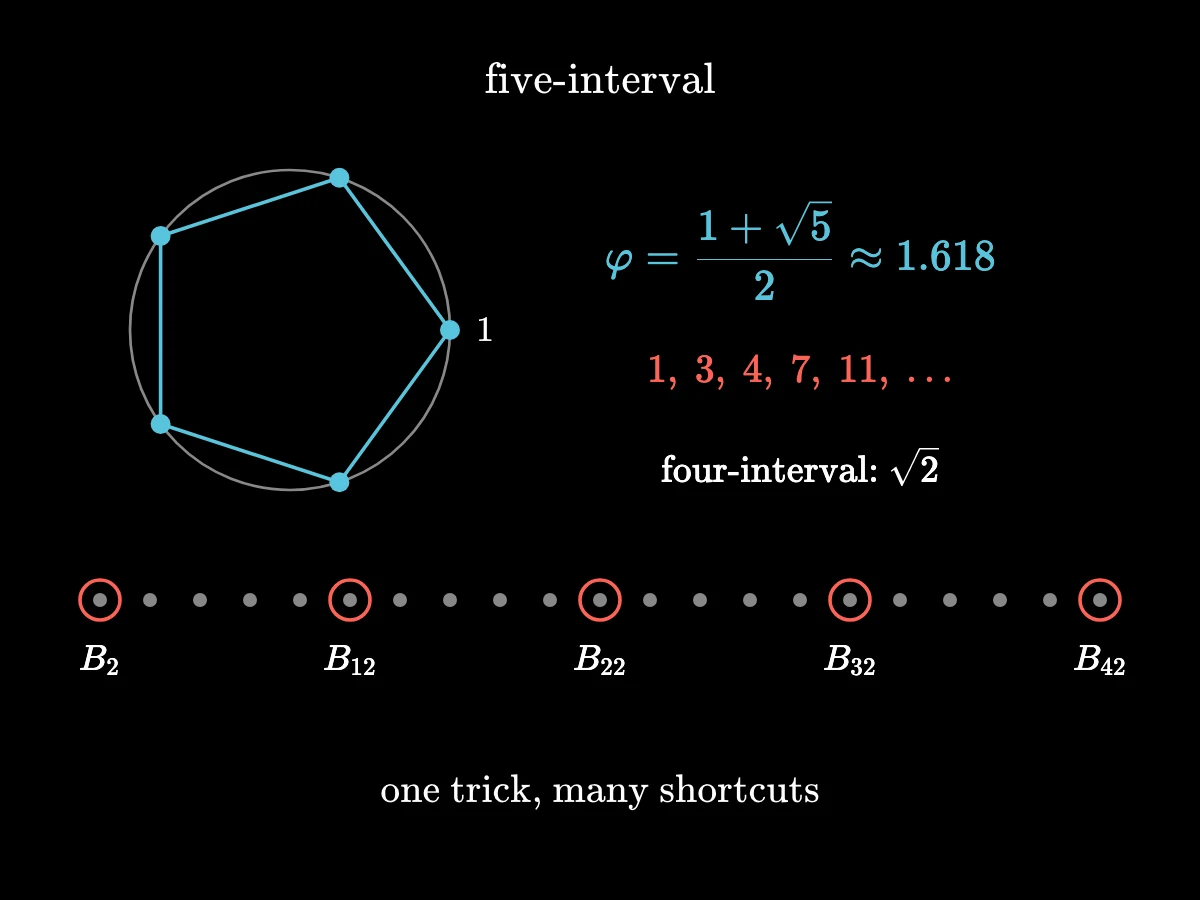
The five fifth roots of one at the corners of a regular pentagon bring in the golden ratio φ ≈ 1.618; each five-interval formula keeps every tenth Bernoulli number; the four-interval case uses √2.
Finer Sieves, and an Honest Verdict

The pentagon and phi

To show the recipe working, he carries out the five-interval case. The five fifth roots of one sit at the corners of a regular pentagon, and the pentagon brings in the golden ratio, the number about one point six one eight famous from sunflowers, seashells and the Fibonacci numbers.

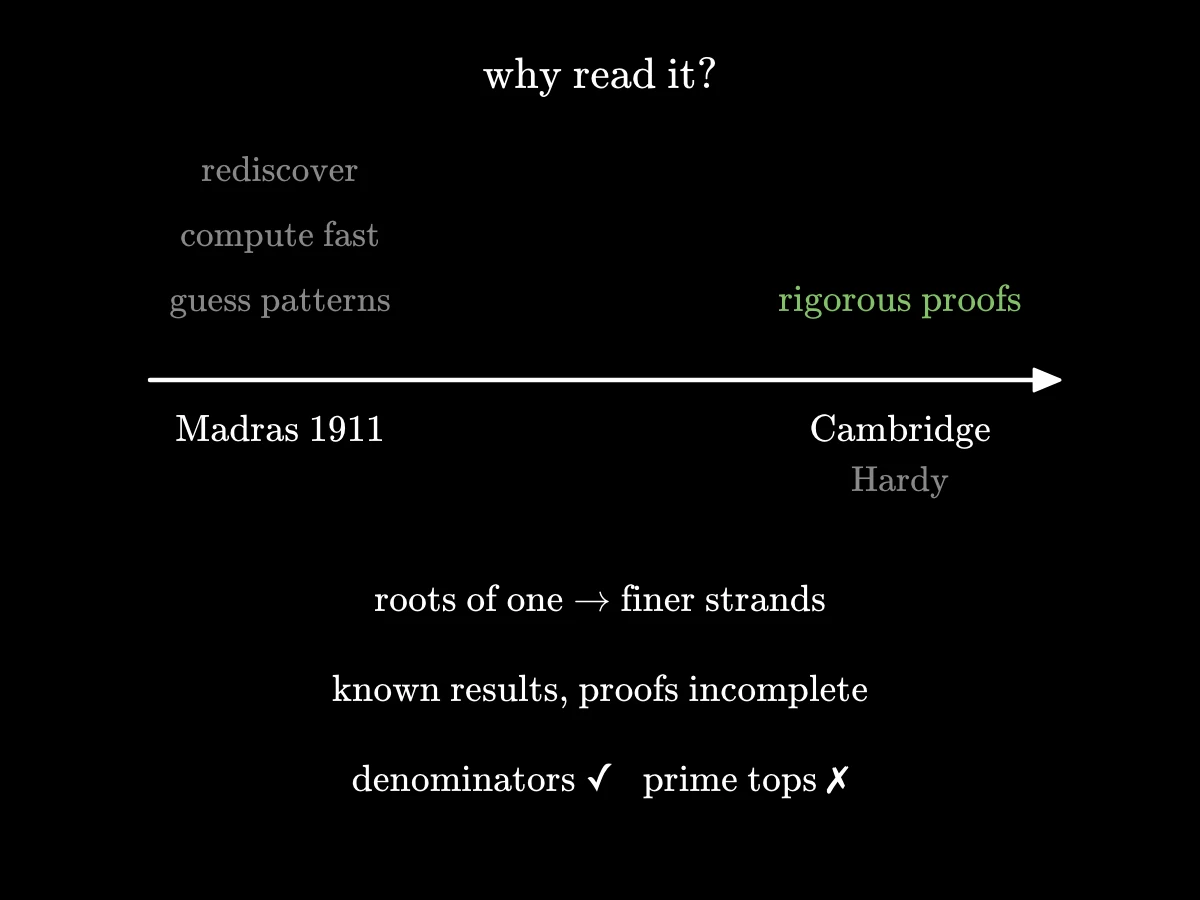
Why read it: a young Ramanujan alone in Madras rediscovering a theorem, inventing fast methods, guessing patterns; a few years later in Cambridge with Hardy he adds rigorous proofs. Summary of interval formulas, the editors' verdict and the true and false conjectures.
Finer Sieves, and an Honest Verdict

From Madras to Cambridge

Why read such a paper today? Because it is a rare look at a great mind before it was trained: a young man working alone in Madras, rediscovering a famous theorem, inventing fast ways to compute, and guessing patterns from data with a sure instinct for which ones matter.

How it was made

Examples for: a curious adult with school maths who likes number puzzles and knows Ramanujan's story; add one modern instance per idea, such as a calculator, computer algebra or cryptography

The source

The lectures retell the English text of the Cambridge 1927 edition (Internet Archive pli.kerala.rare.28155). The author died in 1920; the work is in the public domain. The retelling, the drawings and the voice are made by AI and checked against the book by a second model; nothing was edited by hand. How AI is used.

The lectures are free to read, share and quote with a link to this page.

Your own hard book, the same way

Upload a textbook or any difficult book. The first five minutes are free.

Upload a book