Library · Public domain

The Principlesof Chemistry

Основы химии

Cover illustration of the book

Choose your version

The same text, told at every level, in every language and look shown here. Pick, then listen or download.

Listen and watch

The same player the product gives for your own book: the voice, the drawings as they are drawn, the text.

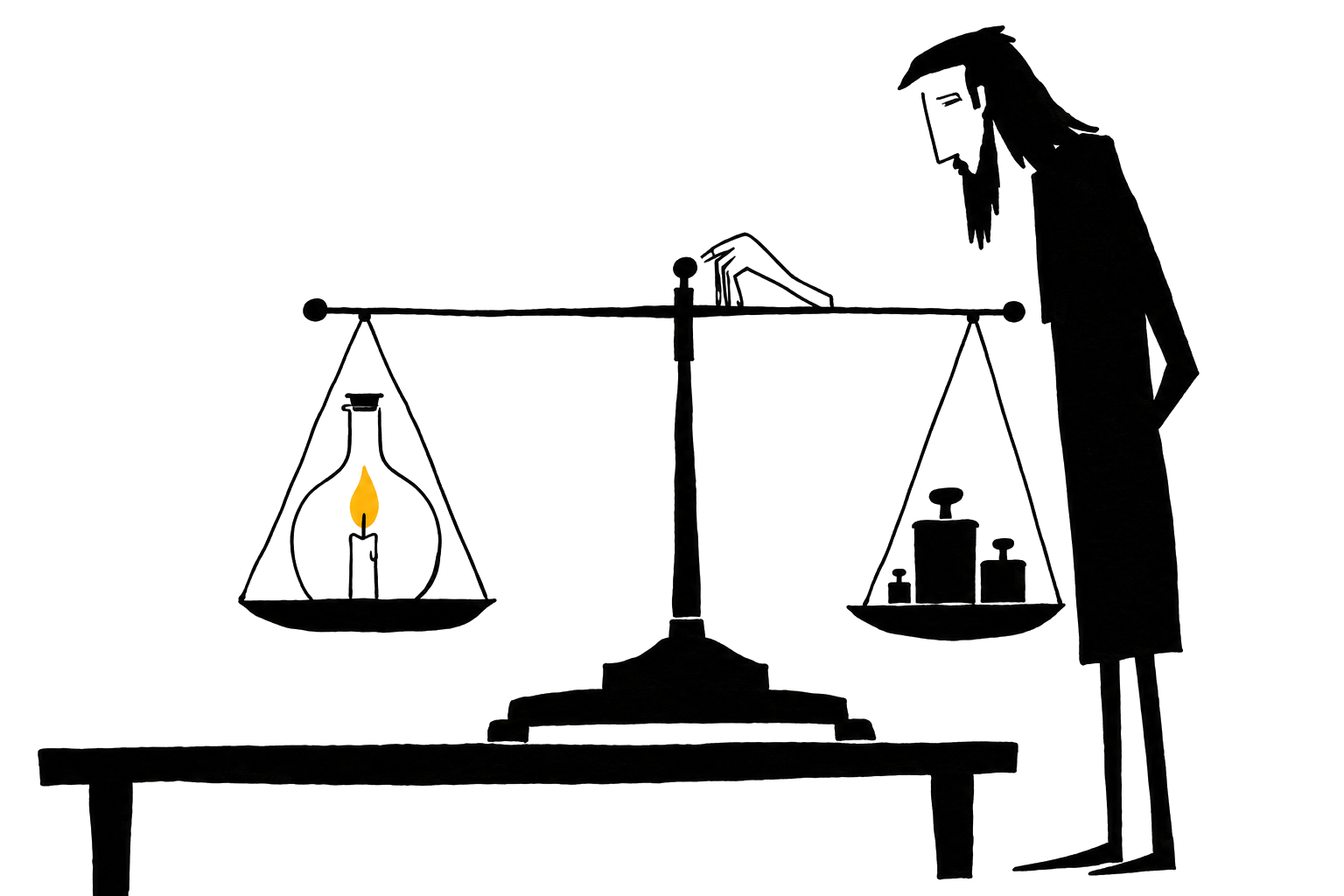
The textbook in which Mendeleev first set out his periodic law, in its last edition from his lifetime. Its Introduction asks what changes when one substance turns into another and what stays the same: the weight on Lavoisier's balance, the elements, the fixed proportions in which they combine.

This is a sample: 1 of 25 chapters.

From the lectures

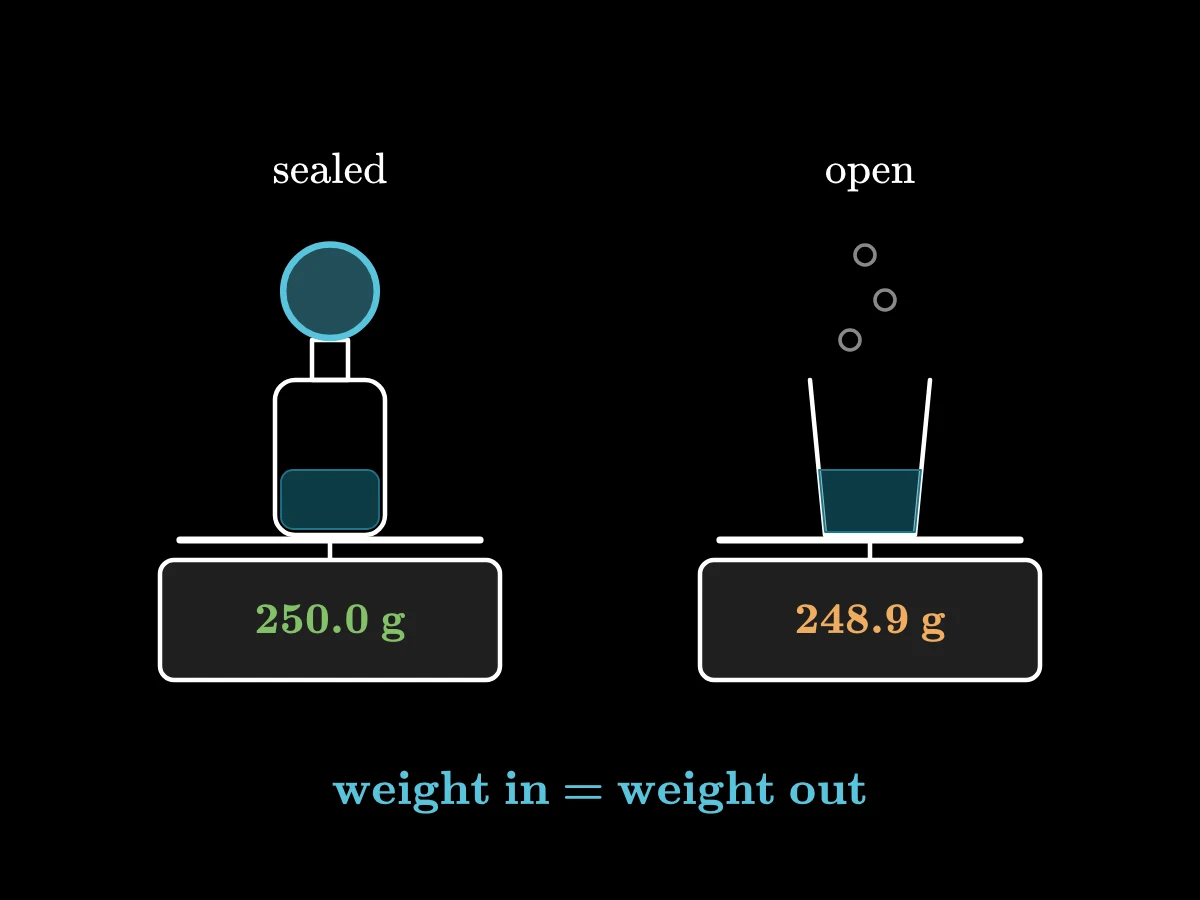
Two kitchen scales: a sealed bottle with a balloon keeps reading 250.0 grams; an open glass fizzes and its reading drops to 248.9 grams; below, 'weight in = weight out'.
Where Does the Log Go?

Sealed bottle, open glass

Put a bottle with a little vinegar and a small paper twist of baking soda on a kitchen scale, and stretch a balloon over the neck. Note the reading, then tip the soda in by shaking the bottle without lifting it. It fizzes and the balloon swells, yet the number on the scale stays where it was.
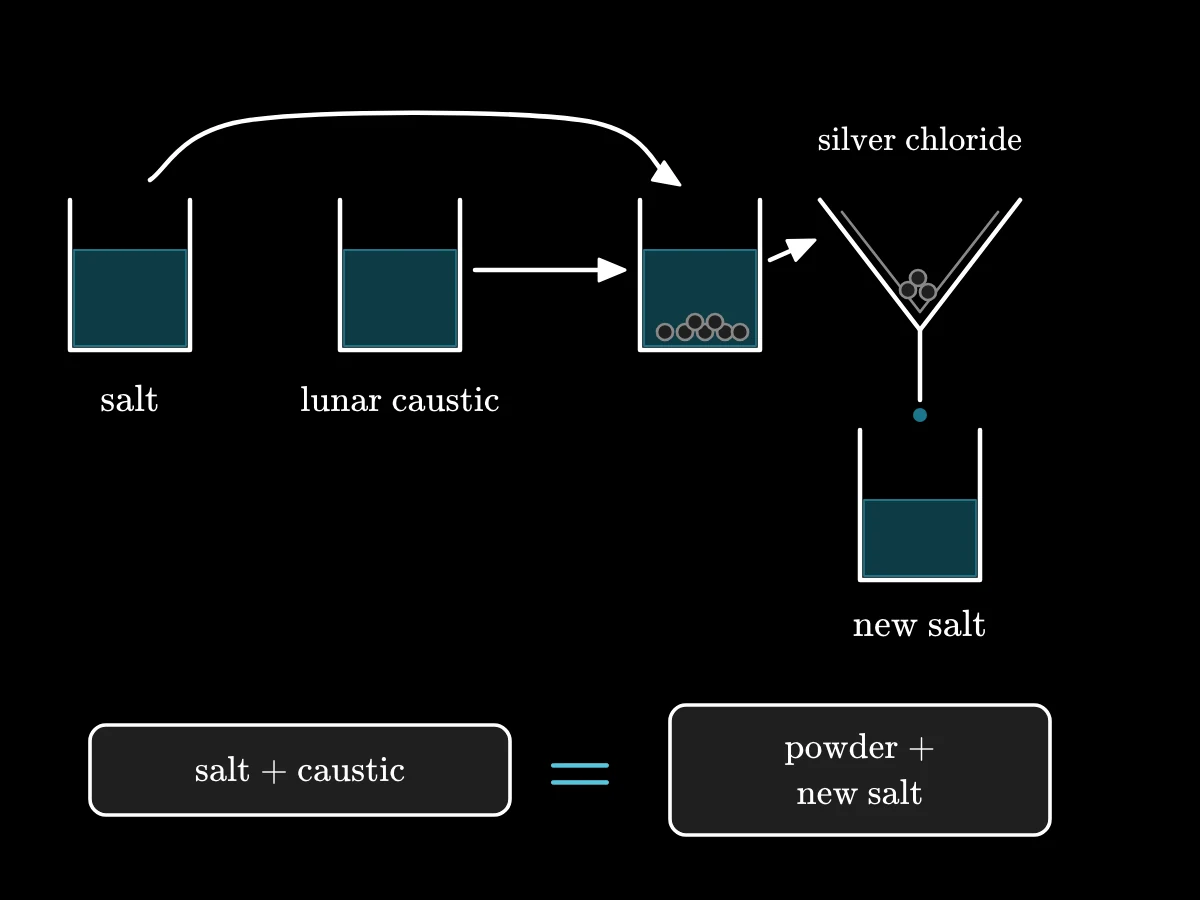
Two clear solutions, table salt and lunar caustic, poured together give a white solid; a paper filter keeps the white powder and lets the clear liquid through; the weights before and after are equal.
The Scales as a Detective

Two salts swap partners

The fourth case shows a substitution. Take table salt, and lunar caustic, the silver salt once used to cauterise wounds. Both dissolve in water into clear solutions. Pour the two together, and at once a white solid appears and sinks: a new substance that will not dissolve.

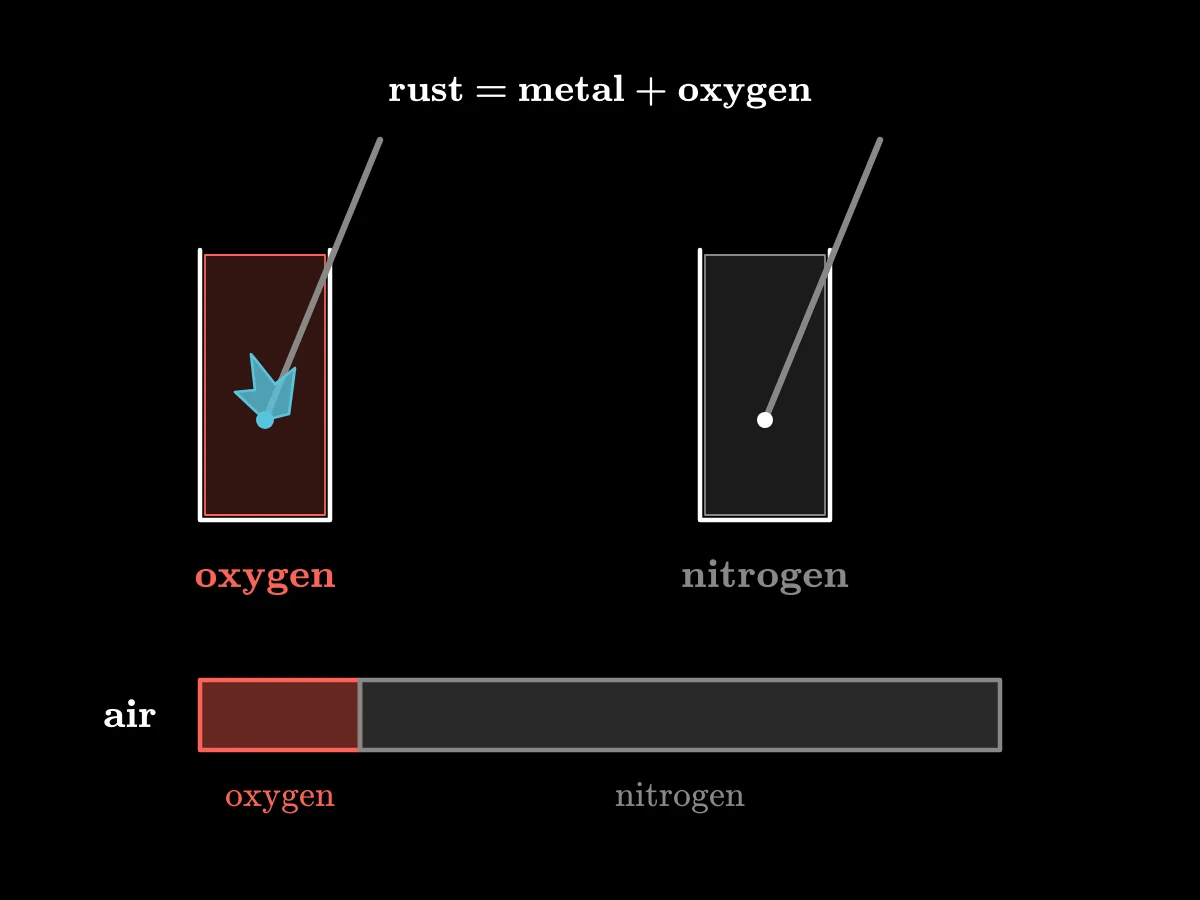
A bar of air divided into about one fifth oxygen and four fifths nitrogen; a glowing splinter blazes in the oxygen jar and goes out in the nitrogen jar.
Twelve Days with a Flask of Mercury

Air is two gases

That swallowed part of the air can be driven back out of the red oxide, and it is the gas in which a glowing splinter blazes up. It was named oxygen. The part of the air left under the bell behaved quite differently.

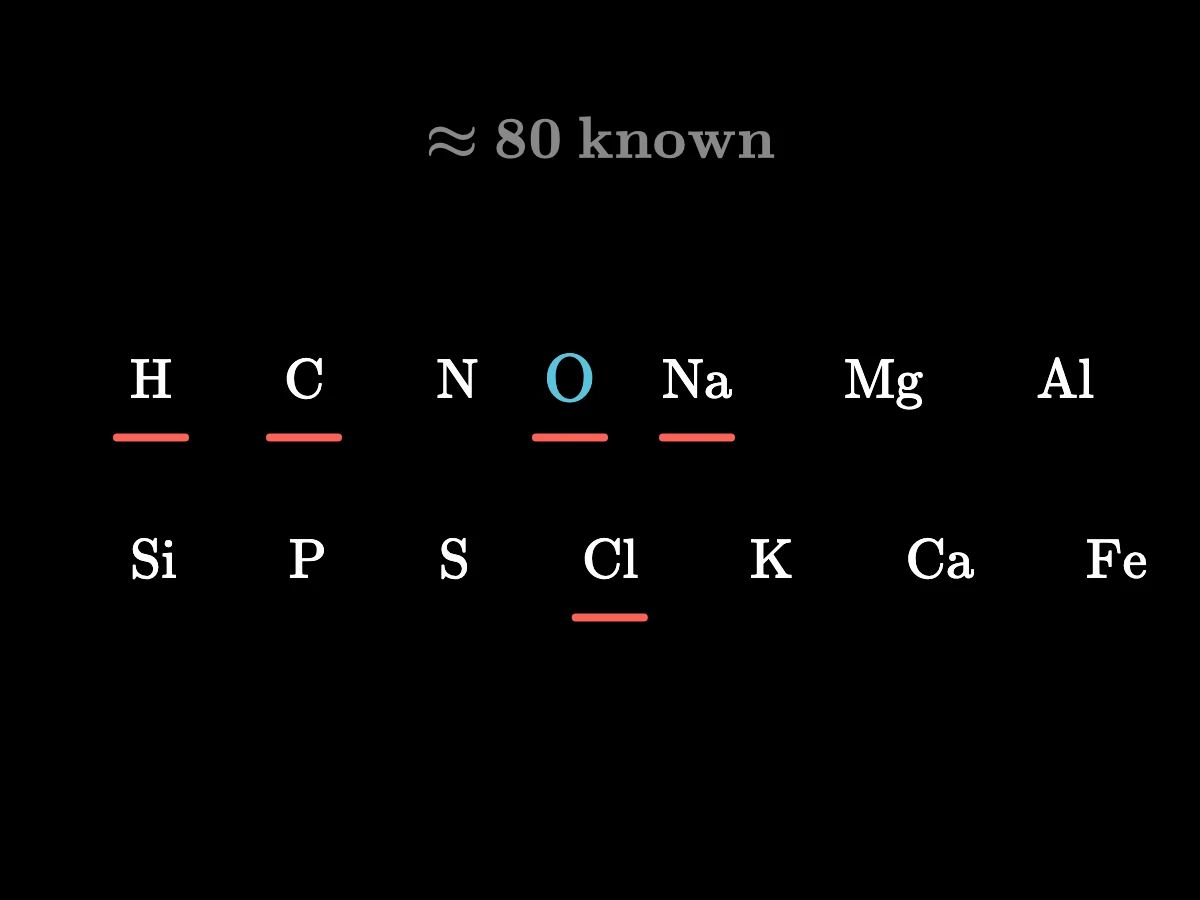
Fourteen tiles with the signs of the commonest simple substances, H, C, N, O, Na, Mg, Al, Si, P, S, Cl, K, Ca and Fe, with oxygen drawn largest; five of them, H, O, Na, Cl and C, light up for water, salt and a pencil.
A Roll Call of Simple Substances

The fourteen commonest

Then Mendeleev calls the roll. About eighty simple substances were recognised in his day, though for about six of them the knowledge was still thin, because they are so rare and had been obtained in such tiny amounts.

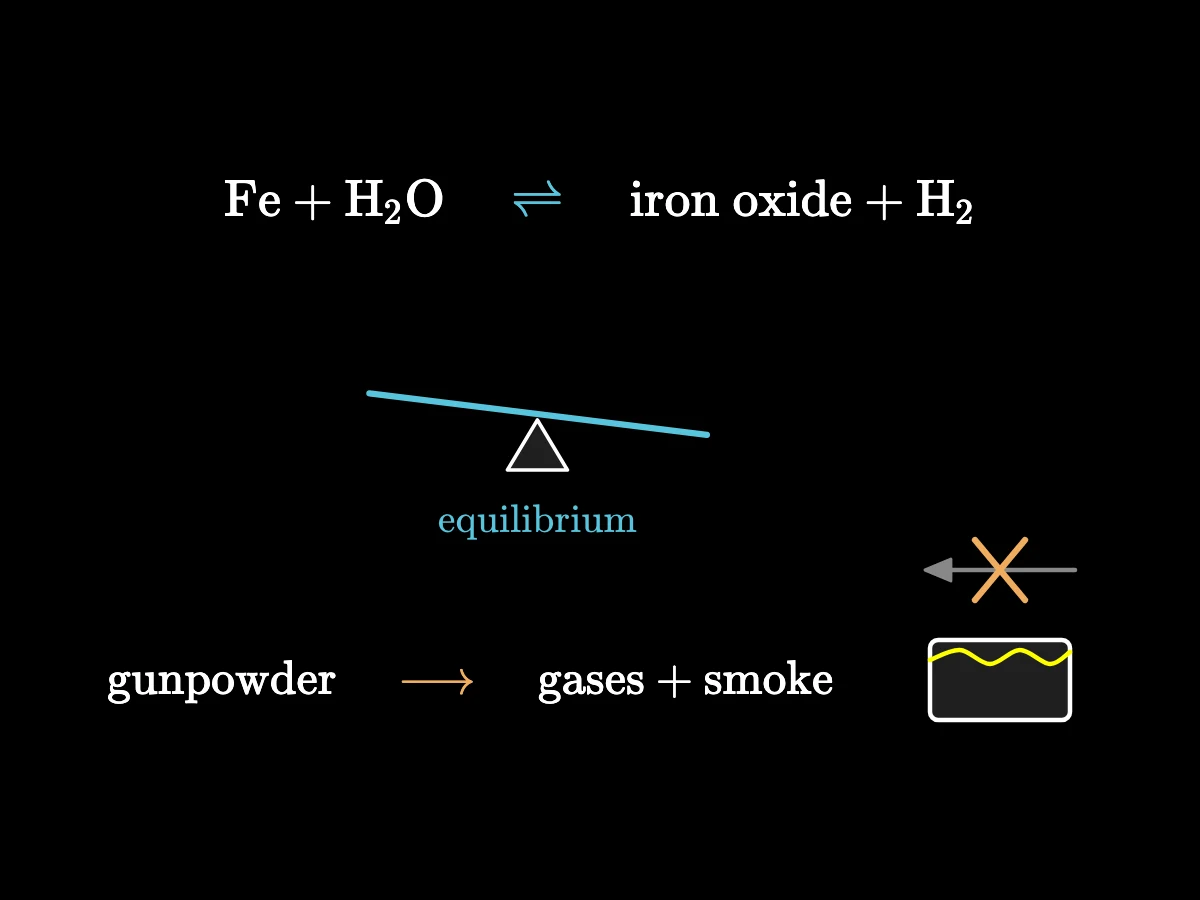
Top: iron and water give iron oxide and hydrogen, and hydrogen and iron oxide give iron and water back, with a double arrow and a balance sign. Bottom: gunpowder burns to gases with a one-way arrow, and a cake that cannot be unbaked.
Energy Stored in Substances

Both ways, or one way

For chemical mechanics it is also vital to tell reversible reactions from irreversible ones. Salt dissolves in water at room temperature, and at that same temperature the solution can give the salt back as the water evaporates.

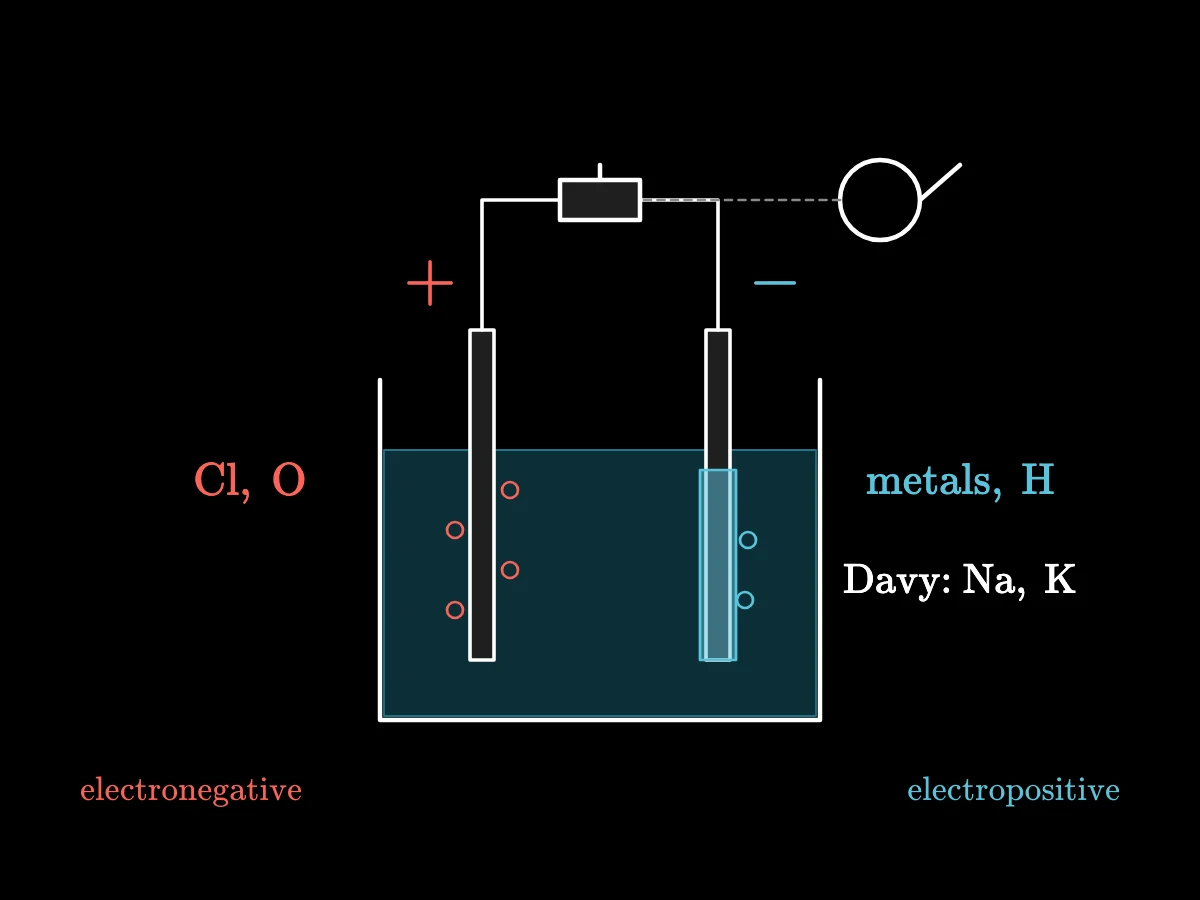
An electrolysis cell: a battery drives current through a dissolved compound between two electrodes; chlorine and oxygen gather at the positive pole, metals and hydrogen at the negative pole; Davy obtains sodium and potassium there.
Heat and Current Decide

Current sorts the parts

The second great condition is electricity, and its influence is much like that of heat. Most compounds that conduct an electric current are split by it, and, just as with heat, combination often happens close to the conditions of decomposition.

How it was made

Examples for: a curious adult with school chemistry; add one modern instance per idea, such as a kitchen, a battery, a lab scale or a factory

The source

The lectures retell the Russian text of the 7th edition, St Petersburg 1903 (Internet Archive 20200627_mendeleev_basic). The author died in 1907; the work is in the public domain. The retelling, the drawings and the voice are made by AI and checked against the book by a second model; nothing was edited by hand. How AI is used.

The lectures are free to read, share and quote with a link to this page.

Your own hard book, the same way

Upload a textbook or any difficult book. The first five minutes are free.

Upload a book