Albert Einstein · 1917 · retold from the German original
Über die spezielle und die allgemeine Relativitätstheorie (Gemeinverständlich)
Einstein’s own account of relativity for readers without higher mathematics, written in 1916. The first three sections lay the ground: what a geometrical statement means physically, what a coordinate system is, and how classical mechanics treats space and time.
3 of 29 sections · Made in 21 min for $2.23
Level 2: Формули з поясненнями
Demonstrator
Graphic ink
How many: Many
Voice: Oliver (Inworld)
Text written by Claude Fable 5.1 (Anthropic)
1
When Is a Theorem True?
Predicting the Diagonal
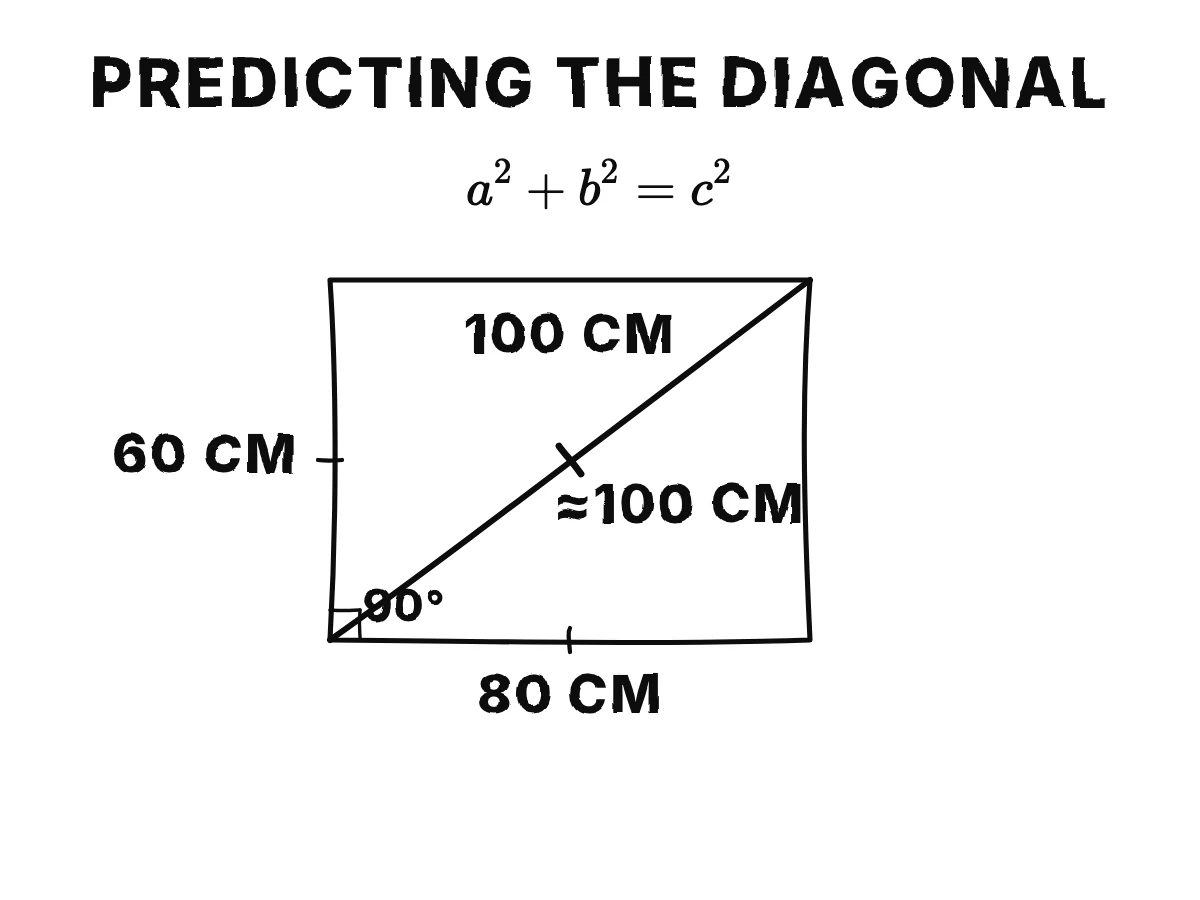
Take a tape measure to a rectangular table, the kitchen table will do. Measure the short side and the long side, and write the two numbers down. Now stretch the tape from one corner to the opposite corner, across the diagonal. Before you read the number, predict it with the one theorem everybody remembers from school, the theorem of Pythagoras: a² + b² = c², where a and b are the two sides of a right angle and c is the diagonal that closes the triangle. Suppose the sides were 60 centimetres and 80 centimetres; then 60 squared is 3600, 80 squared is 6400, the sum is 10 000, and the square root of 10 000 is 100 centimetres. You look at the tape, and there it is, 100 centimetres, perhaps a millimetre more or less.
What exactly have you just confirmed? Most people would say they have checked that Pythagoras was right, that the theorem is true. Albert Einstein opens his little book by stopping us precisely here and asking, with some mischief, what we even mean when we call such a statement true. He reminds us that most of us learned Euclidean geometry as children, climbing its staircases under the eye of a conscientious teacher, and that we remember it with more respect than affection. Out of loyalty to that schooling we would scorn anyone who doubted the humblest of its theorems. And yet, he says, our proud certainty may evaporate the moment someone asks what "true" is supposed to mean.
From Axioms to Theorems
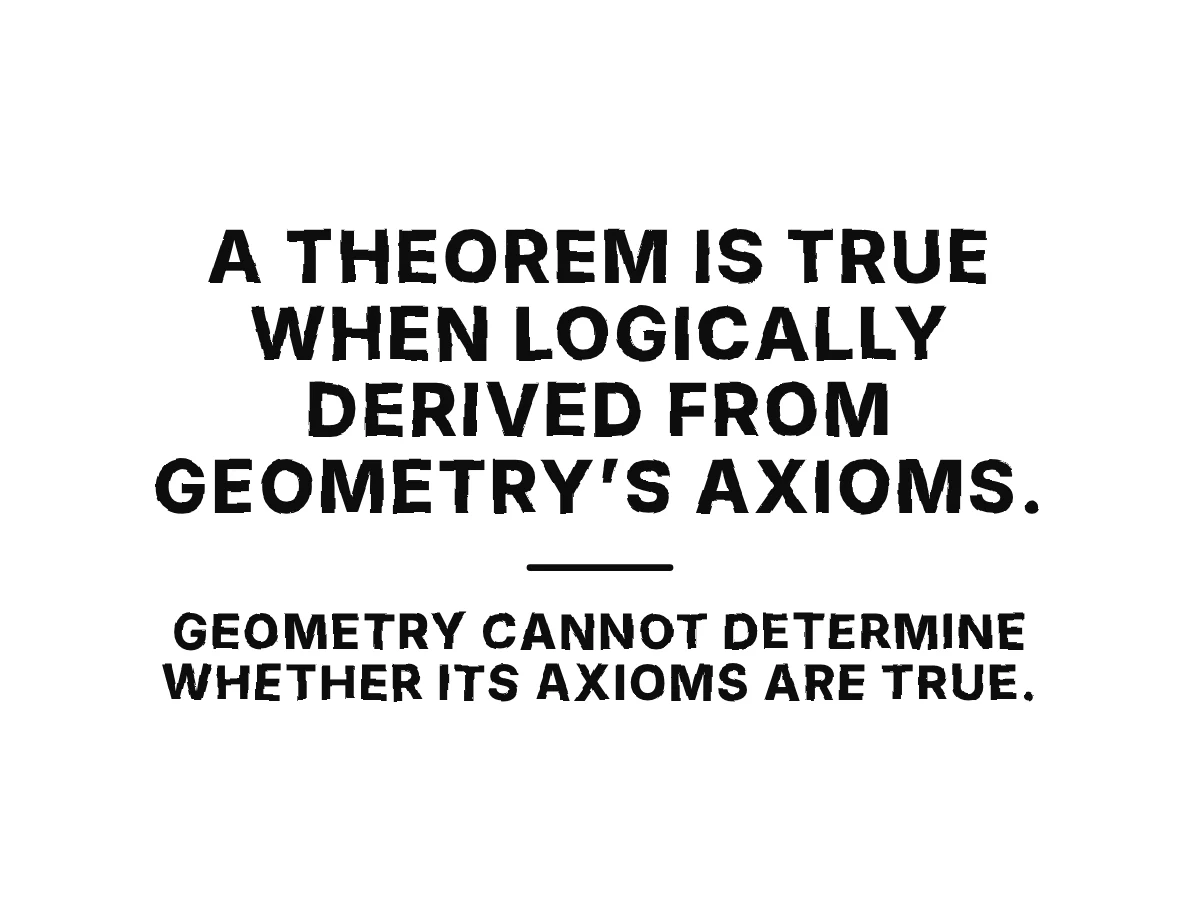
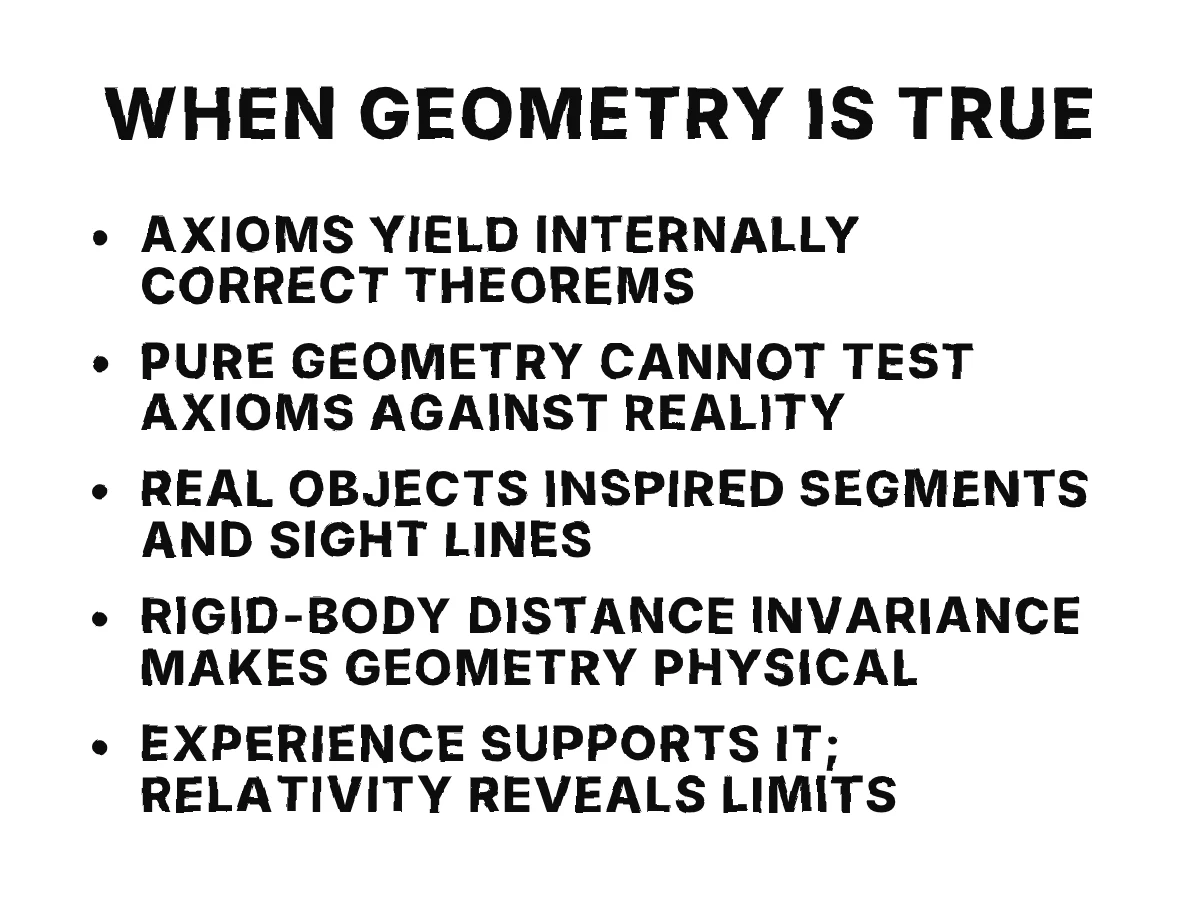
Here is how geometry is built. It starts from a few basic notions, such as plane, point and straight line, which we picture more or less clearly, and from a few simple statements about them, the axioms, which we are willing to accept because the pictures make them feel obvious. Every other statement is then derived from the axioms by logical steps whose validity we feel obliged to grant; that derivation is what we call a proof. So within geometry a theorem is correct, or "true", when it has been properly derived from the axioms, and nothing more. The whole question of truth is thereby pushed back onto the axioms themselves. And there it dies, because, as Einstein says, the question whether an axiom is true cannot be answered by geometry, and worse, it has no meaning at all.
What Geometry Defines
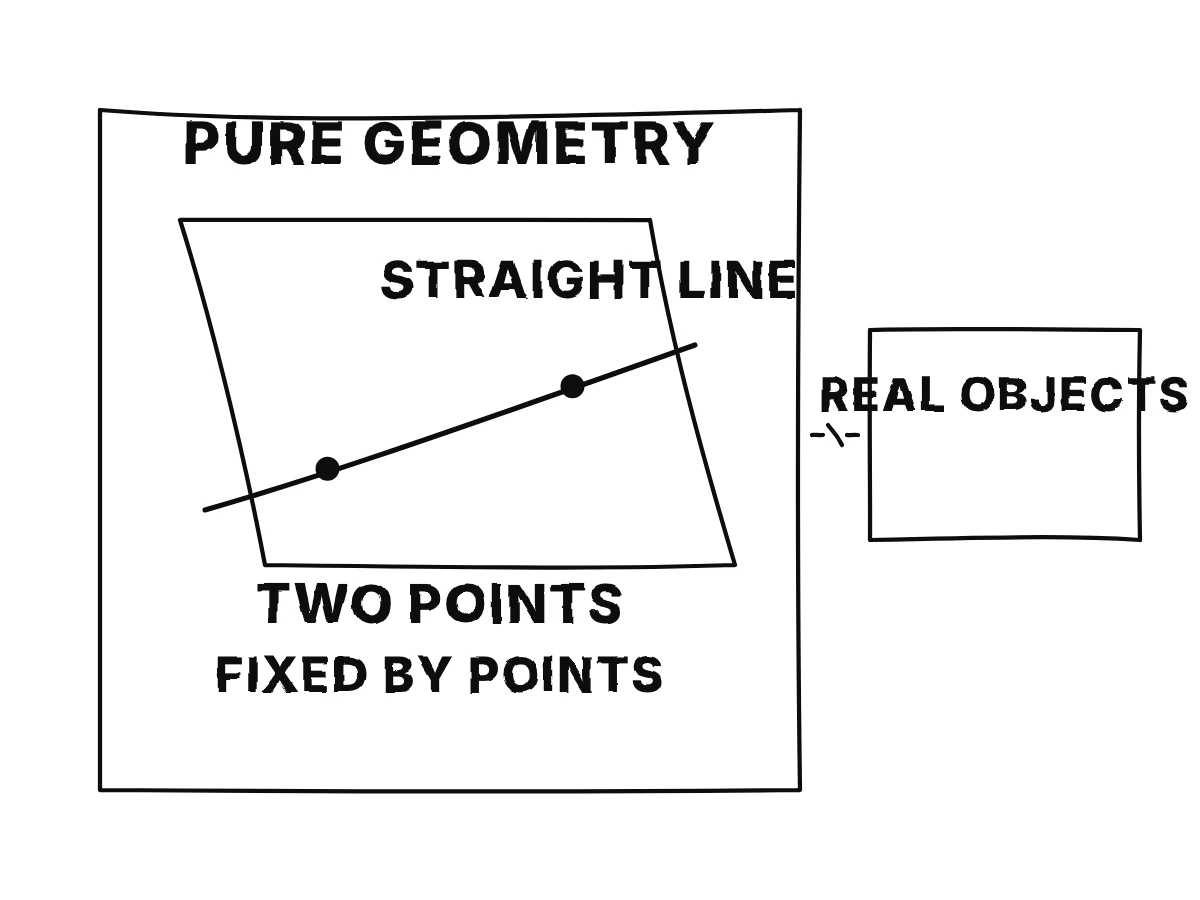
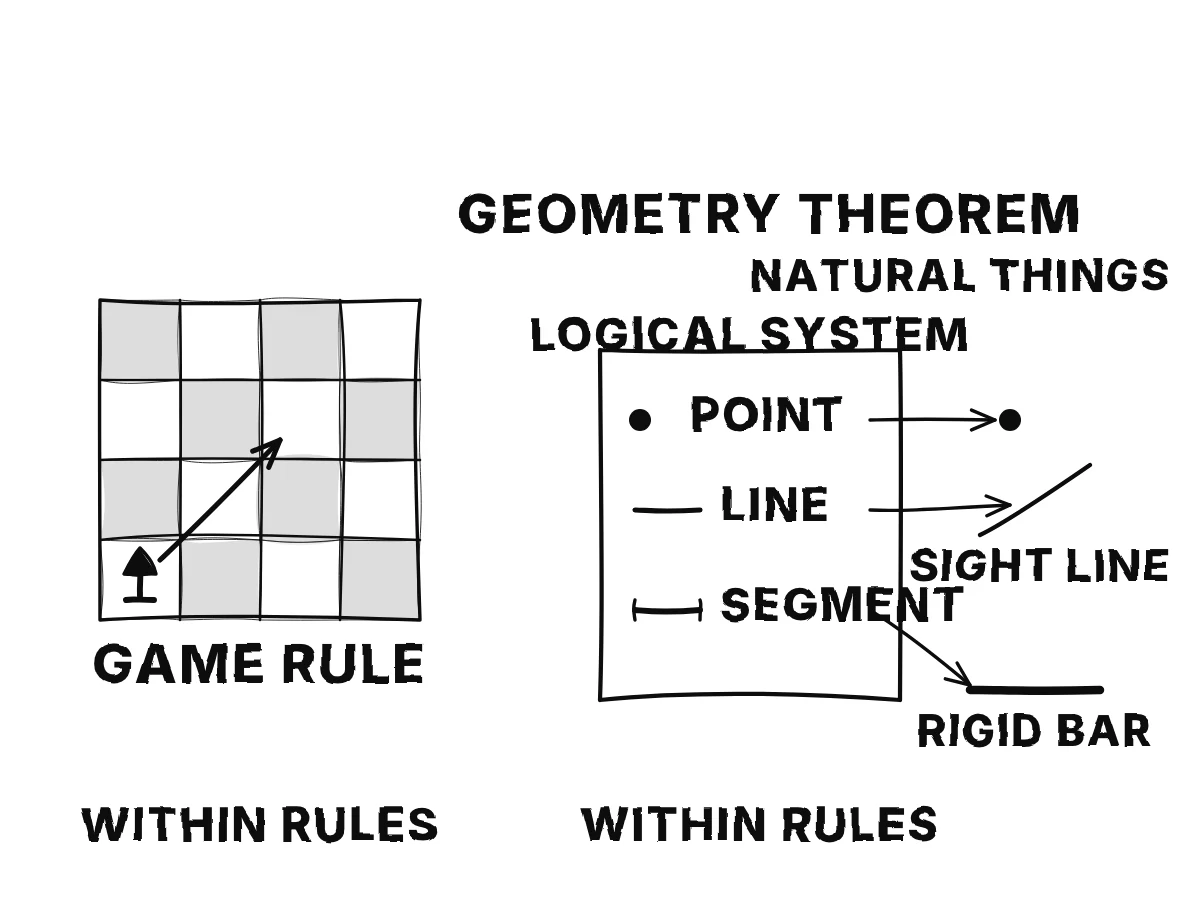
Consider the axiom that through two points passes exactly one straight line. You cannot ask whether that is true. All you can say is that Euclidean geometry deals with certain objects it chooses to call straight lines, and that it assigns them the property of being fixed by any two of their points. The word "true" simply does not fit statements of pure geometry, because when we say "true" we always mean, in the end, agreement with some real object, and pure geometry says nothing about real objects; it speaks only of how its concepts hang together logically. A modern comparison: the rule that a bishop in chess moves diagonally is not true or false, it defines the game. A theorem of pure geometry is like a statement about chess: correct within the rules, but silent about the world.
Rules and Their Origins
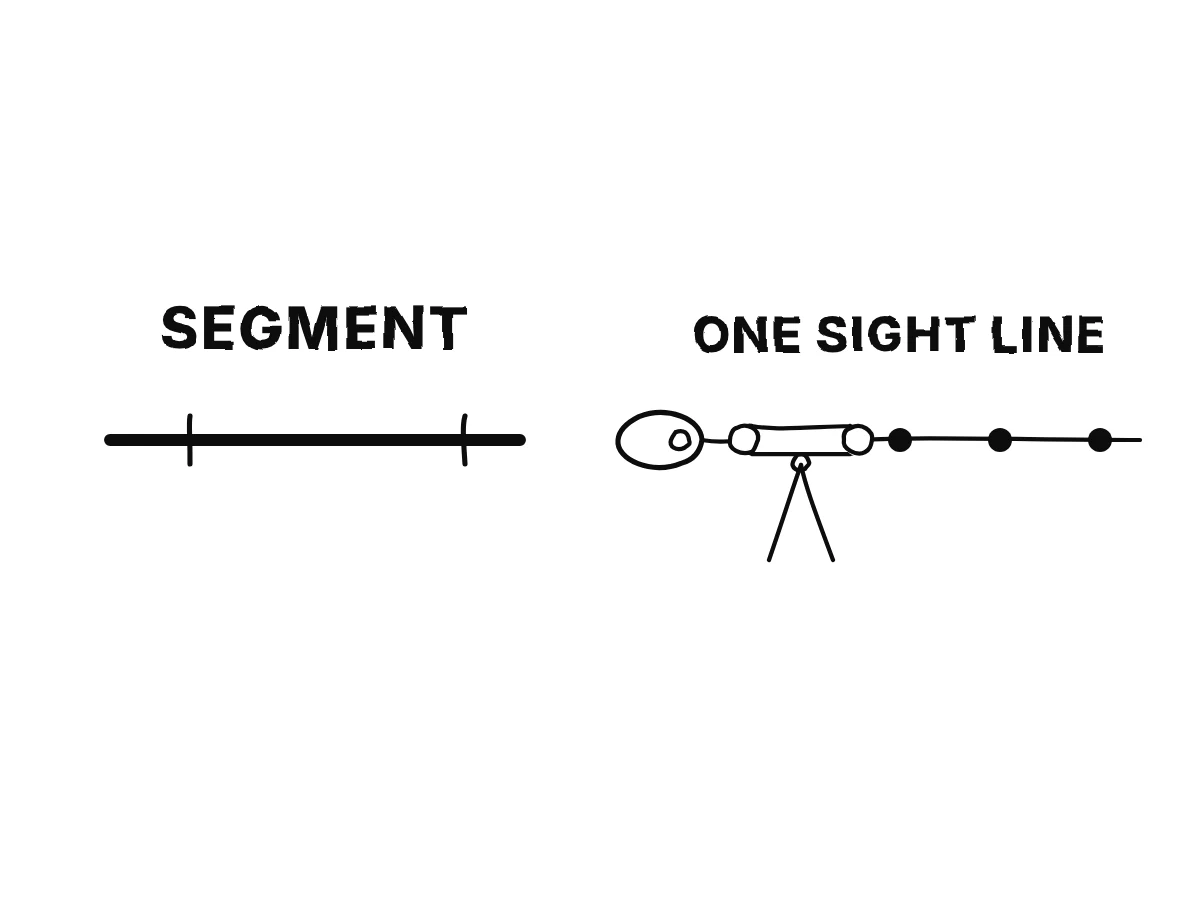
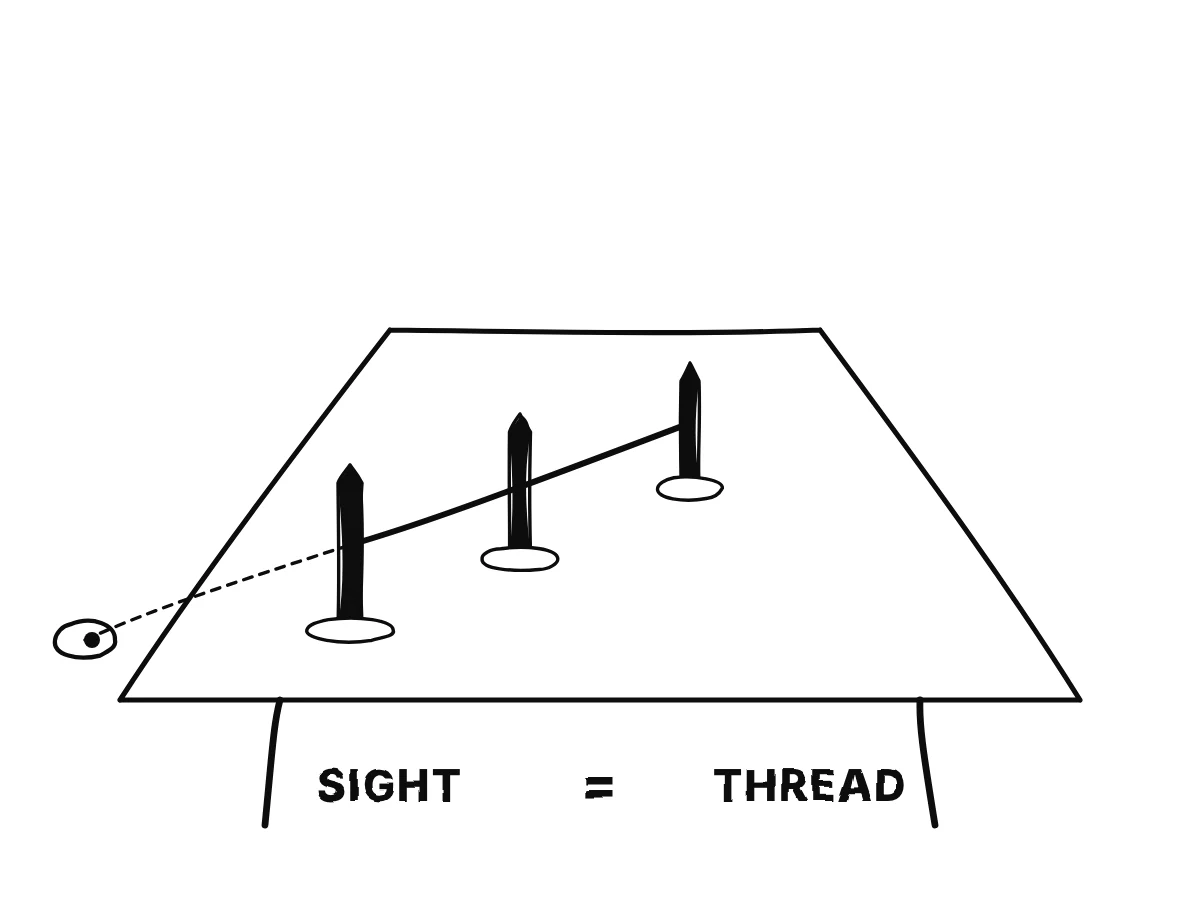
Why, then, do we so stubbornly feel that geometry is true? Einstein's answer is that each geometrical concept corresponds, more or less exactly, to something in nature, and that those natural things are without doubt the sole reason the concepts ever arose. Geometry may disown that origin in order to keep its logical structure clean, but the habit sits deep in us. When we think of a segment, we think of two marks scratched on a practically rigid body, a ruler, a steel bar, a table edge. And we are used to saying that three places lie on a straight line when we can find a spot from which, looking with one eye, their apparent positions fall on top of one another. A surveyor sighting through a theodolite, or a builder squinting along a laser line, is doing exactly that.
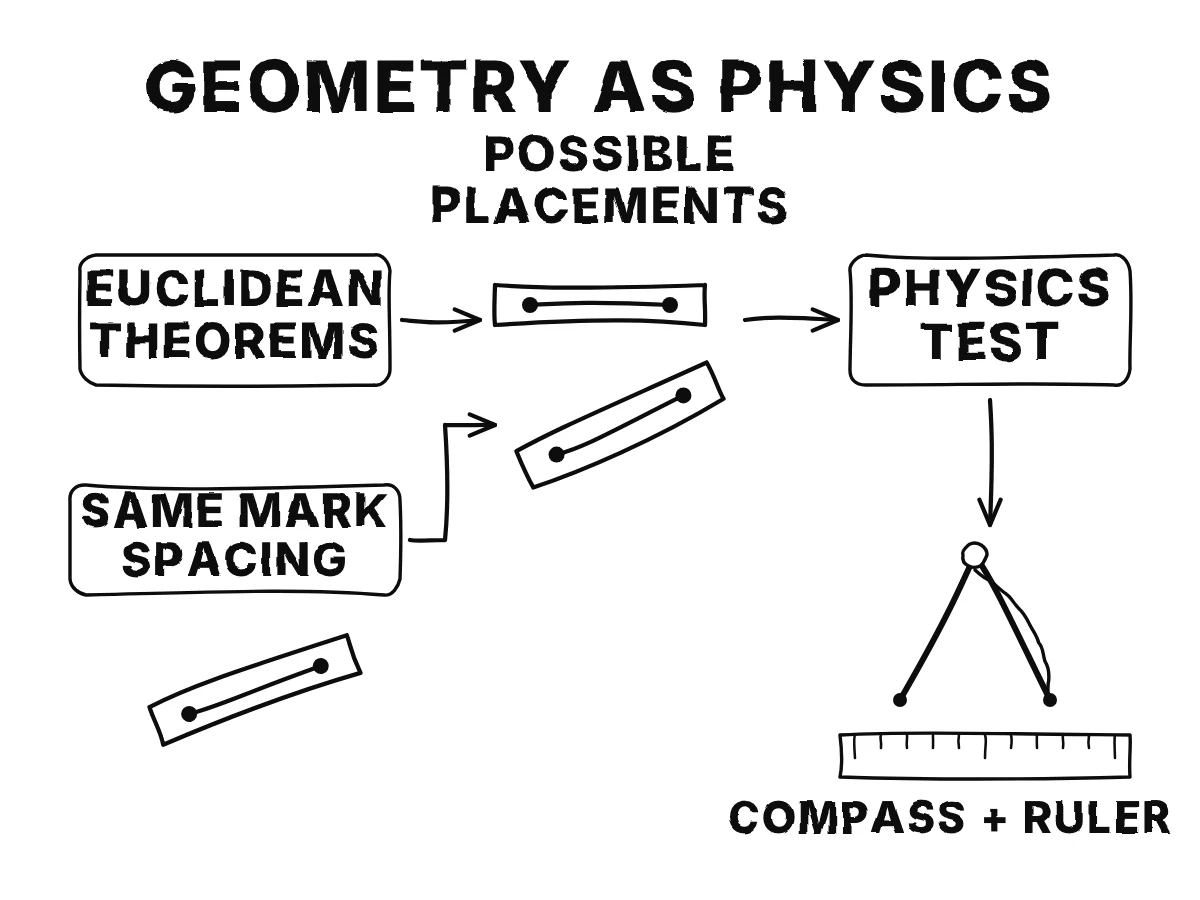
Segments and Sight LinesTesting AlignmentGeometry Meets Physics
Now comes the decisive move, and it is a single added sentence. To the theorems of Euclidean geometry we add just this: two points on a practically rigid body always correspond to the same distance, the same segment, no matter how we move or turn the body. That is all it takes. With this one addition the theorems of geometry stop being statements about ideal concepts and become statements about the possible relative placement of real rigid bodies. Geometry, so extended, is a branch of physics, and now the question of truth is legitimate, because we can ask whether those statements hold for the real things we have assigned to the concepts. Somewhat loosely, Einstein says, the "truth" of a geometrical theorem in this sense means that it checks out in a construction with compass and ruler.
From Tape to GPS
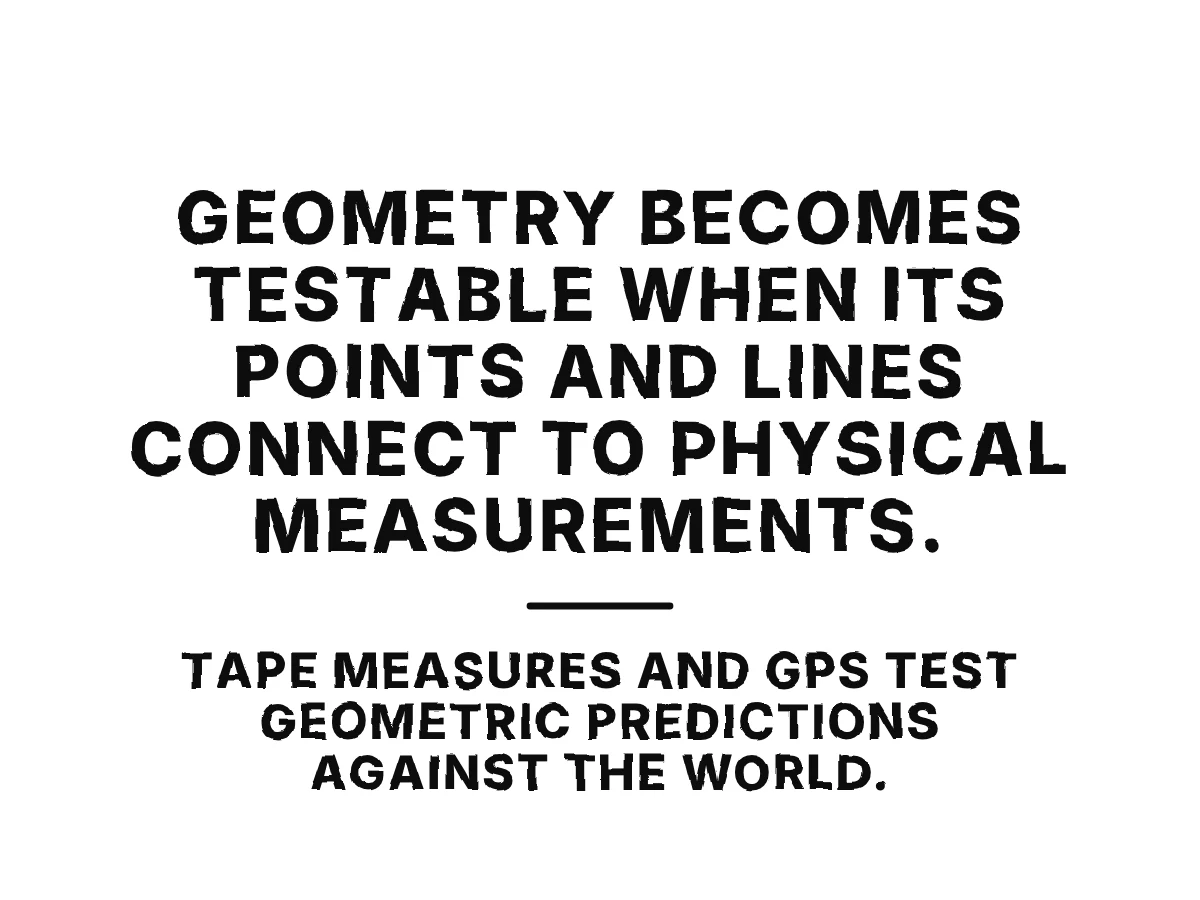
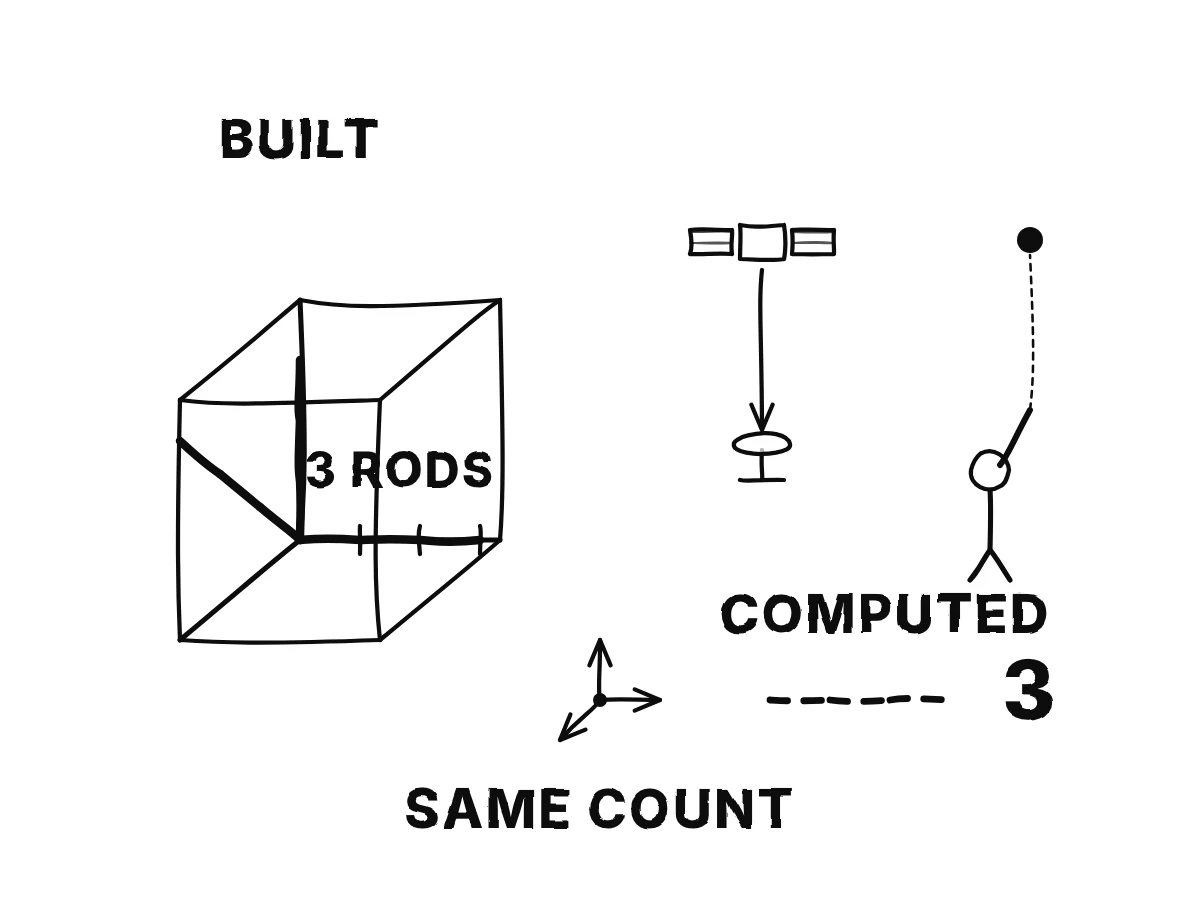
Your tape measure on the table was such a construction. The tape is a practically rigid body; you assumed its marks kept the same distance apart whether it lay along the side or across the diagonal; and under that assumption Pythagoras made a prediction that the world either honours or refuses. It honoured it, to within a millimetre. A GPS receiver does the same thing on a grand scale: it takes its distances from several satellites and combines them as sides of Euclidean figures to compute where you stand, which is Pythagoras in three dimensions, trusted with your life on the motorway. Said once more, in other words: pure geometry can only be consistent, never true; it becomes true or false only when its points and lines are tied to marks on rigid bodies and to lines of sight.
A Working Hypothesis
But notice what kind of foundation that is. Our conviction that geometry, so interpreted, is true rests entirely on experience, and on rather imperfect experience at that, on tapes and threads and sightings, each good to a millimetre or a fraction of an arc second, never to infinity. Einstein is explicit: we will assume this truth for now, as a working hypothesis, and only in the last part of the book, when we reach the general theory of relativity, will we see that it has limits, and exactly where. The GPS system will turn out to be a fine witness there too, because its clocks and signals have to be corrected for effects that only that later theory predicts. For the moment, keep the question alive: which of your certainties about space come from logic, and which from a tape measure?
When Geometry Is True
Where it is in the book: § 1. Physikalischer Inhalt geometrischer Sätze. · pages 1–3 (estimated) · Gewiß hast auch du, lieber Leser, als Knabe oder Mädchen mit dem stolzen Gebäude der Geometrie Euklids Bekanntschaft gemacht und erinnerst…
Questions
Within pure geometry, what does it mean to call a theorem 'true'?
That it has been correctly derived from the axioms by accepted logical steps
That it agrees with measurements made on real rigid bodies
That its axioms have been shown to hold in nature
Show the answer
Answer: That it has been correctly derived from the axioms by accepted logical steps. Inside geometry a theorem is correct, or 'true', when it has been properly derived from the axioms, and nothing more.
Why does the lecture say the question 'is this axiom true?' has no meaning at all?
Because axioms are too simple to be checked by any experiment
Because geometry has too few axioms to decide the matter
Because 'true' means agreement with a real object, and pure geometry mentions none
Show the answer
Answer: Because 'true' means agreement with a real object, and pure geometry mentions none. When we say 'true' we mean, in the end, agreement with some real object, and pure geometry speaks only of how its concepts hang together logically.
What single addition turns Euclidean geometry into a branch of physics?
The rule that through two points passes exactly one straight line
The assumption that two marks on a practically rigid body keep the same distance however the body is moved
The requirement that every theorem be checked with compass and ruler
The identification of straight lines with lines of sight
Show the answer
Answer: The assumption that two marks on a practically rigid body keep the same distance however the body is moved. With that one added sentence the theorems stop being statements about ideal concepts and become statements about the possible relative placement of real rigid bodies.
On what does our conviction that physically interpreted geometry is true ultimately rest?
On the logical consistency of the axioms
On rather imperfect experience with tapes, threads and sightings
On the proofs we learned at school
Show the answer
Answer: On rather imperfect experience with tapes, threads and sightings. The conviction rests entirely on experience, each measurement good only to a millimetre or a fraction of an arc second, never to infinity.
Worked examples
Diagonal of the kitchen table
A rectangular table has sides of 60 cm and 80 cm. Predict the diagonal with the theorem of Pythagoras, then say what assumption about the tape measure makes the comparison with a real measurement meaningful.
Show the answer
Square each side, because the theorem relates squares: 60² = 3600 and 80² = 6400.
Take the square root to get the diagonal: c = 100 cm.
Note the physical assumption: the tape is a practically rigid body whose marks stay the same distance apart whether it lies along a side or across the diagonal; only then does the prediction become a statement about the real table.
Answer: 100 cm
Practice
A rectangular board is 30 cm by 40 cm. Predict the length of its diagonal, and explain whether this prediction is a theorem of pure geometry or a statement of physics.
Show the answer
Hint: Square both sides and add before taking the root; then ask what the numbers 30 and 40 are measurements of.
Answer: 30² + 40² = 900 + 1600 = 2500, so the diagonal is 50 cm. As a derivation from the axioms it is pure geometry; as soon as 30 and 40 are tape readings on a real board and 50 is compared with a tape laid across it, it is a physical statement that can be true or false.
Explain in your own words why the pencil-sighting experiment, where three pencils hide one another to one eye and a taut thread then brushes the middle one, is 'a small piece of physics, not of pure geometry'.
Show the answer
Hint: Ask what two real things are being compared.
Answer: Pure geometry only connects concepts logically. Here a straight line is tied to a real thing in two ways: a line of sight with one eye, and a taut thread. Whether these two real procedures agree is a question about the world, which can turn out either way, so it is physics.
Someone says: 'Geometry has been proved, so it must be true about space.' Using the lecture's distinction, say what is right and what is confused in this claim.
Show the answer
Hint: Separate 'correctly derived' from 'agrees with real objects'.
Answer: What is right: geometry's theorems are proved from the axioms, so within geometry they are correct. What is confused: that only means consistency; the claim about space adds the physical assumption that marks on rigid bodies keep their distance, and that rests on limited experience, which the book promises will show its limits in the general theory of relativity.
7 min · 1332 words
2
Counting Rods and Naming Places
Counting a Length
Take a pencil, lay it along the edge of your kitchen table, and mark where its tip ends with a fingernail. Now slide the pencil forward so its back end sits at the mark, and do it again, and again, until you reach the far corner. You expect, perhaps, that this is a crude substitute for a proper tape measure. What actually happens is that you have just performed the complete, fundamental act of length measurement, and nothing a tape measure does is different in kind. A tape is simply a rigid body on which somebody else has already laid the pencil end to end a thousand times and printed the count.
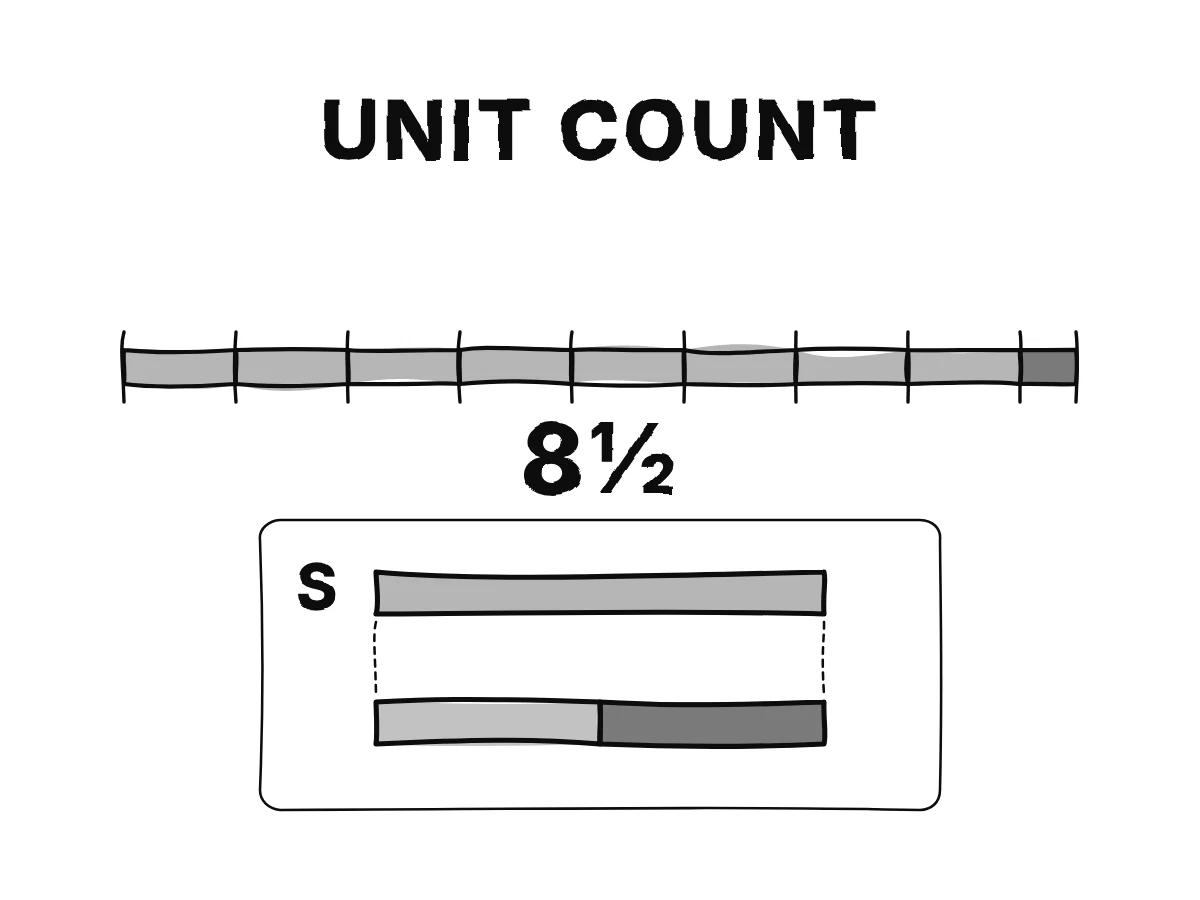
That is exactly how the author grounds the distance between two points of a rigid body. You choose, once and for all, one segment, a little rod he calls S, the unit measure. Given two points A and B on a rigid body, you first construct the straight line joining them, by the rules of geometry, say a taut thread or a line of sight, as we saw. Then you lay the rod along that line starting at A, end to end, until you arrive at B. The number of times you had to lay it down is the measure of the segment AB. If a table edge takes the pencil eight times with a little left over, and that little bit is half a pencil, the edge measures eight and a half pencils, and the fraction is itself found by laying down a smaller rod that fits the pencil twice. The author says all measuring of lengths rests on this, and he means it quite literally: the metre, the light-year, the width of an atom, all are counts of a unit rod, however cleverly the counting is hidden.
Naming a Place
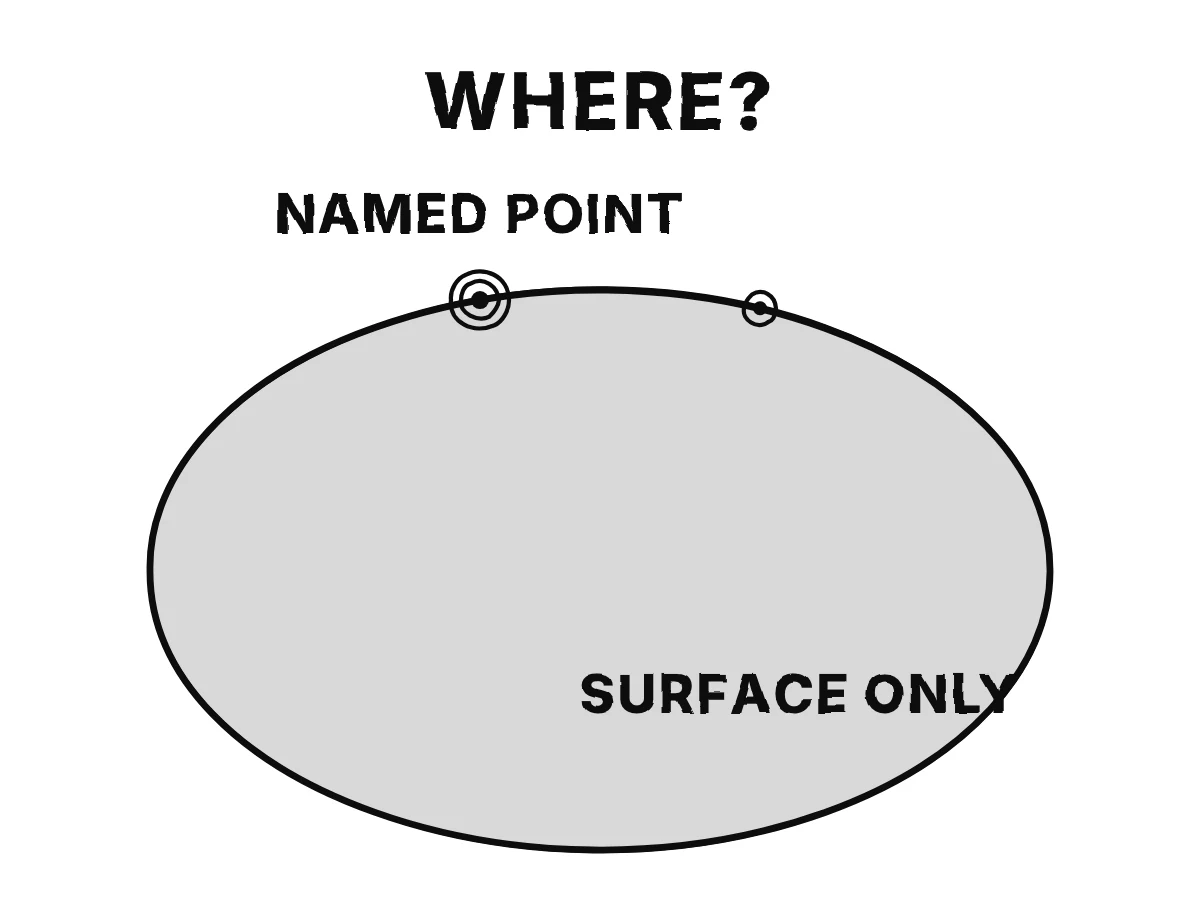
Now a different question: where is something? Every spatial statement of the place of an event or object, the author says, comes down to naming a point of a rigid body, the reference body, with which the thing coincides. Not only in science, but in everyday life. Take his own example, "in Berlin, at Potsdamer Platz". Unpack it and you find a rigid body, the surface of the Earth, on which a particular point has been marked and given a name, and the event is simply said to coincide spatially with that marked point. Your home address works the same way, and so does the dot on a map in your phone: a marked point on the rigid crust of the Earth.
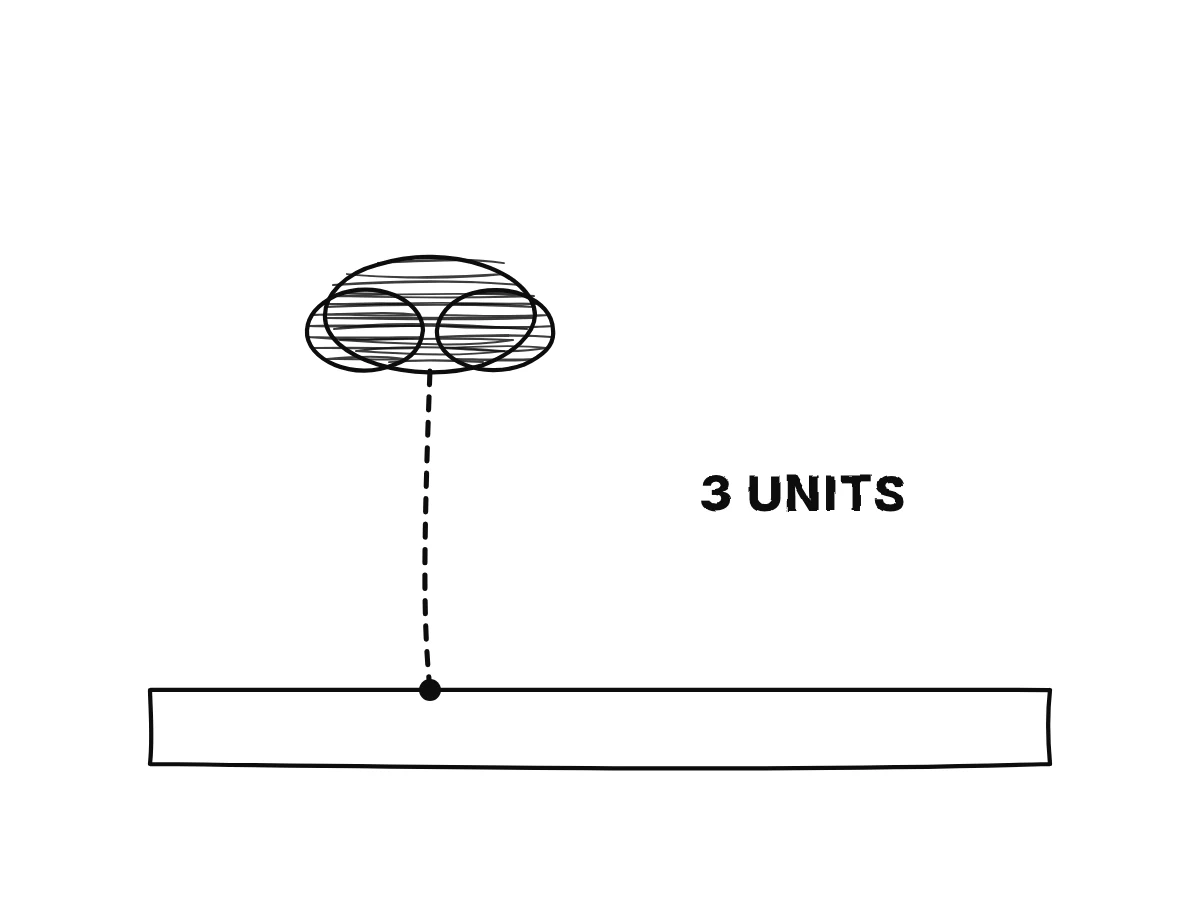
But this primitive way of giving a place has two weaknesses. It knows only places on the surface of rigid bodies, and it depends on there being distinguishable, named points on that surface. Watch how both limits fall away without the idea of location changing at all. Suppose a cloud hangs over Potsdamer Platz. You could fix its place relative to the Earth by planting a vertical pole on the square, tall enough to touch the cloud. The length of the pole, measured by laying off the unit rod, together with the place of its foot, is a complete statement of where the cloud is.
Extending the Reference Body
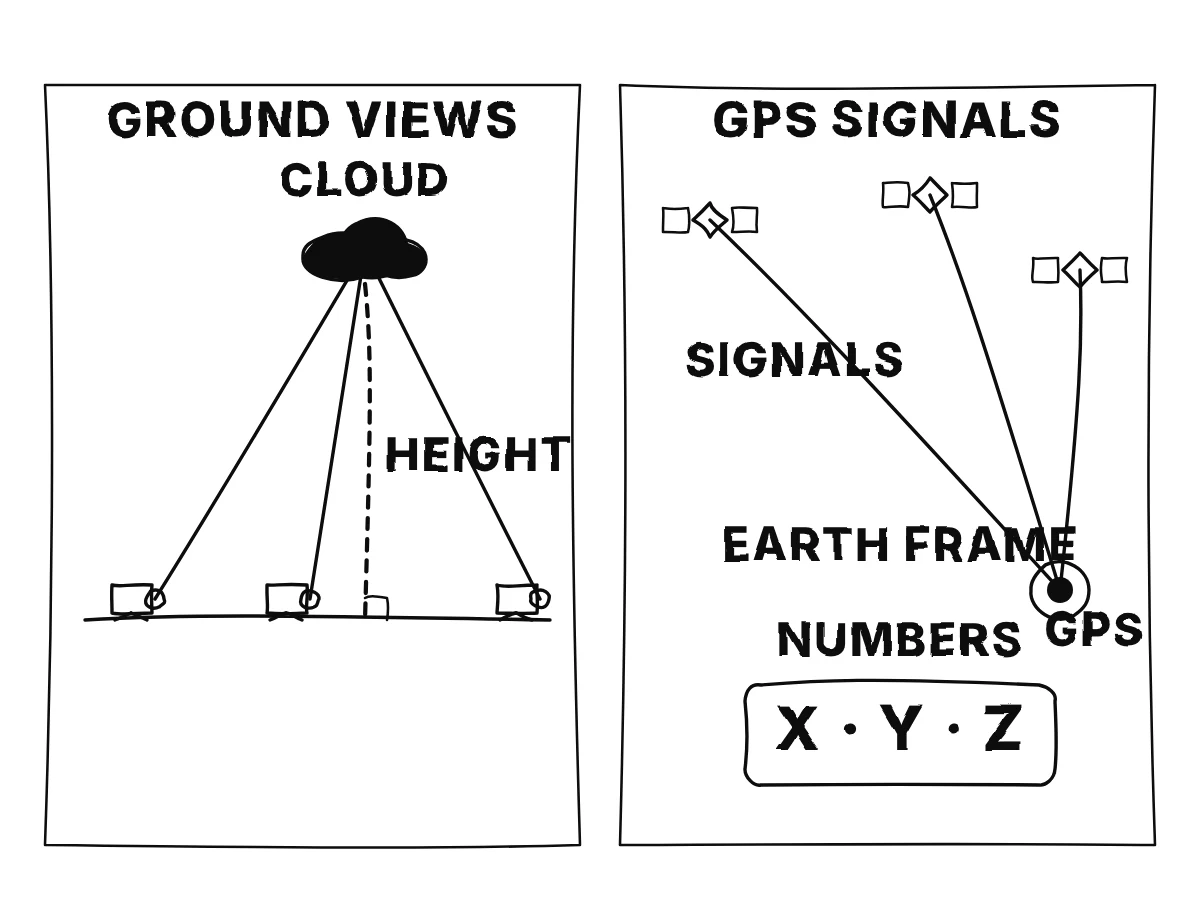
Three refinements are hiding in that pole, and the author draws them out one by one. First, you extended the rigid body: the Earth plus the pole is a new, larger rigid body that reaches the thing you wanted to locate. Second, you described the place by a number, the measured length of the pole, instead of by a named landmark. Third, and this is the boldest step, you may speak of the height of the cloud even when no pole has been built. In his day, one photographed the cloud from several spots on the ground and, using what is known about how light travels, worked out how long the pole would have to be. Here is your modern instance in full: a GPS receiver never touches a pole or a satellite; it times radio signals from several satellites, applies the known propagation of light, and announces three numbers that tell how long the imaginary rods from the Earth's reference frame to you would be. The number stands in for the rod; the rod is never built; the meaning is still the rod.
Computing an Unbuilt Rod
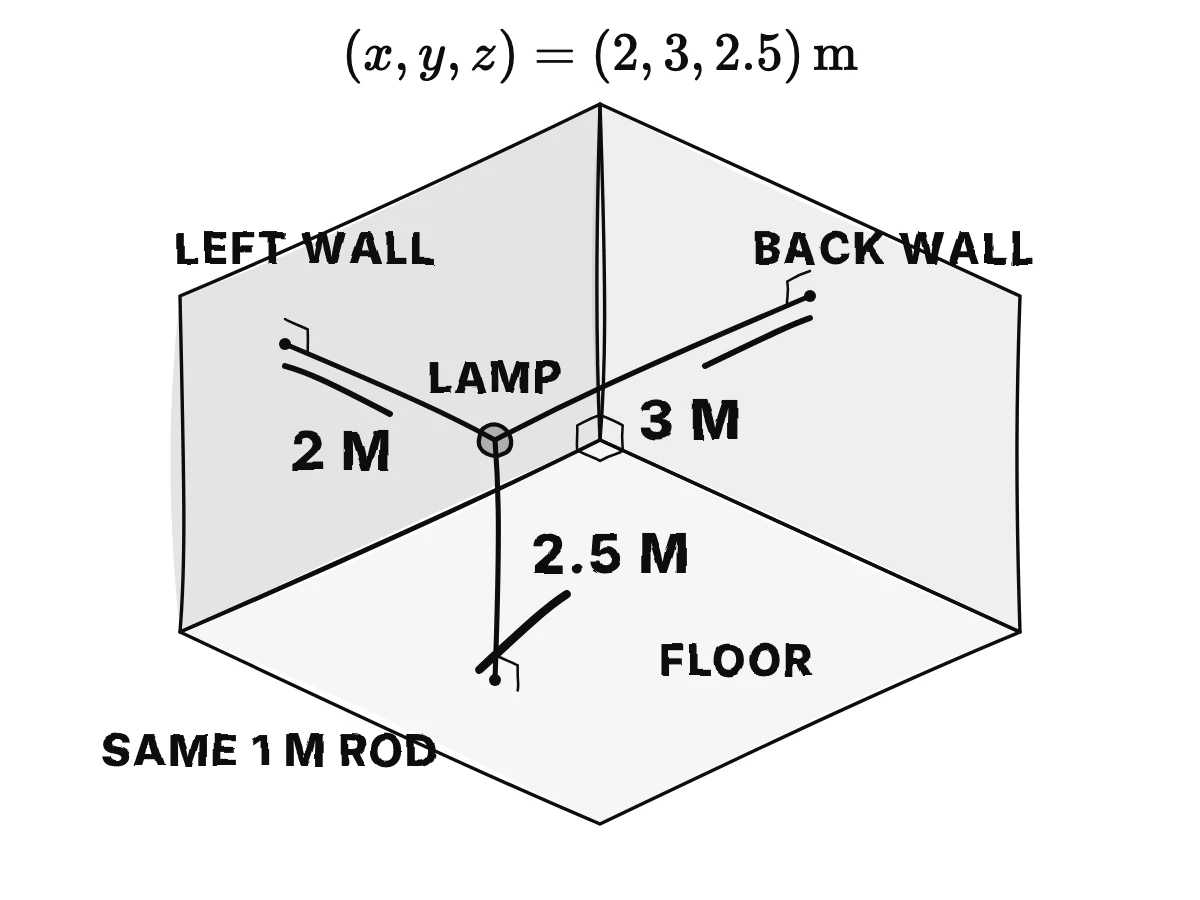
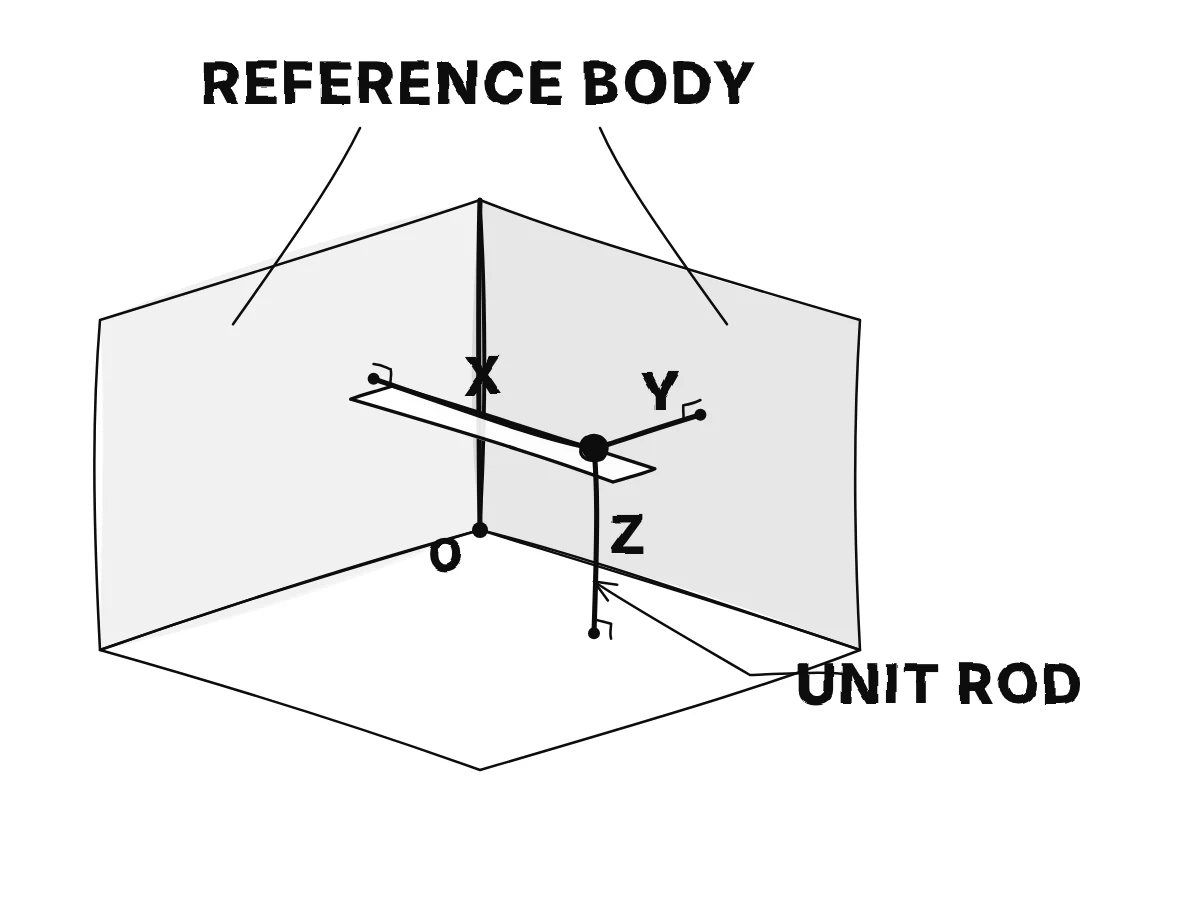
So it pays, for describing places, to free oneself from named landmarks altogether and use measured numbers. Measuring physics does this with the Cartesian coordinate system, named after Descartes. Picture three rigid, flat walls, each perpendicular to the other two, like the floor and two adjoining walls in the corner of a room, all fastened to one rigid body. The place of any happening is given, essentially, by the lengths of the three perpendiculars dropped from it onto those three walls, the three coordinates written (x, y, z). What it says in words: go so many units out from one wall, so many from the second, so many from the third, and you are at the event. Where it comes from: it is the pole over Potsdamer Platz three times over, one imaginary pole for each wall. One calculation aloud: a lamp hanging in your room is 2 metres from the left wall, 3 metres from the back wall, and 2.5 metres above the floor, so its coordinates are (2, 3, 2.5), and each of those three numbers is a count of a metre rod laid end to end along a perpendicular. The author stresses that these three lengths are found by a sequence of manipulations with rigid rods, manipulations prescribed by the laws and methods of Euclidean geometry, which is what guarantees that the perpendiculars exist and that one count will match another.
Three CoordinatesLocate the Shelf ObjectNumbers Promise a Count
In practice, of course, the three rigid walls are almost never built, and the coordinates are almost never obtained by actually laying rods along perpendiculars. GPS satellites carry no walls, and an astronomer measuring the position of a star drops no plumb lines. Yet the author insists that the physical meaning of every statement of place must always be traced back to this picture of rods and walls, otherwise the results of physics and astronomy dissolve, in his words, into vagueness. Whatever indirect trick produces the number, the number is a promise: had you been able to build the rigid frame and lay the rod, this is the count you would have got.
The Hidden Assumption
Pull the threads together and two things stand out. Every spatial description of happenings makes use of a rigid body to which the happenings are referred. And that referring quietly assumes that segments, meaning pairs of marks on a rigid body, obey the laws of Euclidean geometry: that perpendiculars can be dropped, that a rod keeps its length when moved from one wall to another, that counts add up the way school geometry says. Hold onto that assumption, because the whole book will eventually turn on asking whether it is really safe.
Place and Measurement
Where it is in the book: § 2. Das Koordinatensystem. · pages 3–5 (estimated) · Auf Grund der angedeuteten physikalischen Interpretation des Abstandes sind wir auch in der Lage, den Abstand zweier Punkte eines starren…
Worked examples
Locating the cloud
A cloud hangs above Potsdamer Platz. Using the unit rod S, a vertical pole from the square to the cloud takes the rod 350 times exactly. Give a complete statement of the cloud's place relative to the Earth, and name the three refinements involved.
Show the answer
The surface of the Earth is the rigid reference body, and Potsdamer Platz is a marked, named point on it: the foot of the pole.
Earth plus pole is an extended rigid body that now reaches the cloud, so the cloud coincides with a point of this larger rigid body (refinement a).
The pole's length is measured by laying the unit rod along it: 350 repetitions, so its measure is 350 units; a number replaces a named landmark (refinement b).
The complete place is therefore: foot at Potsdamer Platz, height 350 units. Had no pole been built, this same number could be worked out from photographs taken from several ground points using how light travels (refinement c).
Answer: Foot of the pole at Potsdamer Platz, height 350 units of S
Practice
Points A and B lie on a rigid body. Laying the rod S from A along the straight line toward B, it fits 12 times and a remainder is left; a smaller rod that fits S exactly four times fits the remainder three times. What is the measure of AB in units of S?
Show the answer
Hint: First count whole rods, then express the remainder as a fraction of S using the smaller rod.
Answer: 12.75 units of S. Twelve whole rods give 12; the small rod is one quarter of S, and three of them give 3/4, so AB measures 12 + 3/4 = 12.75.
In a room, take the floor and two adjoining walls meeting in a corner as a Cartesian coordinate system. A book is 1.5 metres from the left wall, 4 metres from the back wall and 1 metre above the floor. Write its coordinates (x, y, z) and explain what each number physically is.
Show the answer
Hint: Each coordinate is the length of the perpendicular dropped from the book onto one of the three walls.
Answer: (1.5, 4, 1). Each number is the count of a metre rod laid end to end along the perpendicular from the book to the respective wall: 1.5 to the left wall, 4 to the back wall, 1 to the floor.
A GPS receiver gives three coordinates without any rods or walls having been built. Explain in your own words what, according to the lecture, those three numbers mean physically, and why the author insists on this.
Show the answer
Hint: Think of the cloud whose height is computed from photographs.
Answer: The numbers are a promise: had one been able to build the rigid frame of three perpendicular walls fastened to the Earth and lay the unit rod along the perpendiculars from the receiver to each wall, these are the counts one would have got. The rod is never built, but its meaning is the rod. The author insists on this because otherwise statements of place lose their physical meaning and the results of physics and astronomy dissolve into vagueness.
7 min · 1377 words
3
A Stone Dropped from a Train
Two Views of the Fall
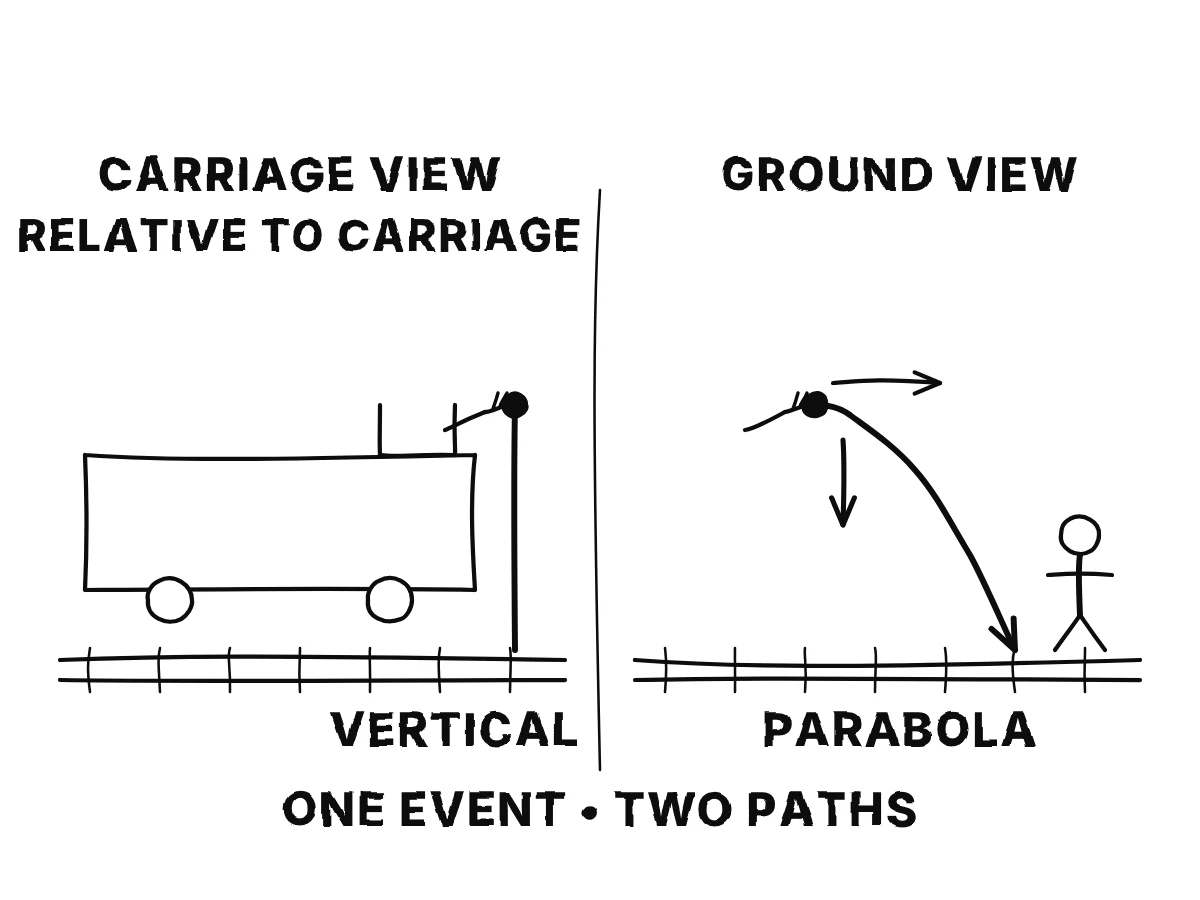
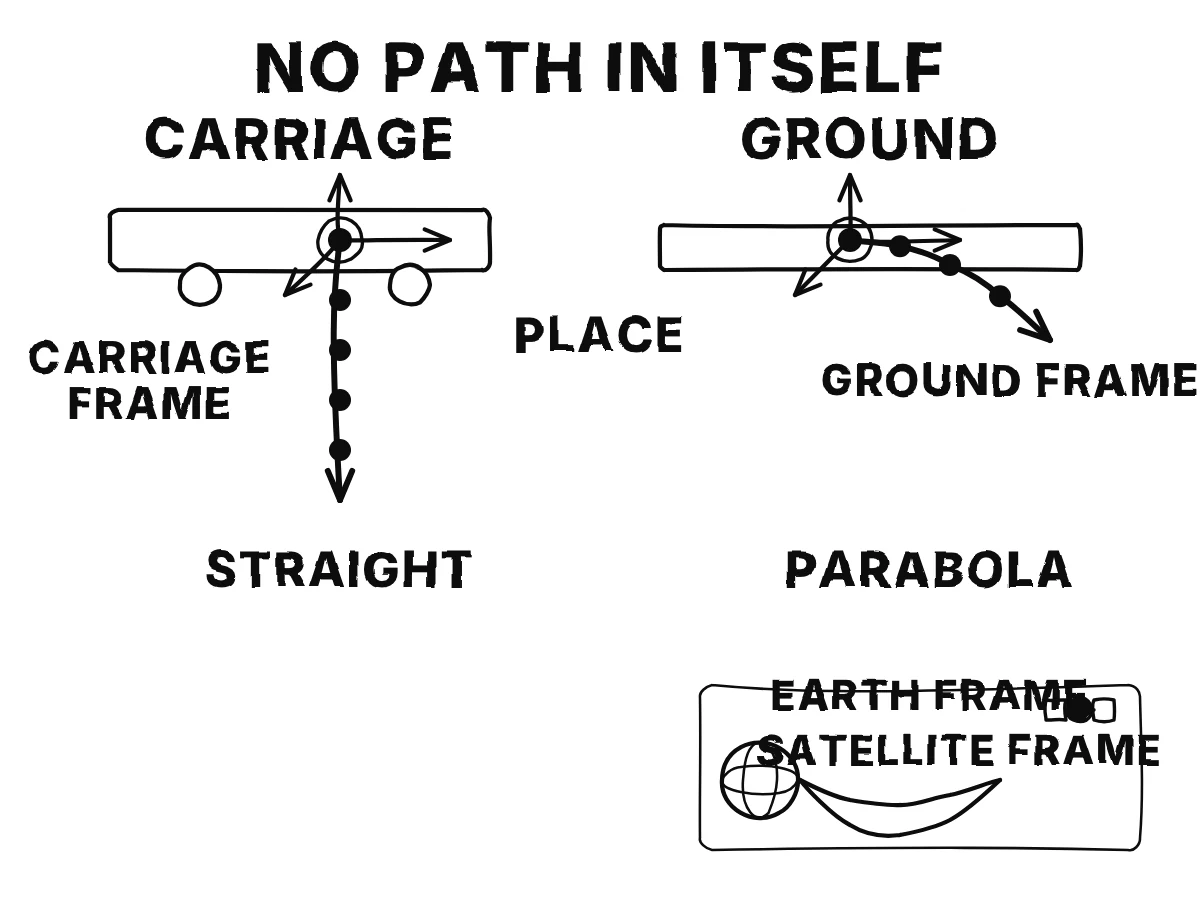
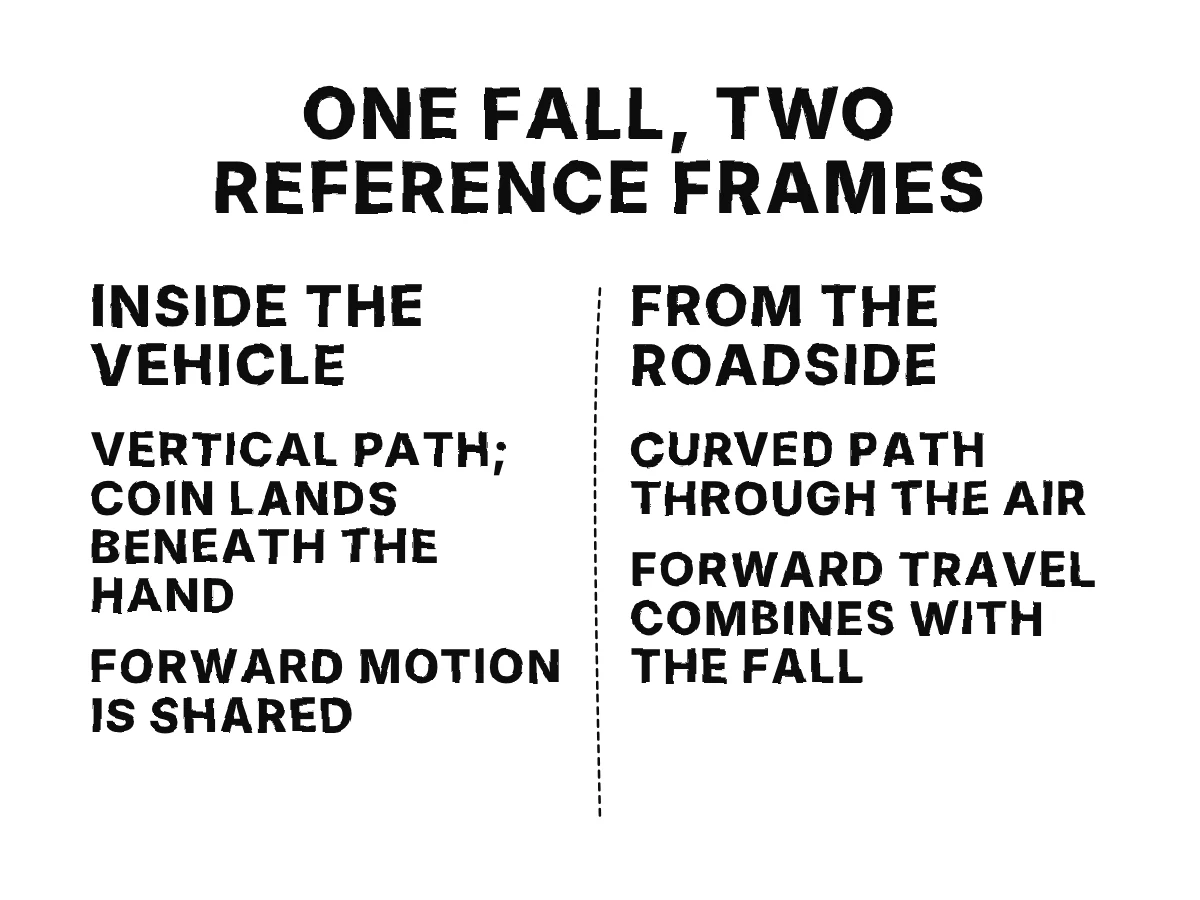
Picture yourself in a railway carriage running smoothly and steadily along a straight stretch of track, standing at an open window. You hold a small stone outside the window and simply open your fingers, giving it no push in any direction. Air resistance aside, what do you see? The stone drops straight down, a vertical line from your hand to the embankment, exactly as it would if the train were standing in the station. Now put a second person on the footpath beside the track, watching the same stone. That person sees something different: the stone leaves your hand already moving forward with the train, keeps that forward speed while gravity pulls it down, and so traces a curve, a piece of a parabola, until it hits the ground.
Both observers are honest and both have good eyes, yet one reports a straight line and the other a curved arc. So Einstein asks the uncomfortable question: which of them is right, where did the stone "really" go, along a line or along a parabola? He admits that the usual statement of what mechanics does, namely that it describes how bodies change their place in space with time, quietly commits what he calls deadly sins against the spirit of clarity. The words "place" and "space" sound familiar, but the stone shows that they carry no clear meaning on their own. If "space" cannot tell us whether the path is straight or curved, then "space" is not doing any work in the sentence.
The way out is the one we built in the previous part. We drop the obscure word "space" altogether, and in its place we say "motion relative to a practically rigid reference body". A place was defined as a spatial coincidence with a point of such a body, and here two bodies are on offer: the carriage and the ground. Relative to the carriage, the stone passes a sequence of points that lie on one vertical line. Relative to the ground, it passes a sequence of points that lie on a parabola. Neither statement contradicts the other, because each is a statement about a different reference body.
Paths Need a Reference
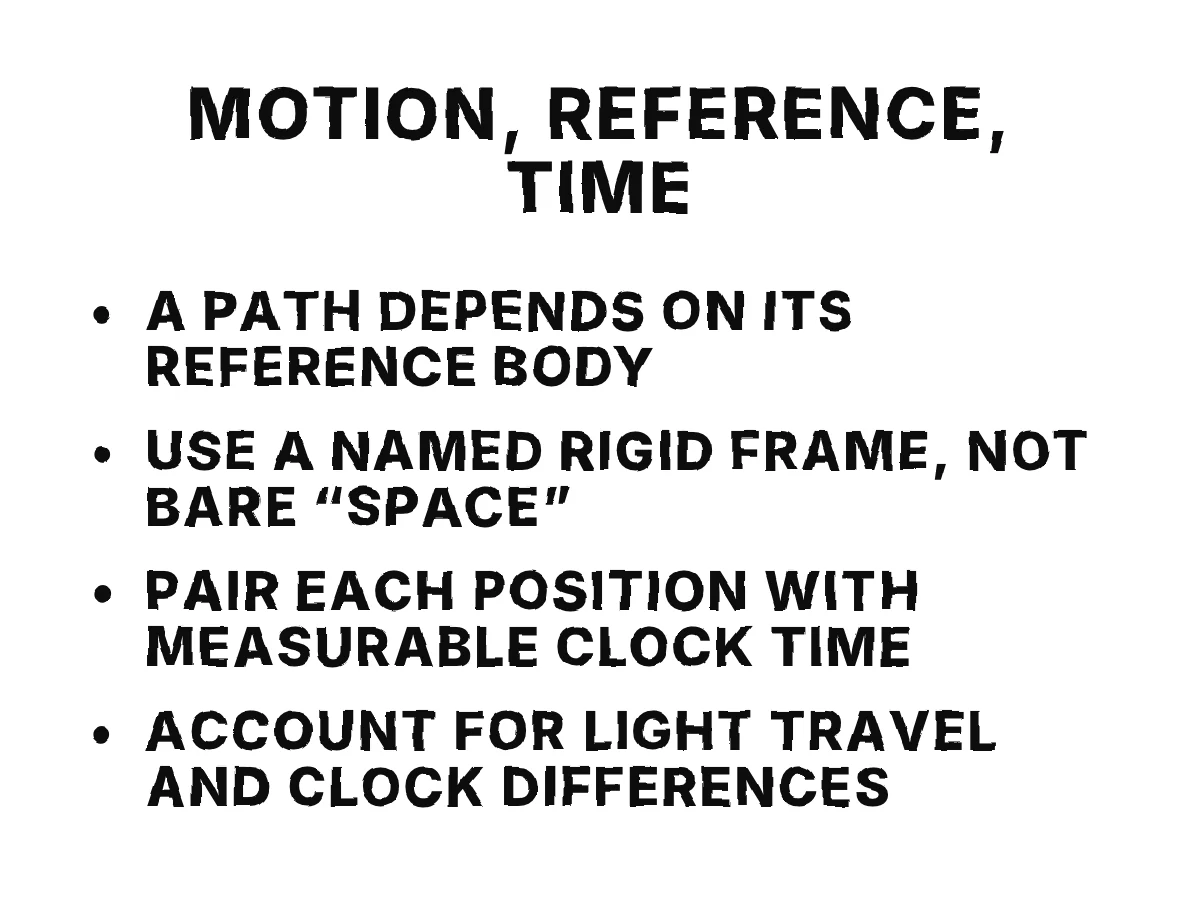
For mathematical work it is convenient to replace the phrase "reference body" by "coordinate system", meaning the three rigid perpendicular walls fixed to that body, as we set them up before. Then the result reads cleanly: in a coordinate system rigidly attached to the carriage the stone describes a straight line, and in a coordinate system rigidly attached to the ground it describes a parabola. The lesson, in Einstein's own words, is that "there is no such thing as a path in itself, only a path relative to a particular reference body." Said another way, a trajectory is not a property of the stone alone; it is a relation between the stone and whatever rigid body you choose to measure against. Your GPS receiver reports a track across the Earth's surface, but the same journey, measured in a coordinate system fixed to the orbiting satellites, would be an entirely different curve; neither is the true one and both are correct.
Position Paired with Time
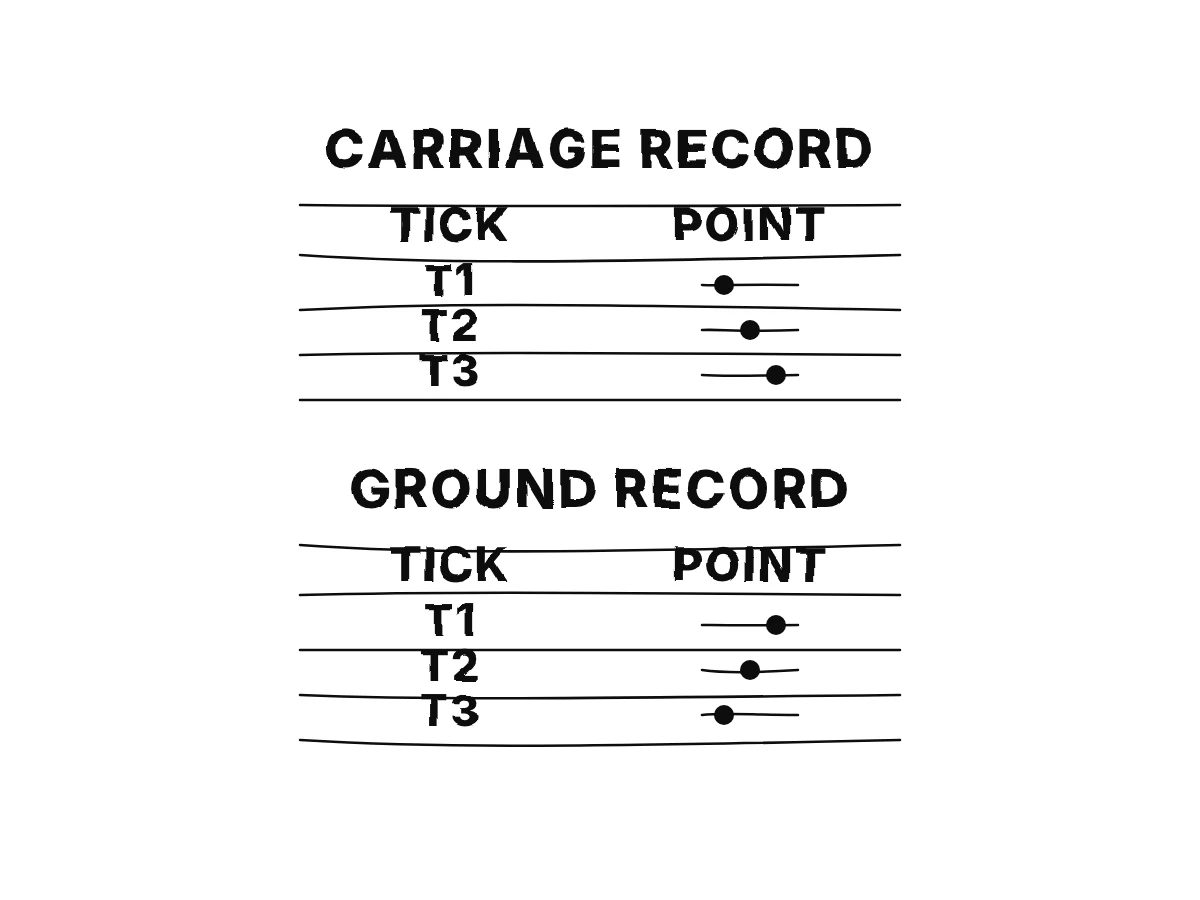
A list of places is still only half a description of motion. To describe the fall completely we must also say, for every point on the path, at what time the stone was there. And that word "time" must be defined in such a way that time values are, at least in principle, things one can observe, results of a measurement, not something taken on faith. On the footing of classical mechanics, Einstein meets this demand simply. Take two clocks built exactly alike; the person at the carriage window holds one, the person on the footpath holds the other. Each of them notes, at every tick of the clock in their own hand, the point of their own reference body with which the stone coincides at that instant. The result is two tables, one pairing ticks with points of the carriage, the other pairing ticks with points of the ground, and each table is a full description of the motion relative to its body.
Light Travel and Clock Corrections
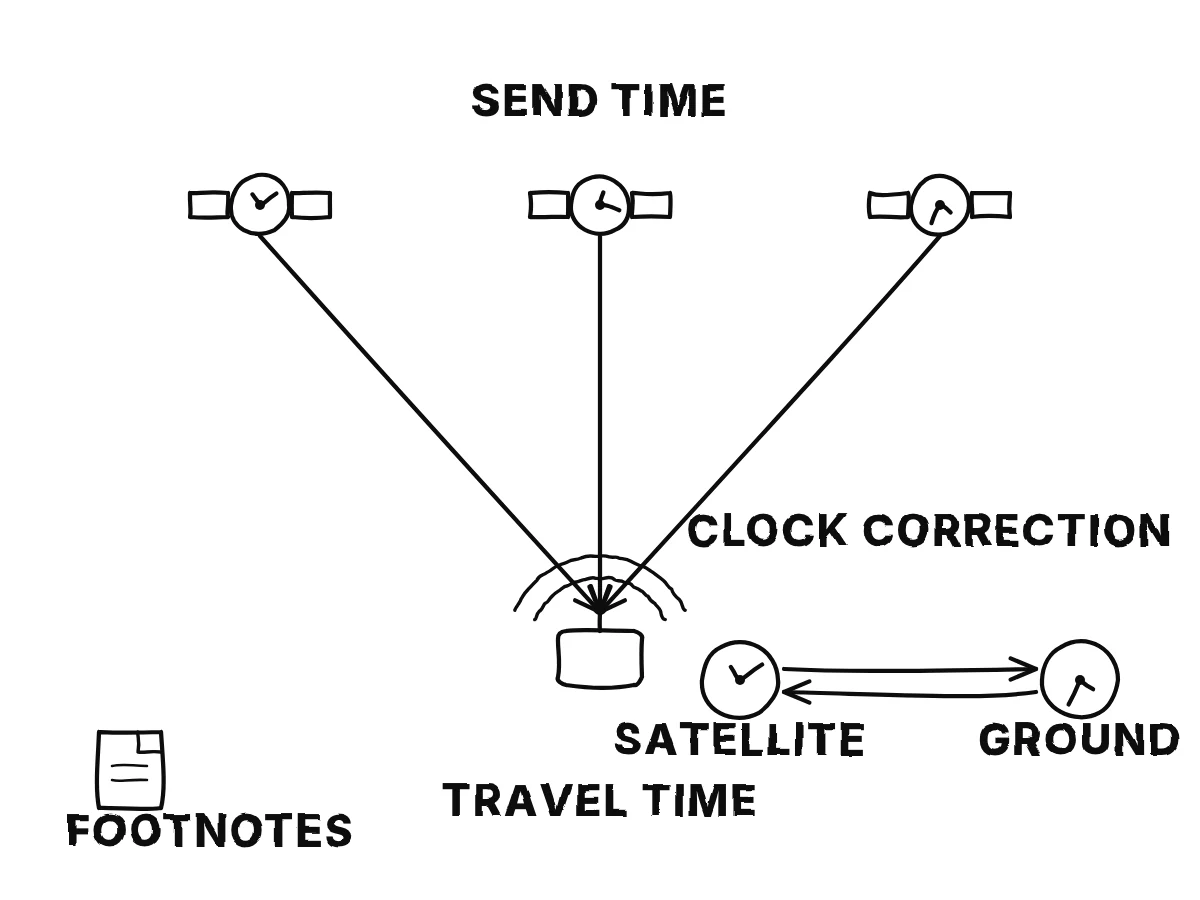
Einstein then sets aside, for now, the small error that creeps in because the observer sees the stone by light, and light takes time to travel from the stone to the eye. He also mentions a second difficulty lurking here, without naming it yet, and promises that both will be treated at length later. That promise is the doorway to everything that follows in the book, and it is far from academic. Every GPS satellite carries an atomic clock and tags its signals with the time of sending; your receiver works out its position precisely from how long those signals took to arrive, so the finite speed of light is not a nuisance to be ignored but the whole method. And the satellite clocks must be corrected for the fact that they do not keep the same time as clocks on the ground, which is exactly the kind of difficulty Einstein is hinting at.
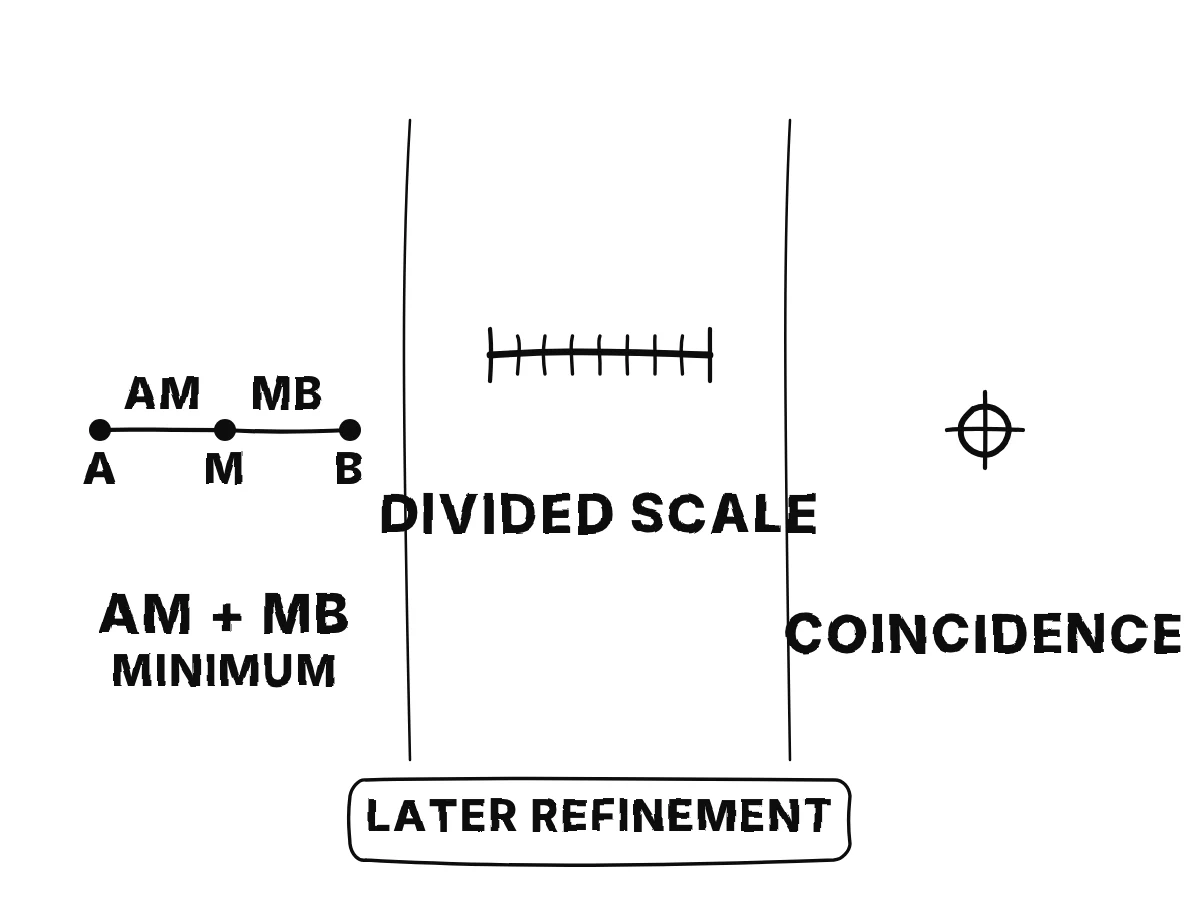
The footnotes gathered at the end of this section tidy up loose ends from the earlier parts. A straight line, too, is given a natural object: three points of a rigid body lie on a straight line when the middle one is placed so that the sum of its distances to the two outer ones is as small as possible. The counting of unit rods was assumed to come out whole, and the remedy is a divided scale, which brings no new principle. Spatial coincidence needs no deeper analysis, since in real cases people hardly ever disagree about whether it holds. And the last note warns that only general relativity, in the second half of the book, will force these ideas to be refined and changed.
Footnotes on MeasurementThe Coin Drop Test
With this the first section of the course closes, and so does the ground-laying part of Einstein's book. We have learned to say what a geometrical statement means, how a length is measured, how a place is named, and now how a motion is described: always against a named rigid body, and always with clocks.
Motion, Reference, Time
Where it is in the book: § 3. Raum und Zeit in der klassischen Mechanik. · pages 5–7 (estimated) · Wenn ich ohne schwere Bedenken und eingehende Erläuterungen die Aufgabe der Mechanik so formuliere: „Die Mechanik hat zu beschreiben, wie…
Questions
Why does Einstein say the two observers do not contradict each other when one reports a straight line and the other a parabola?
Each statement is about motion relative to a different reference body, so both are correct.
The footpath observer is misled by air resistance curving the stone's path.
Only the ground is at rest, so the parabola is the real path and the line an illusion.
The stone's path is a property of the stone alone, and both are approximations to it.
Show the answer
Answer: Each statement is about motion relative to a different reference body, so both are correct.. A path exists only relative to a particular reference body: relative to the carriage the stone passes points on a vertical line, relative to the ground points on a parabola, and neither is more real.
Why does the lecture say the word 'space' is 'not doing any work' in the sentence that defines mechanics?
Because space can only be measured with divided scales, not whole rods.
Because 'space' cannot tell us whether the stone's path is straight or curved; a rigid reference body can.
Because space is identical with the coordinate system of the ground.
Because the general theory of relativity later abolishes space entirely.
Show the answer
Answer: Because 'space' cannot tell us whether the stone's path is straight or curved; a rigid reference body can.. If 'space' cannot decide whether the path is straight or curved, it settles nothing; so we replace it with motion relative to a practically rigid reference body.
What would be missing from a description of the stone's fall if it consisted only of the list of points the stone passes relative to the carriage?
The corresponding list of points relative to the ground.
A proof that the points really lie on a straight line.
The time at which the stone was at each of those points, read from a clock.
The correction for the finite speed of light.
Show the answer
Answer: The time at which the stone was at each of those points, read from a clock.. A list of places is only half a description; a full description pairs each point of the path with the time the body was there, taken from the ticks of a measurable clock.
In classical mechanics, how does each observer attach times to the stone's positions?
Both read one shared clock placed on the ground.
Each computes the time from the stone's height and the law of gravity.
The carriage observer sends light signals to the footpath observer.
Each notes, at every tick of an identical clock in their own hand, where the stone is relative to their own body.
Show the answer
Answer: Each notes, at every tick of an identical clock in their own hand, where the stone is relative to their own body.. Two clocks built exactly alike are used, one per observer; at each tick the observer notes the point of their own reference body with which the stone coincides.
Worked examples
Which path, which body?
A stone is released from the window of a carriage moving steadily along a straight track. State the stone's path (a) in a coordinate system rigidly attached to the carriage and (b) in one rigidly attached to the ground, and explain why the two answers do not conflict.
Show the answer
Recall that a place means spatial coincidence with a point of a rigid reference body, so a path is a sequence of such points on a named body.
Relative to the carriage, the stone shares the carriage's forward motion and only falls, so the points it coincides with lie on one vertical line.
Relative to the ground, the stone keeps its forward speed while gravity pulls it down, so the points it coincides with lie on a parabola.
The two statements refer to different reference bodies, so neither contradicts the other; there is no path 'in itself'.
Answer: (a) a vertical straight line; (b) a parabola; both correct, each relative to its own body.
Practice
Drop a coin inside a car moving at constant speed on a straight road. Will it land behind your hand or directly below it? Describe its path relative to the car and relative to the road.
Show the answer
Hint: Ask first which reference body you are measuring against, and remember the coin shares the car's forward motion.
Answer: It lands directly below your hand. Relative to the car the path is a vertical line; relative to the road it is a parabola. This is the stone example with the car as the rigid reference body.
A friend says: 'The observer on the footpath is right about the parabola, because the ground is really at rest and the train really moves.' Explain, in Einstein's terms, what is wrong with this.
Show the answer
Hint: Recall what the word 'space' was replaced with and what a path is a relation between.
Answer: A path is not a property of the stone alone but a relation between the stone and the chosen rigid body. The ground and the carriage are both practically rigid reference bodies; saying one is 'really' at rest reintroduces the empty word 'space', which settles nothing. Both descriptions are correct.
Explain what two things each observer must record to give a complete classical description of the stone's motion, and name the simplification Einstein admits he is making about how the observer sees the stone.
Show the answer
Hint: Think of the table each observer produces: what are its two columns?
Answer: Each observer records, at every tick of an identical clock in hand, the point of their own reference body with which the stone coincides, giving a table of ticks paired with points. Einstein sets aside the error from light taking time to travel from the stone to the eye, and also a second difficulty he postpones.
6 min · 1238 words
How it was made
Level
2: Формули з поясненнями. Усі формули збережено й пояснено крок за кроком.
Lecturer
Demonstrator
Drawings
Graphic ink · how many: many
With
questions, places in the book, worked examples
Voice
Oliver (Inworld)
Told in
English
Examples for
a curious adult with school physics; add one modern instance per idea, such as GPS satellite clocks
Text written by
Claude Fable 5.1 (Anthropic)
Made
Made in 21 min for $2.23 (check 3× $0.01, director 3× $0.01, map 1× $0.01, scene 120× $0.44, study 5× $0.42, writer 3× $0.68, narration (Inworld) 3× $0.67) Model calls only, at our cost, without the markup a customer pays. Time from the first call to the last file.
The lectures retell the German text of Project Gutenberg #77850, the 1917 Vieweg edition. The author died in 1955; the work is in the public domain. The retelling, the drawings and the voice are made by AI and checked against the book by a second model; nothing was edited by hand. How AI is used.
The lectures are free to read, share and quote with a link to this page.
Your own hard book, the same way
Upload a textbook or any difficult book. The first five minutes are free.