Albert Einstein · 1917 · retold from the German original
Über die spezielle und die allgemeine Relativitätstheorie (Gemeinverständlich)
Einstein’s own account of relativity for readers without higher mathematics, written in 1916. The first three sections lay the ground: what a geometrical statement means physically, what a coordinate system is, and how classical mechanics treats space and time.
3 of 29 sections · Made in 20 min for $1.46
Level 2: Wzory z objaśnieniami
Demonstrator
Graphic ink
How many: Many
Voice: Oliver (Inworld)
Text written by GPT-6.1 (OpenAI)
1
When Geometry Meets the World
One Sightline
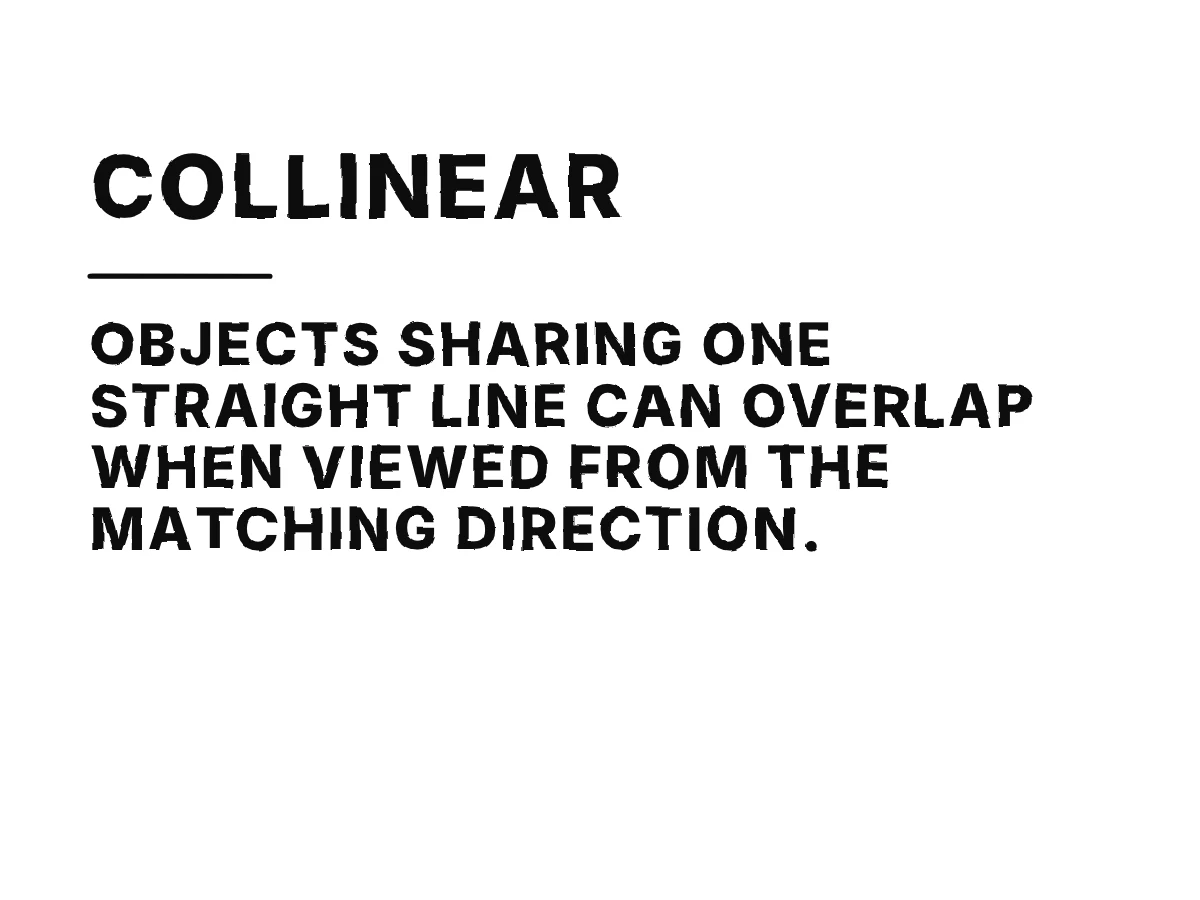
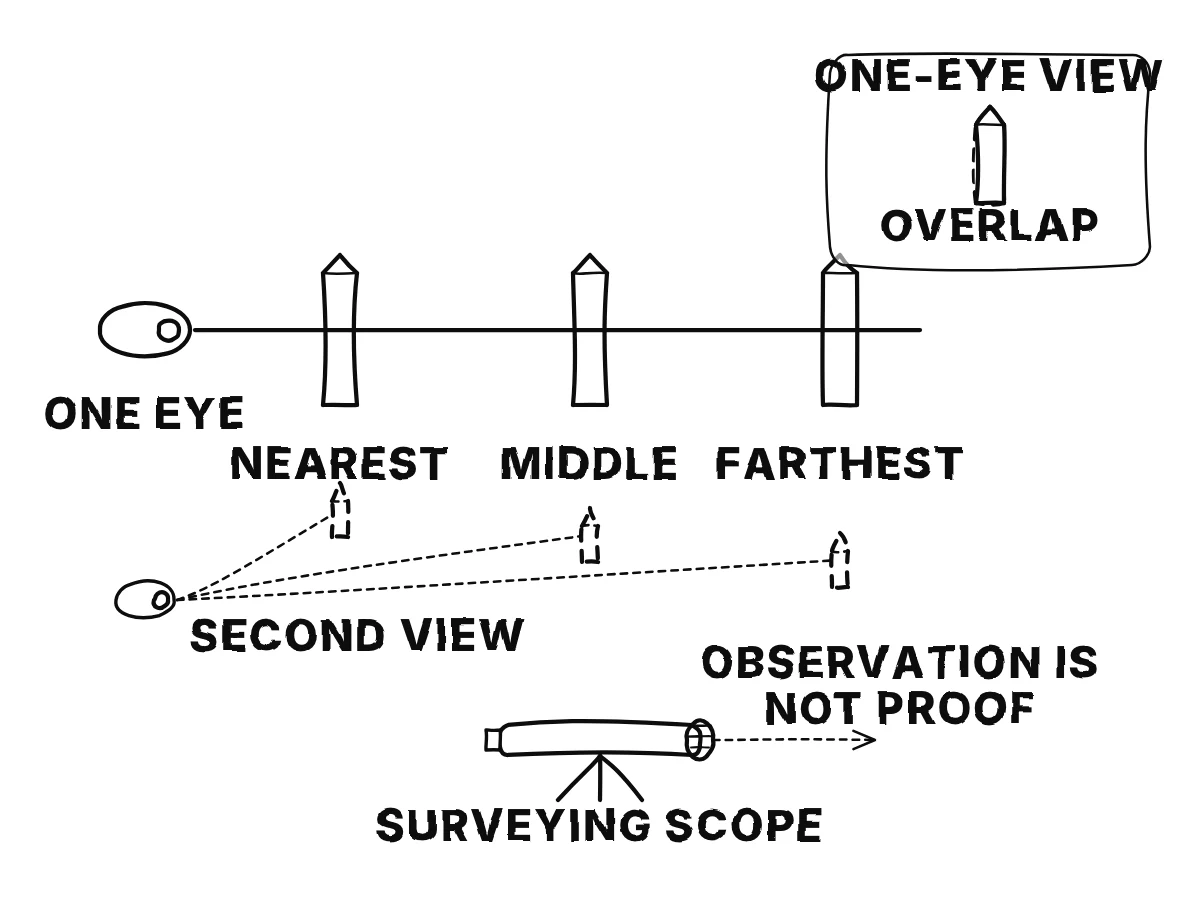
Put three pencils upright in lumps of modeling clay on a table, roughly in a row, and look at them with one eye closed. Move your head slowly from side to side. You expect that, if the pencils are properly arranged, there will be one viewpoint from which the nearest hides the other two. Try it, adjusting the middle pencil if necessary: the three separate shapes finally merge into one narrow silhouette. You have made something visible that you would ordinarily describe by saying, “Those three places lie on a straight line.” But what makes that statement true: the reasoning you learned at school, or what you have just seen?
Proof and Physical World
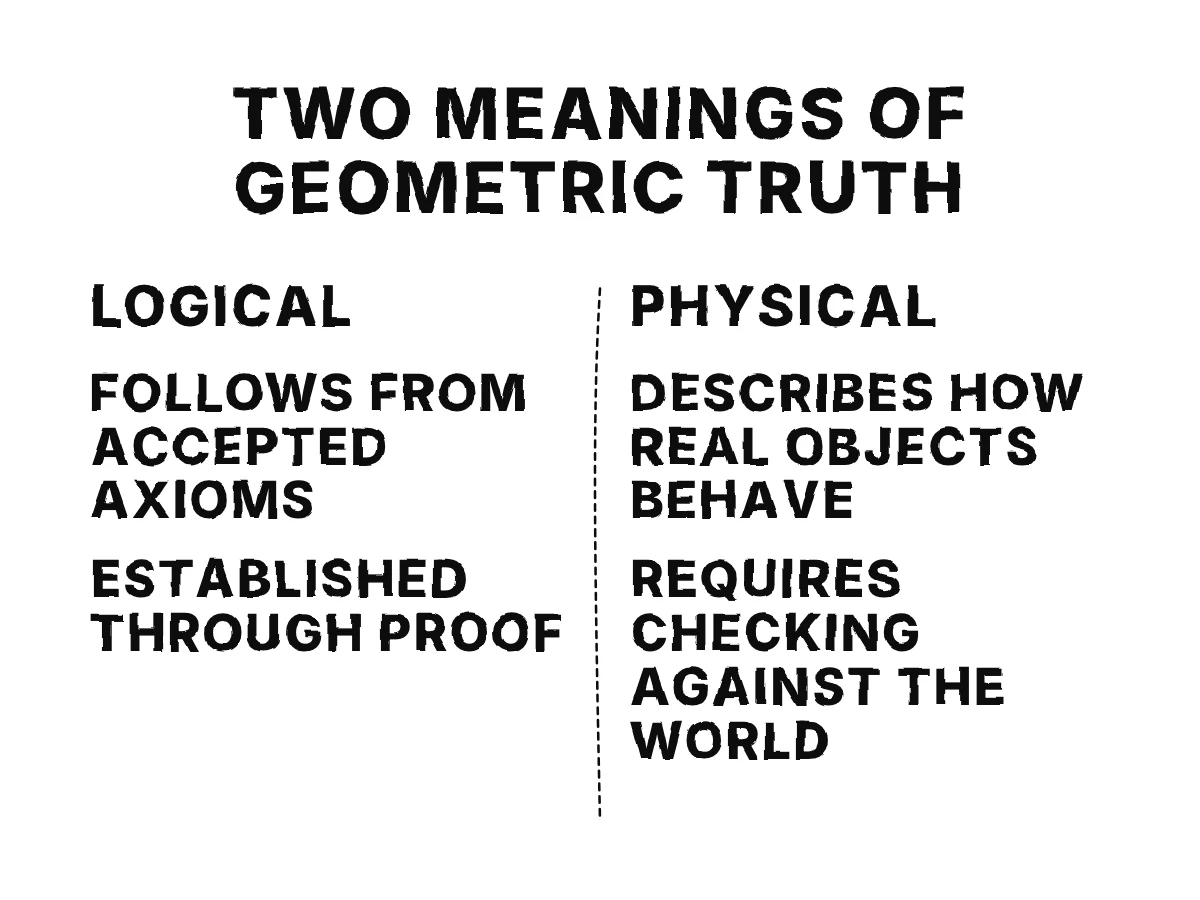
School geometry can leave us with an unusually strong feeling of certainty. A geometrical proof seems to settle a question once and for all, unlike a measurement that might improve with a better instrument. Einstein begins by asking us to examine that certainty rather than merely trust it. When we call a geometrical statement true, do we mean that it follows from certain starting assumptions, or that actual things behave as it says? Those are different claims, and the distinction is the doorway into this book.
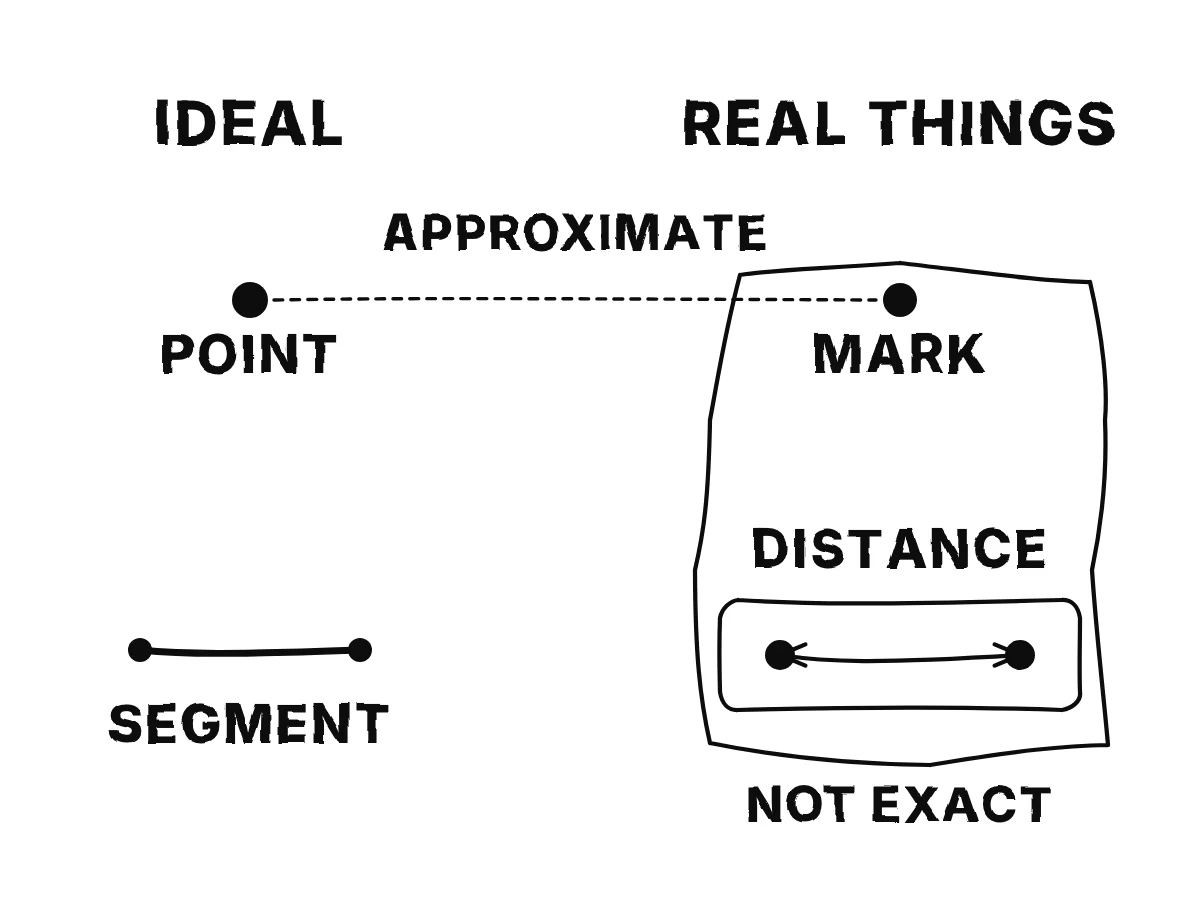
Euclidean geometry, the familiar geometry associated with Euclid, begins with basic concepts such as a point, a straight line, and a plane. A point is an ideal location without size; a straight line is an ideal straight connection, without thickness; a plane is an ideal flat surface. We can picture them, although a pencil dot, a drawn stroke, and a tabletop are only approximate illustrations. Geometry also adopts starting statements called axioms. From these, it derives further statements by logical reasoning. A proof shows that a conclusion follows from the accepted starting statements; it does not, by itself, show that a tabletop or a pencil mark obeys them.
The Proof’s Hooks
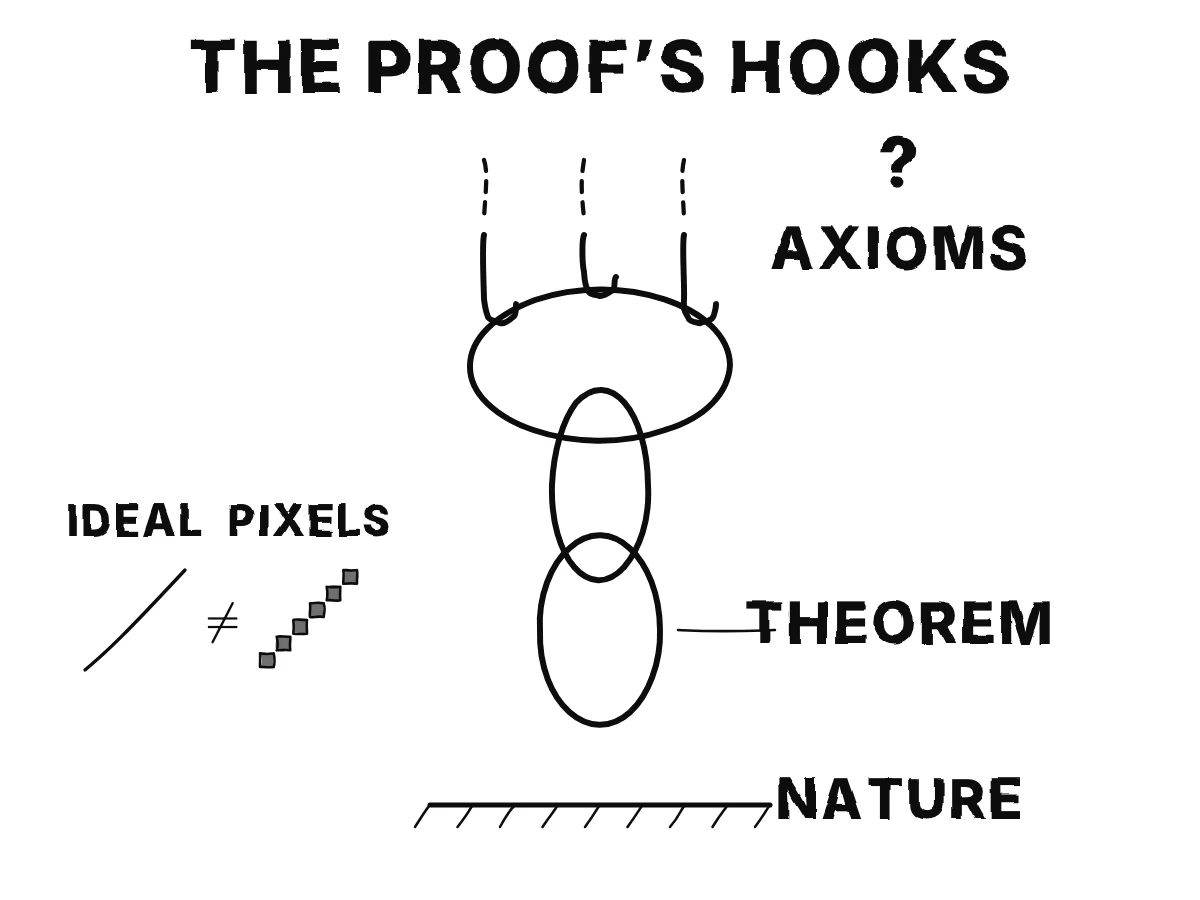
Think of a geometrical proof as a chain suspended from a set of hooks. Checking each link tells you whether the chain holds together, but it does not tell you what the hooks are attached to in the physical world. In the same way, proving a theorem carries the question back to the axioms. If someone then asks whether the axioms themselves agree with nature, more geometrical deduction cannot settle the matter. A modern drawing program makes the distinction easier to picture: its ideal geometrical construction and the imperfect glowing pixels that display it are not the same thing.
One Line, Two Questions
Take the familiar statement that two distinct points determine one straight line. Within Euclidean geometry, this specifies a property of the things the theory calls straight lines. Once the two points are fixed, there is not a choice of different Euclidean straight lines through them. But asking whether that starting property is physically true makes no definite claim until we say what real things will stand for points and lines. A rule governing ideal objects is not yet a report about objects on your desk. That is why Einstein resists applying the word “true,” in the sense of agreement with reality, to pure geometry by itself.
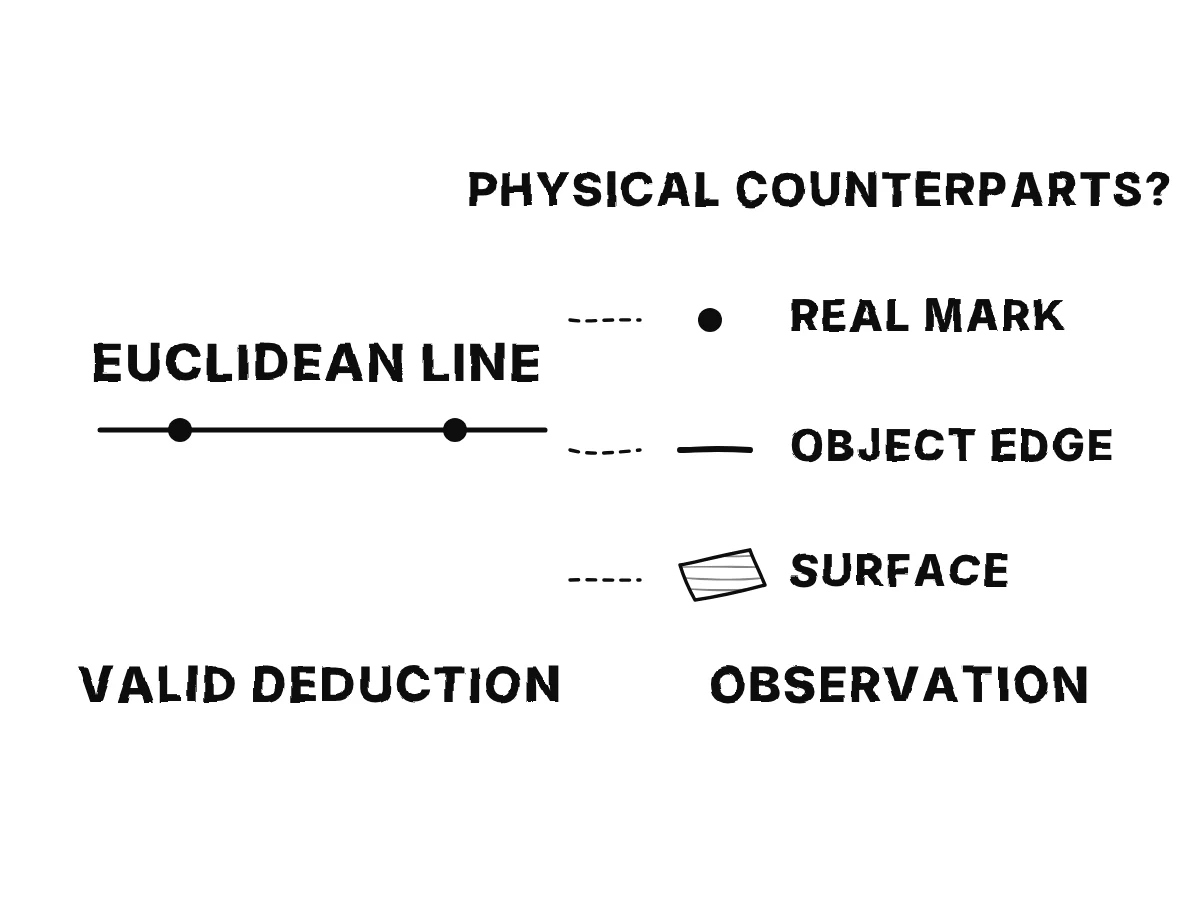
Pure geometry concerns the logical relationships among its concepts. It does not have to say whether a particular mark is a point, whether a particular edge is straight, or whether a particular surface is flat. You could follow a proof perfectly without ever laying a straightedge on a table. Conversely, a beautifully straight-looking table edge cannot prove a theorem. Logical validity and agreement with observation answer different questions, even though everyday speech often gives both answers the same name: truth.
Ideal Concepts, Real Marks
Why, then, does geometry feel so firmly rooted in the world? Because its concepts grew out of our dealings with things, and we habitually connect them with things again. We see a small mark and think of a point. We see two marked places on a solid object and think of a line segment, with a distance between its endpoints. The distance is their separation, represented physically by those marks on the object. Nature supplies approximate counterparts to the ideal concepts, not perfect copies of them.
Testing Alignment
Return to the three pencils. Our ordinary test for three places lying on one straight line is that, from a suitable viewpoint, their apparent positions can coincide when we look with one eye. Closing the other eye matters because it removes the second viewpoint, from which the pencils may still appear separated. The picture is simple: your eye comes first, then the nearest pencil, then the middle one, then the farthest, all hidden behind one another. An optical alignment instrument used in surveying makes a more precise version of this familiar judgment. Neither the home test nor the instrument turns observation into a proof; each connects a geometrical concept with something observable.
A Body Carries Distance
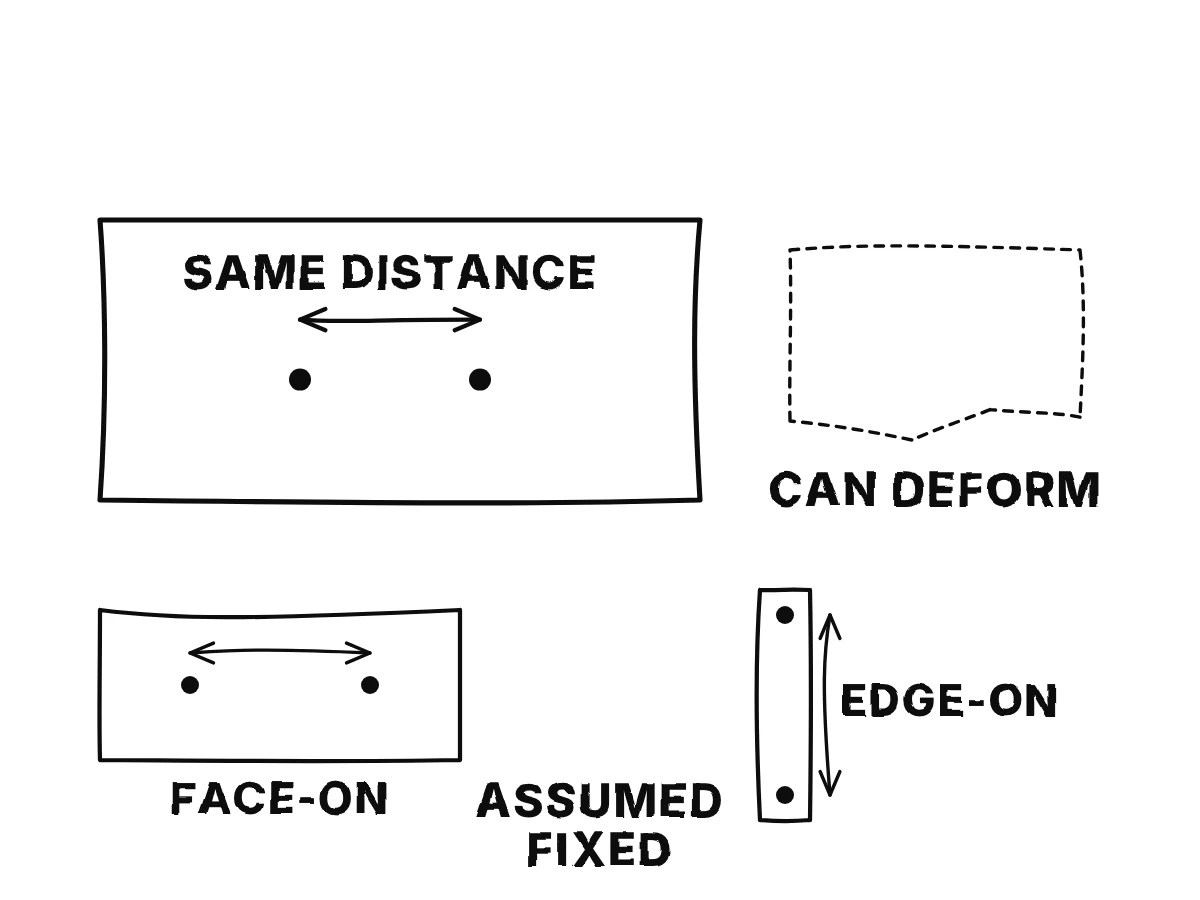
Now we need one additional connection between ideal geometry and physical things. Consider two marks on a practically rigid body, meaning an object solid enough to preserve its shape for the purpose at hand. Imagine two tiny ink dots on a sturdy metal plate. We assume that the same distance belongs to those two dots however we change the plate’s position or turn it around. Face up, edge on, or carried to another table, the plate is taken to preserve the separation of its marks. We are not yet describing a procedure for measuring that separation; we are stating the physical assumption that makes such uses of geometry possible.
Notice how much that assumption adds. Euclidean geometry alone does not guarantee that a metal plate keeps its shape when you move it. The added claim says that a real body can carry fixed geometrical relationships with it. In modern engineering, treating a solid component as rigid serves the same practical purpose, although actual components can bend or expand. “Practically rigid” therefore means sufficiently unchanging under the conditions considered, not perfectly immune to every physical influence.
Geometry Enters Physics
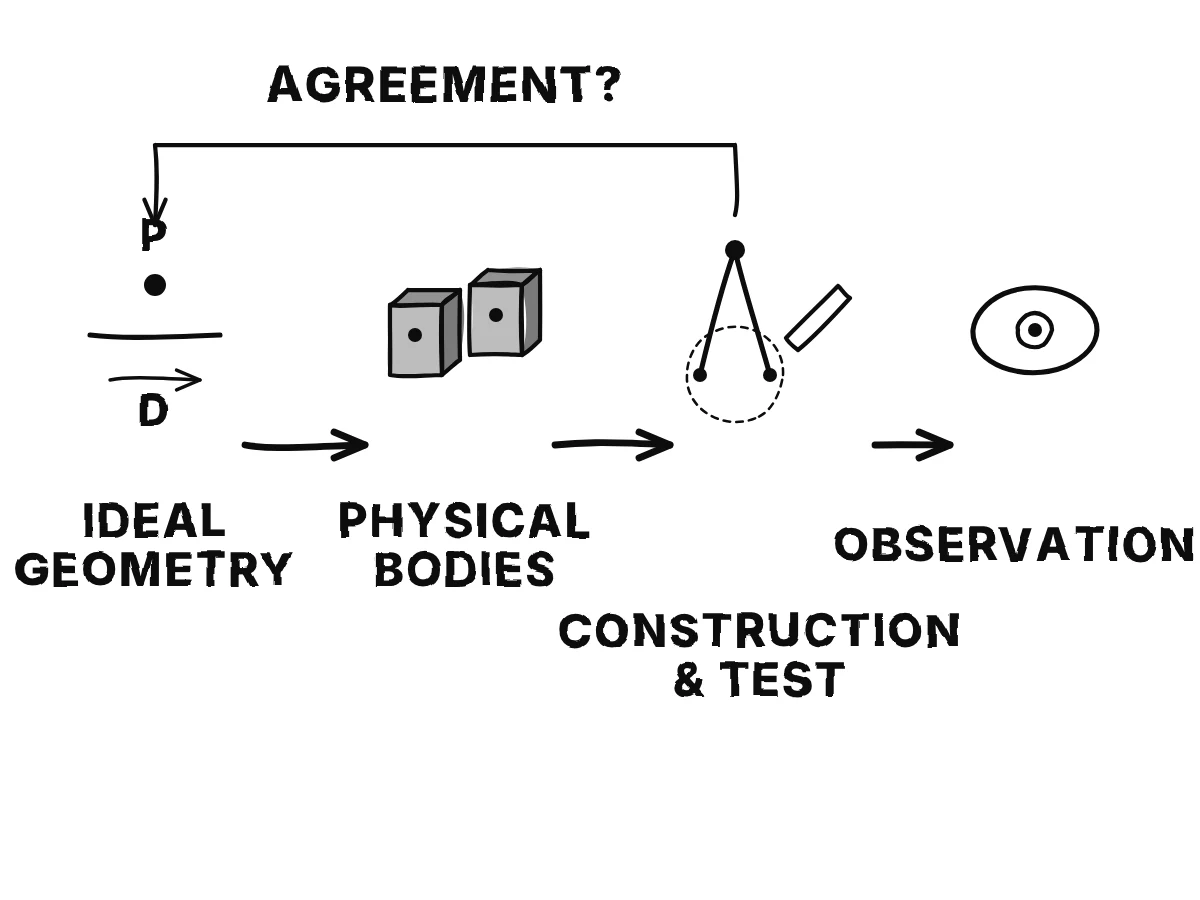
Once this link is added, geometrical statements become statements about the possible arrangements of practically rigid bodies. The ideal drawing now has physical representatives: marks, edges, and solid objects that can be placed beside one another. Geometry interpreted in this way becomes a branch of physics. We can ask whether real constructions agree with its predictions, because we have said what in the world those predictions concern. Roughly speaking, geometrical truth now means that a construction made with a compass and straightedge works as the geometry says it should.
Construction Meets Experience
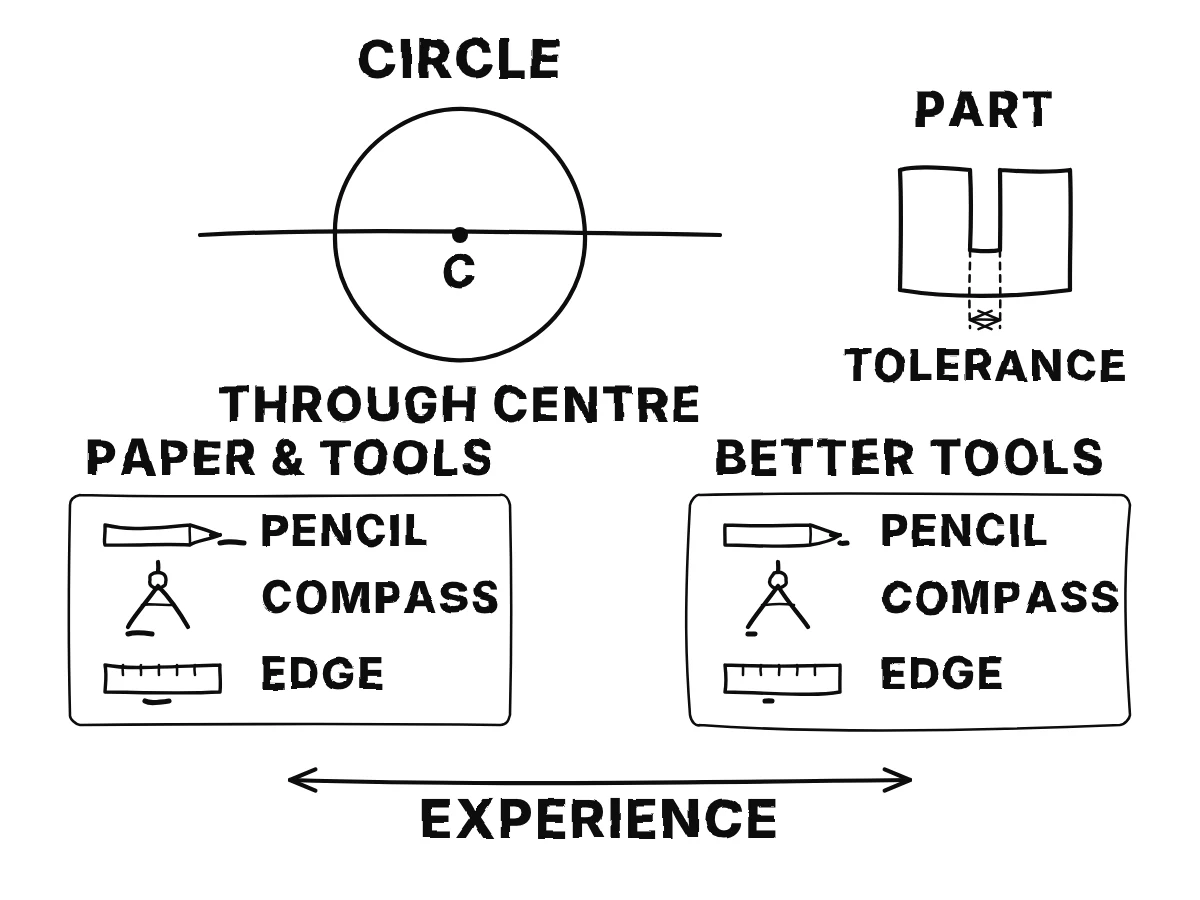
Picture drawing a circle with a compass, then drawing a straight line through its center with a straightedge. The reasoning concerns an ideal circle and an ideal line, while your test concerns graphite, paper, and tools. A blunt pencil, a slipping compass point, or an uneven edge limits what the construction can establish. Even a digital design eventually meets physical tolerances when a machine makes the part. Better tools improve the comparison, but they do not change its character: agreement with the physical world is learned from experience.
Provisional Confidence
Einstein therefore accepts the physical applicability of Euclidean geometry provisionally. Its success rests on experience, and that experience is inevitably imperfect. This is not a reason to discard the geometry that works so well in ordinary constructions. It is a reason to distinguish confidence supported by observation from necessity established within a proof. Later, in general relativity, Einstein will return to the limits of that physical applicability. For now, the assumption stays in place, but it is an assumption open to testing, not a command that nature must obey.
Geometry and the World
Where it is in the book: § 1. Physikalischer Inhalt geometrischer Sätze. · pages 1–3 (estimated) · Gewiß hast auch du, lieber Leser, als Knabe oder Mädchen mit dem stolzen Gebäude der Geometrie Euklids Bekanntschaft gemacht und erinnerst…
Questions
What does a successful geometrical proof establish?
The conclusion follows from the accepted axioms.
Real objects must obey the conclusion exactly.
The axioms have been confirmed by observation.
Show the answer
Answer: The conclusion follows from the accepted axioms.. A proof checks the logical chain from the accepted starting statements. It does not, by itself, show that physical objects obey them.
Why does adding the assumption about practically rigid bodies make geometry physically testable?
It removes the imperfections of physical measuring tools.
It connects ideal distances with marks on real objects.
It proves the axioms without relying on observation.
Show the answer
Answer: It connects ideal distances with marks on real objects.. The added assumption says that a real body can carry fixed geometrical relationships with it. We can then compare geometrical predictions with real arrangements.
What does seeing three places coincide from a suitable viewpoint with one eye establish?
A deduction that the Euclidean axioms must be true.
An exact replacement for every geometrical proof.
An observable connection with the idea of a straight line.
Show the answer
Answer: An observable connection with the idea of a straight line.. The alignment test connects a geometrical concept with something observable. It does not turn observation into a proof.
Why is the physical applicability of Euclidean geometry accepted only provisionally?
It rests on experience that is inevitably imperfect.
Its theorems cannot be derived from starting assumptions.
Its ideal concepts have no counterparts in nature.
Show the answer
Answer: It rests on experience that is inevitably imperfect.. Agreement with real constructions is learned from experience, not guaranteed by deduction. That leaves its physical applicability open to testing.
Practice
Someone says, “Two points determine one straight line, so nature must obey this statement.” Explain what is missing from the argument.
Show the answer
Hint: First distinguish a property of ideal straight lines from a claim about real things.
Answer: Within Euclidean geometry, the statement specifies a property of what the theory calls straight lines. To make a physical claim, we must say which real things stand for points and lines, then ask whether observation agrees. Deduction alone cannot settle that agreement.
Two marked places on a practically rigid body are assigned a distance. You then move and turn the body. What must be assumed if those marks are to keep representing the same geometrical segment, and why is this more than pure geometry?
Show the answer
Hint: Ask what must remain unchanged when the body changes position.
Answer: We assume that the distance between the two marks remains the same despite changes in the body's position. This is a claim about a real body, not merely a logical relationship among ideal concepts. Adding it lets geometry describe physical arrangements and be tested against experience.
A construction with a compass and straightedge agrees with a geometrical prediction. Explain why this supports the geometry's physical applicability without making that applicability certain.
Show the answer
Hint: Separate what the proof establishes from what the tools let you observe.
Answer: The construction supplies experience showing that real things behave approximately as the geometry predicts. But tools and observations are imperfect, so the agreement is not the necessity established within a proof. It supports using the geometry while leaving room to discover limits.
8 min · 1327 words
2
Giving a Place Three Numbers
Measuring by Repetition
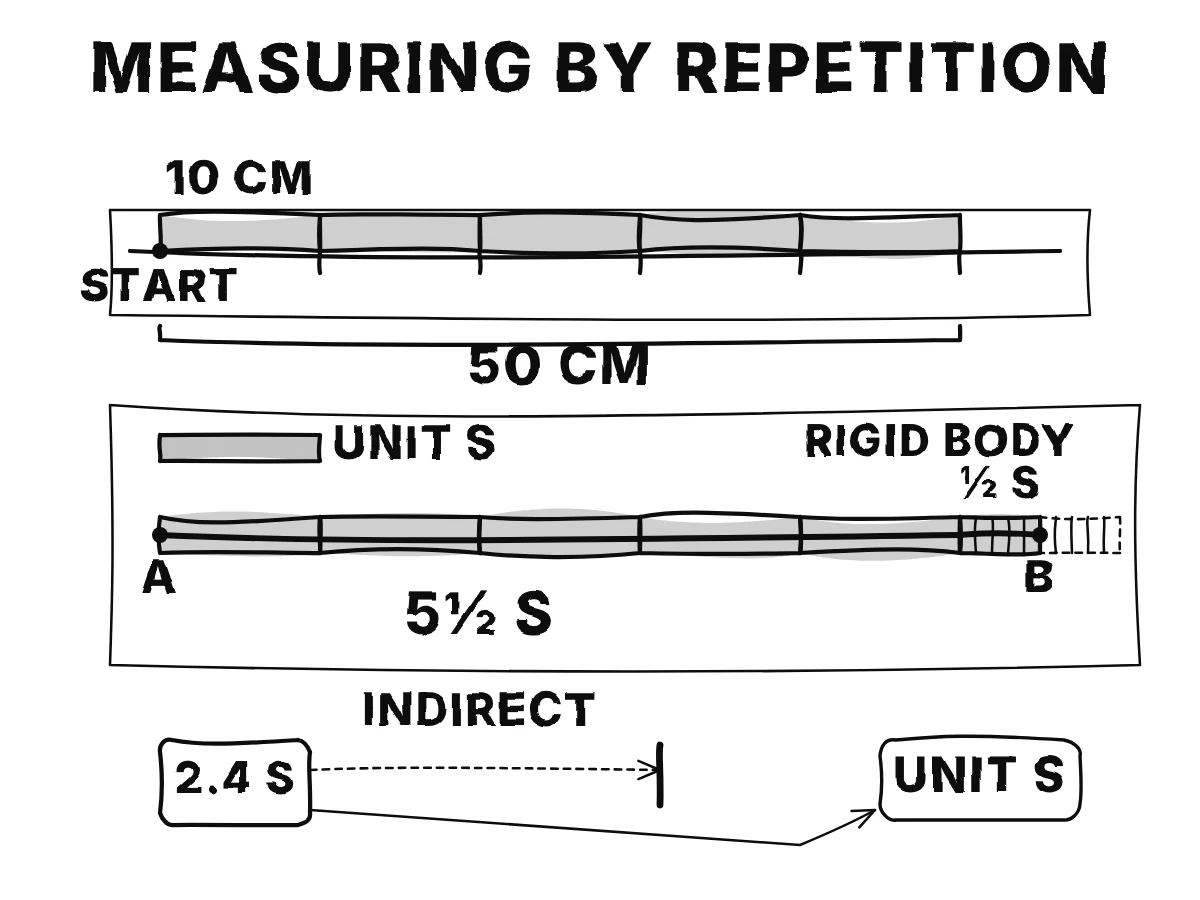
How can a short strip of card tell you the length of a table much longer than itself? Cut a strip 10 centimetres long, and mark a starting point near one end of the table. You expect that laying the strip down repeatedly, end to end, will carry its small length across the larger surface. Try it: each placement gives you a new mark, and five careful placements bring you 50 centimetres from the start. The distance has become a number through an operation you can repeat.
Einstein begins with precisely this operation, using a standard rod called S whose length is retained as the unit. Two points, A and B, are marked on a rigid body, and geometry supplies the straight connection between them. Starting at the first point, you lay the rod along that connection, then move it forward so that its beginning coincides with its previous endpoint. The number of placements needed to reach the second point is the numerical measure of the segment AB in the chosen unit. If the rod fits five times, the separation is five rod-lengths; with your 10-centimetre strip, that means 50 centimetres.
The count works because every placement is supposed to contribute the same length. A strip that stretches, or a careless gap between placements, would spoil that connection between counting and distance. If a whole number of rods does not fit exactly, you compare the remainder with subdivisions of the unit. A modern laser distance meter does not require you to shuffle a rod across the room, but its reading still expresses a length in agreed units. Its method is indirect; the meaning of its answer remains a comparison with a standard length.
A Place on the Ground
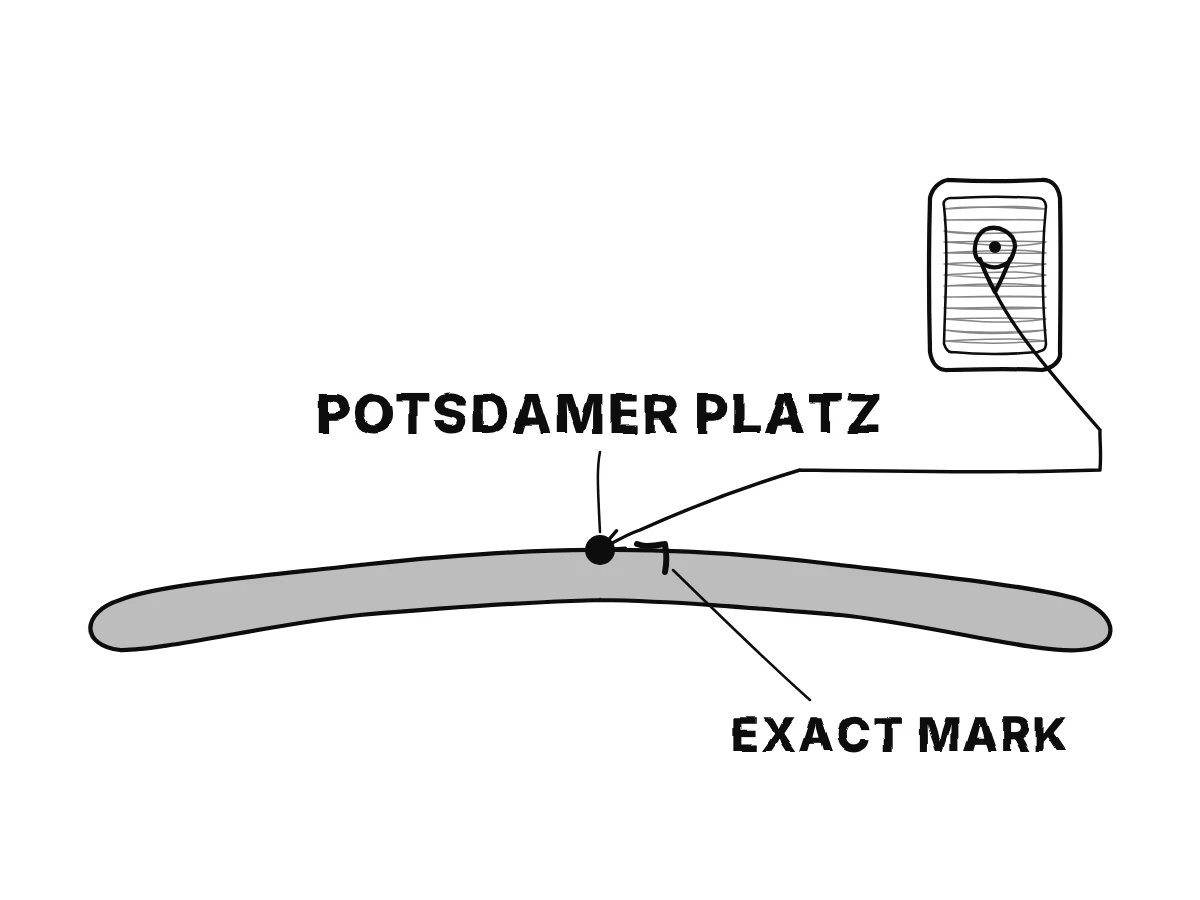
Now suppose you arrange to meet someone at Potsdamer Platz in Berlin. That sounds like a place specified without any measuring equipment, yet it has a physical structure. For this purpose, the Earth's surface serves as the rigid reference body, and the named square identifies a recognisable location on it. To say that an event happens there is to say that it spatially coincides with that location on the reference body. For a more precise meeting, you might name a particular corner or a mark in the pavement.
Your phone's map makes that everyday procedure familiar in a newer form. A labelled meeting point is useful because it identifies a location relative to the ground, not because its name supplies an independent piece of space. The name is a label attached to the reference body. But this way of specifying position has two restrictions: it needs identifiable landmarks, and it directly names only places on the body's surface. How would you use it to locate a cloud above the square?
Locating a Cloud Above
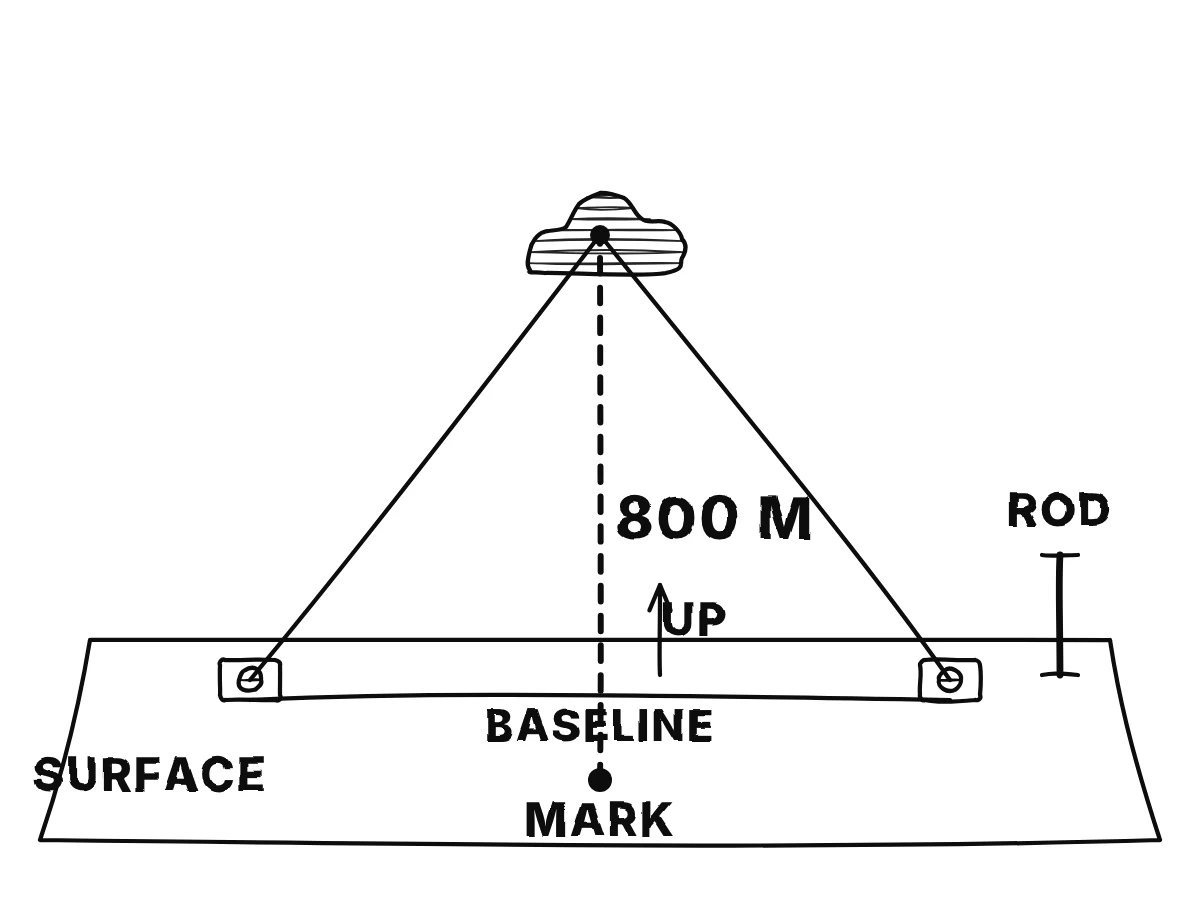
Picture a vertical pole planted at a definite point in the square and extending upward until its tip reaches the cloud. The position of the pole's foot tells you where to start, and the pole's measured length tells you how far upward to go. If its foot is at your chosen pavement mark and its length is 800 metres, the indicated point of the cloud is 800 metres above that mark. The number alone would not be enough, since many points can have that height. The named starting point, the upward direction, and the measured length together complete the description.
Notice the three changes hidden in that picture. First, you extend the reference body, in imagination, until it reaches the object whose position you want. Second, a measured number replaces the need to invent a separate name for every possible point along the pole. Third, you can state the height even when nobody has built the pole. The pole gives a physical meaning to the height, without having to stand there in reality.
Einstein's example of finding that height uses optical observations of the cloud from different places on the ground. Imagine two cameras looking toward the same identifiable feature, with the separation and viewing directions of the cameras known. Their two lines of sight allow you, using geometry and the propagation of light, to work out where that feature lies and how long the imagined pole would have to be. Modern stereo imaging uses this same broad principle of obtaining depth from different viewpoints. The measurement is indirect, but its answer still concerns a length that could be represented by a rod.
Three Distances, One Point
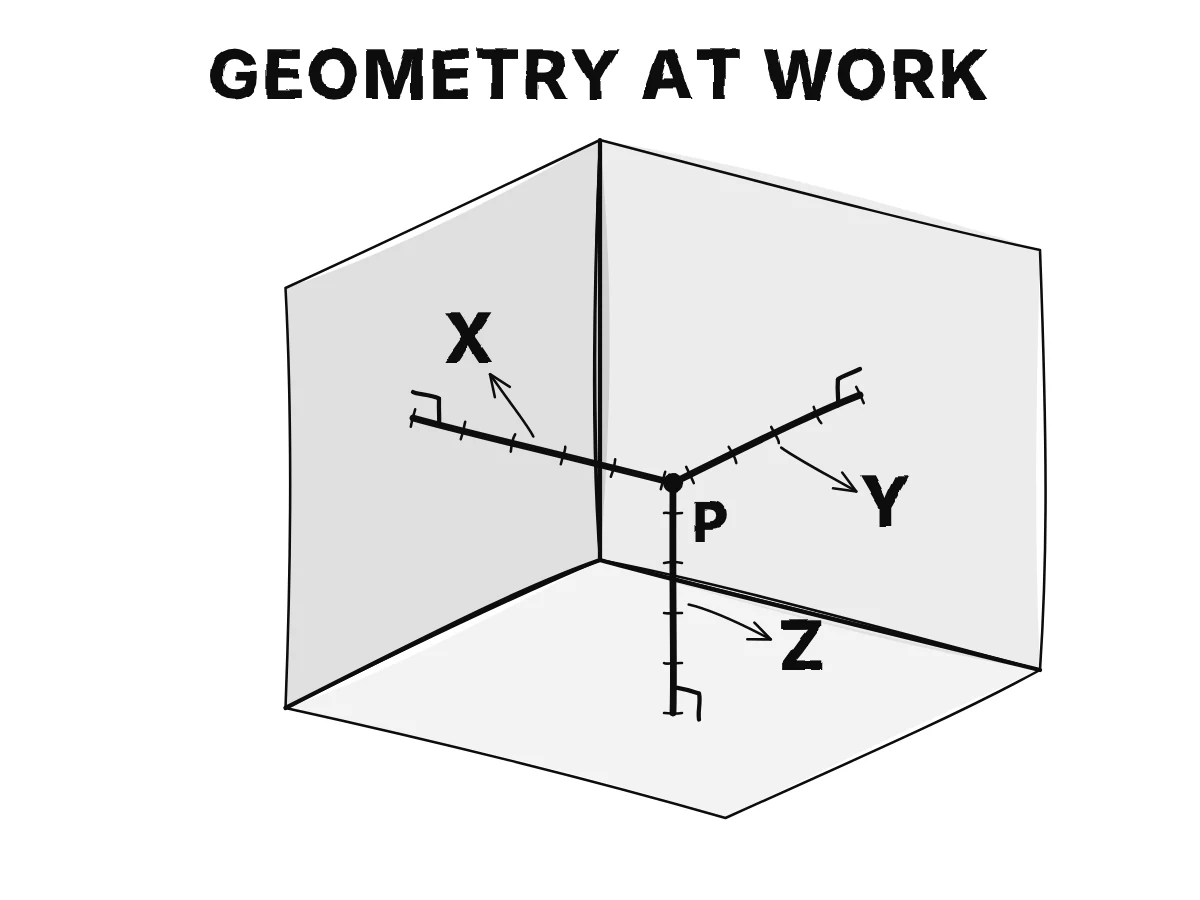
Numbers can free us from named landmarks much more systematically than a single height does. Picture a room corner: a floor and two flat walls, each meeting the other two at right angles, all held together as one rigid structure. Einstein's Cartesian coordinate system consists of three such mutually perpendicular plane walls. To extend the picture beyond an actual room, imagine the surfaces continuing as far as necessary. They form a reference body against which you can specify a location, rather than a collection of names for individual places.
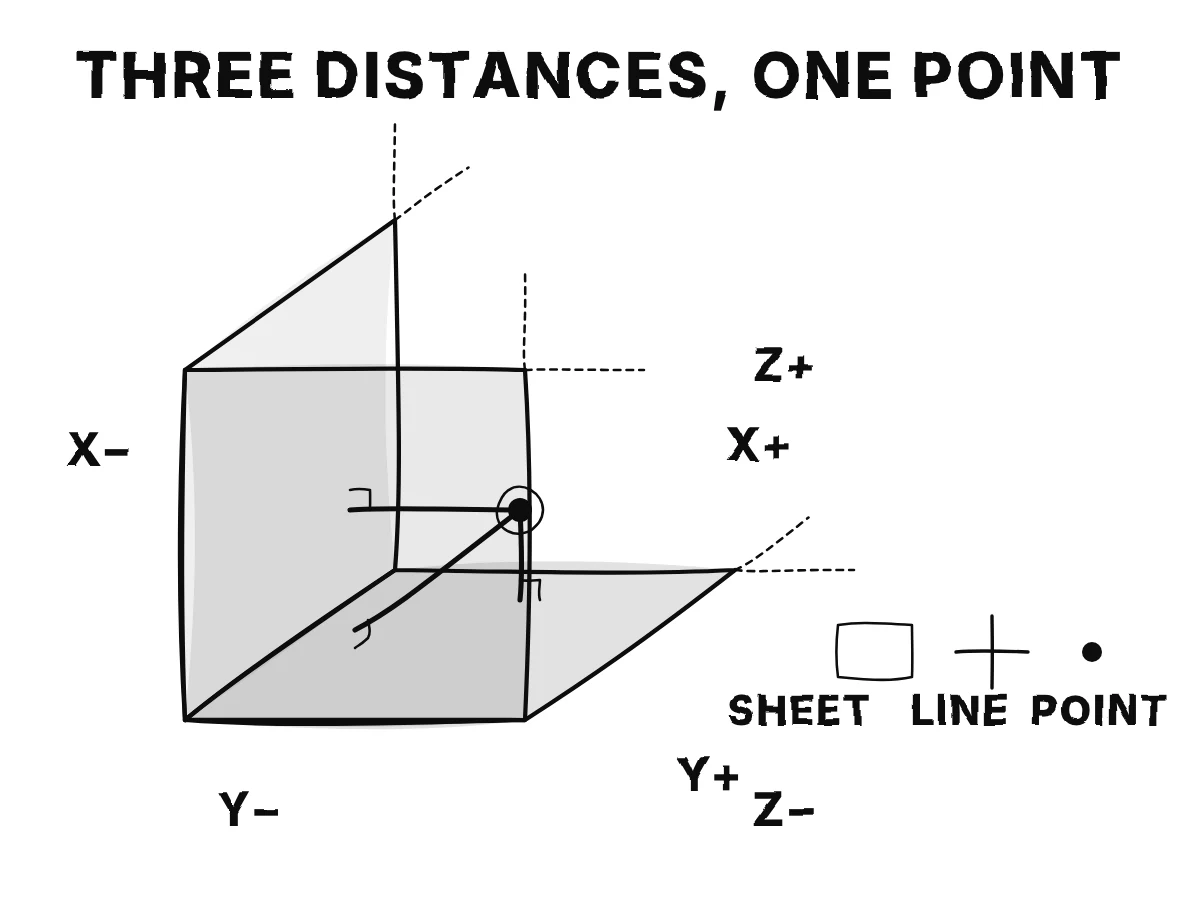
Imagine a tiny flash occurring inside this room. From the flash, picture the shortest straight connection to each of the three surfaces, meeting that surface at a right angle. These are perpendicular segments, and their three lengths are the coordinates (x, y, z). Here x denotes the distance to one wall, y the distance to the other wall, and z the distance to the floor. The coordinate triple says, in numbers, how far the event lies from each reference surface.
Suppose those distances are 2 metres, 3 metres, and 1 metre. Starting at the corner, go 2 metres away from the first wall, 3 metres away from the second, and 1 metre above the floor. The first distance alone leaves a whole sheet of possible positions; adding the second narrows that sheet to a line, and the third selects a point. That is the intuition behind using three coordinates to specify a position in three-dimensional surroundings. Within the room, the triple identifies the point; if we extend the system through the walls, we must also distinguish which side of each plane we mean.
Geometry Makes Measurement Work
Why may those three measurements be combined in this way? As in the earlier discussion, we are assuming that Euclidean geometry applies to the distances physically represented by rigid bodies. Its rules tell us how to construct perpendiculars and how to connect measurements made with rigid rods. In principle, the three coordinate lengths could therefore be found through a succession of rod placements and geometrical constructions. The geometry is doing practical work here: it licenses the route from physical comparisons of length to a description of position.
Coordinates Without Built Walls
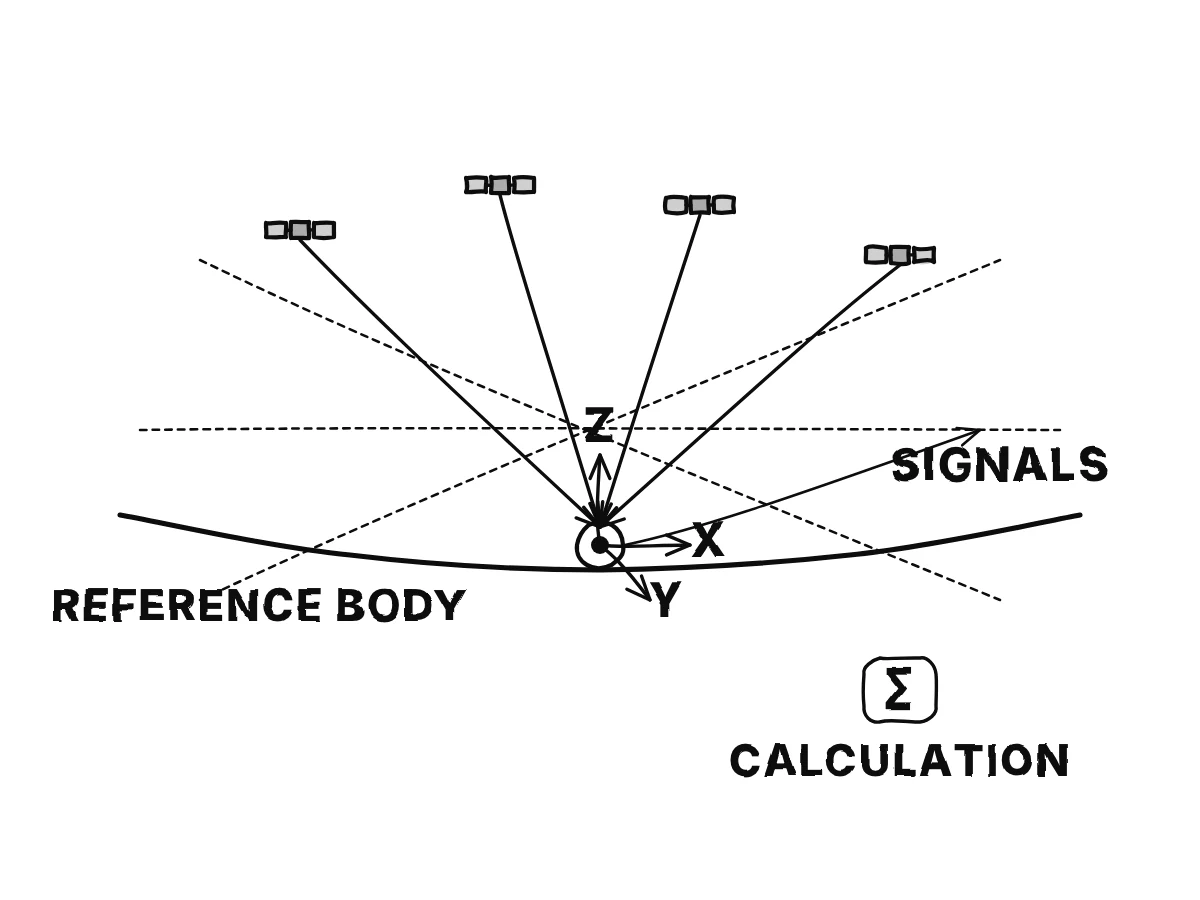
In physics and astronomy, the three enormous walls are usually not built, and the coordinates are usually not obtained by laying down rods. Satellite navigation is a modern instance: signals and calculations provide coordinates without anyone constructing reference walls around the receiver. The reference system and the procedures are more elaborate, but the numbers must still have a definite physical meaning. An indirect method does not remove the need to say what its result locates and relative to what. Behind the numerical description remains a reference body, real or ideally extended, and the assumed geometrical relations between measurable distances.
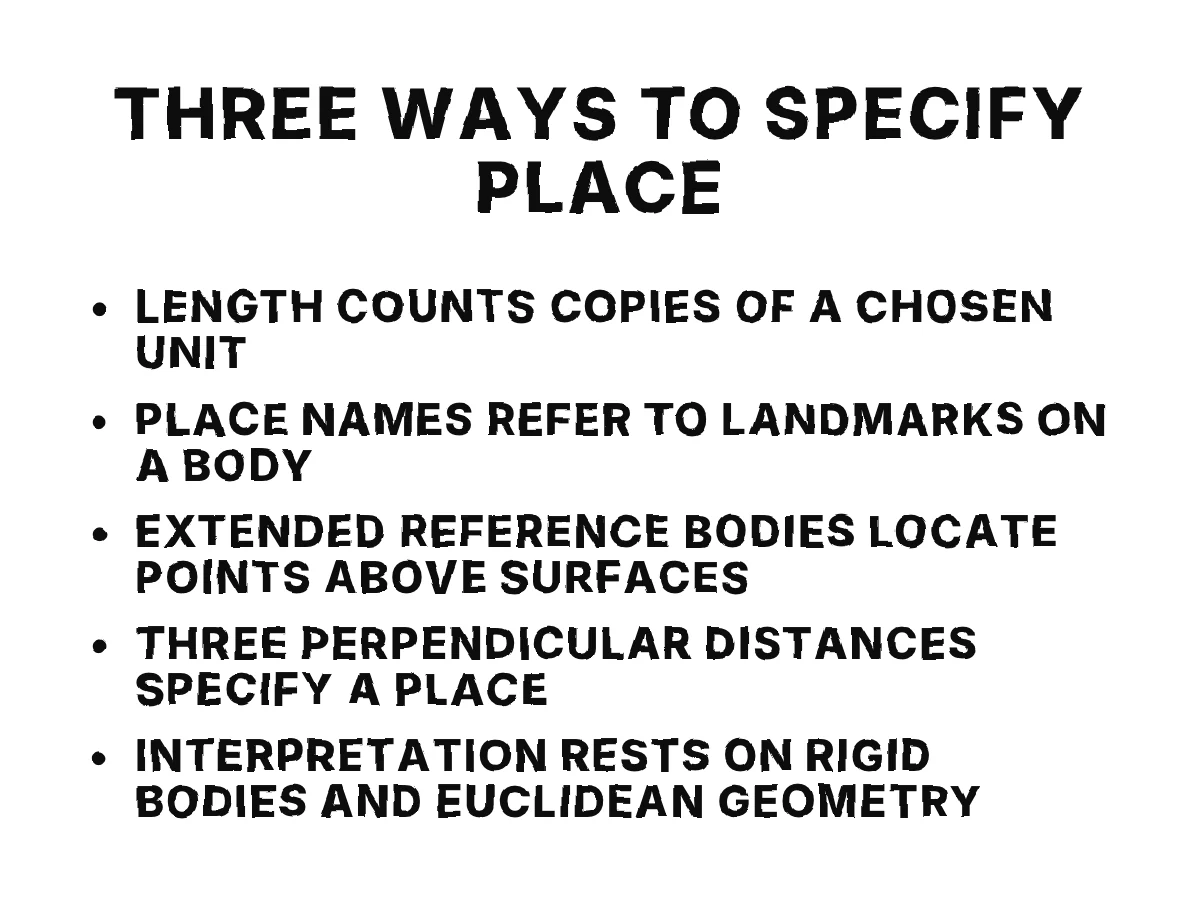
Three Ways to Specify Place
Where it is in the book: § 2. Das Koordinatensystem. · pages 3–5 (estimated) · Auf Grund der angedeuteten physikalischen Interpretation des Abstandes sind wir auch in der Lage, den Abstand zweier Punkte eines starren…
Questions
Why does counting placements of a standard rod give a measure of distance?
Each placement contributes the same length along the connection.
Each placement gives the next point a recognisable name.
Each placement makes the reference body extend farther.
Show the answer
Answer: Each placement contributes the same length along the connection.. The count works because every placement contributes the same length. Stretching the rod or leaving gaps would spoil the connection between counting and distance.
Why is a cloud's height alone not a complete description of its position?
A height has meaning only when a real pole reaches the cloud.
Many points can have that height above different starting points.
A height must be replaced by a named landmark in the cloud.
Show the answer
Answer: Many points can have that height above different starting points.. You also need to say where to start and which direction to go. The starting point, upward direction, and measured length together complete the description.
If coordinates are found indirectly rather than with rods and actual walls, what remains necessary?
Every position must also have its own named landmark.
The reference surfaces must eventually be physically built.
The numbers must locate something relative to a reference body.
Show the answer
Answer: The numbers must locate something relative to a reference body.. An indirect method does not remove the need to say what its result locates and relative to what. The numbers retain their physical interpretation through measurable distances and geometrical relations.
Worked examples
Locating a cloud from the book
A cloud is above Potsdamer Platz. Explain how to give its position relative to the Earth's surface, and why you do not actually have to build a pole.
Show the answer
Choose a definite point in the square as the pole's foot, because you need a fixed starting location on the reference body.
Imagine a vertical pole reaching the cloud, because extending the reference body lets you describe a point beyond its surface.
Specify the pole's length together with its foot and upward direction, because height alone leaves many possible positions.
Use optical observations from different ground locations to determine the required length, because geometry and the propagation of light allow an indirect measurement.
Answer: The cloud's indicated point is located by the pole's foot, the upward direction, and the pole's length. The pole need not exist: it supplies the physical meaning of the indirectly determined height.
Practice
Inside the room-corner coordinate system, you know a flash's perpendicular distances from both walls but not from the floor. Have you located a unique point? Explain what the missing measurement would add.
Show the answer
Hint: Think about the possible positions left after the first distance and then the second.
Answer: No. The first distance leaves a sheet of possible positions, and the second narrows it to a line. The distance from the floor selects a point on that line within the room.
You measure a segment by repeatedly placing the standard rod S along its straight connection. Partway through, you replace S with a rod of a different length but continue counting placements as before. Does the total count still measure the segment in units of S? Explain.
Show the answer
Hint: Ask what every counted placement must contribute for the count to represent one chosen unit.
Answer: No. A count in units of S requires every placement to contribute the length of S. With different lengths contributing to the same count, the count alone no longer tells you how many copies of S fit along the segment.
8 min · 1353 words
3
One Fall, Two Paths
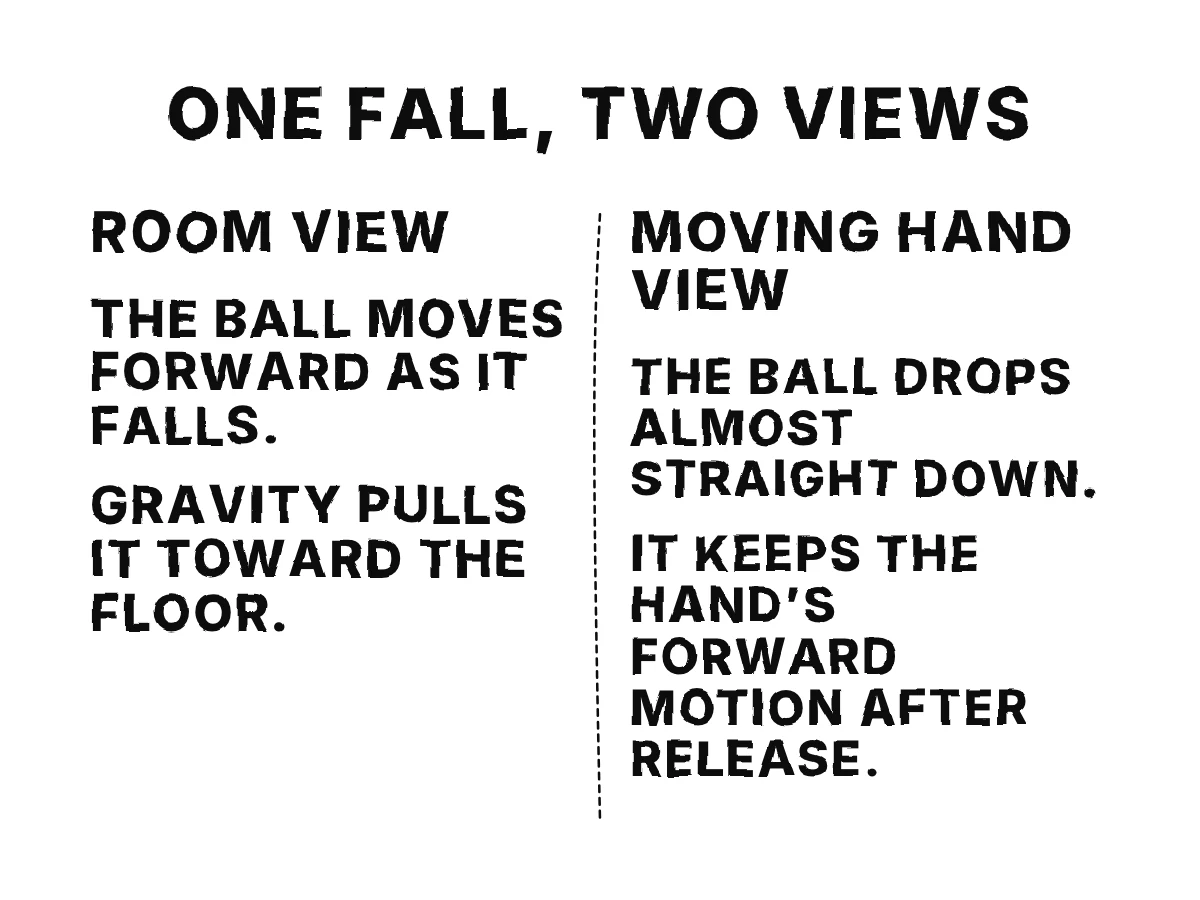
One Fall, Two Views
Walk steadily across a room with a soft ball held in front of you, release it without throwing it, and keep your hand moving forward. Have someone record the fall from the side with a stationary phone. You might expect a ball simply let go to fall straight down toward the floor beneath its release point. But the recording shows it moving forward while falling, whereas, relative to your steadily moving hand, it drops almost straight down. How can the same fall have two different shapes?
The ball already shares your forward motion before you release it. Opening your fingers removes its support; it does not erase that forward motion. Gravity makes it fall, while it continues to travel across the room. For a clean comparison, neglect air resistance and keep your own motion as steady and straight as possible. The phone recording then gives you a modern version of the puzzle Einstein poses with a railway carriage and a stone.
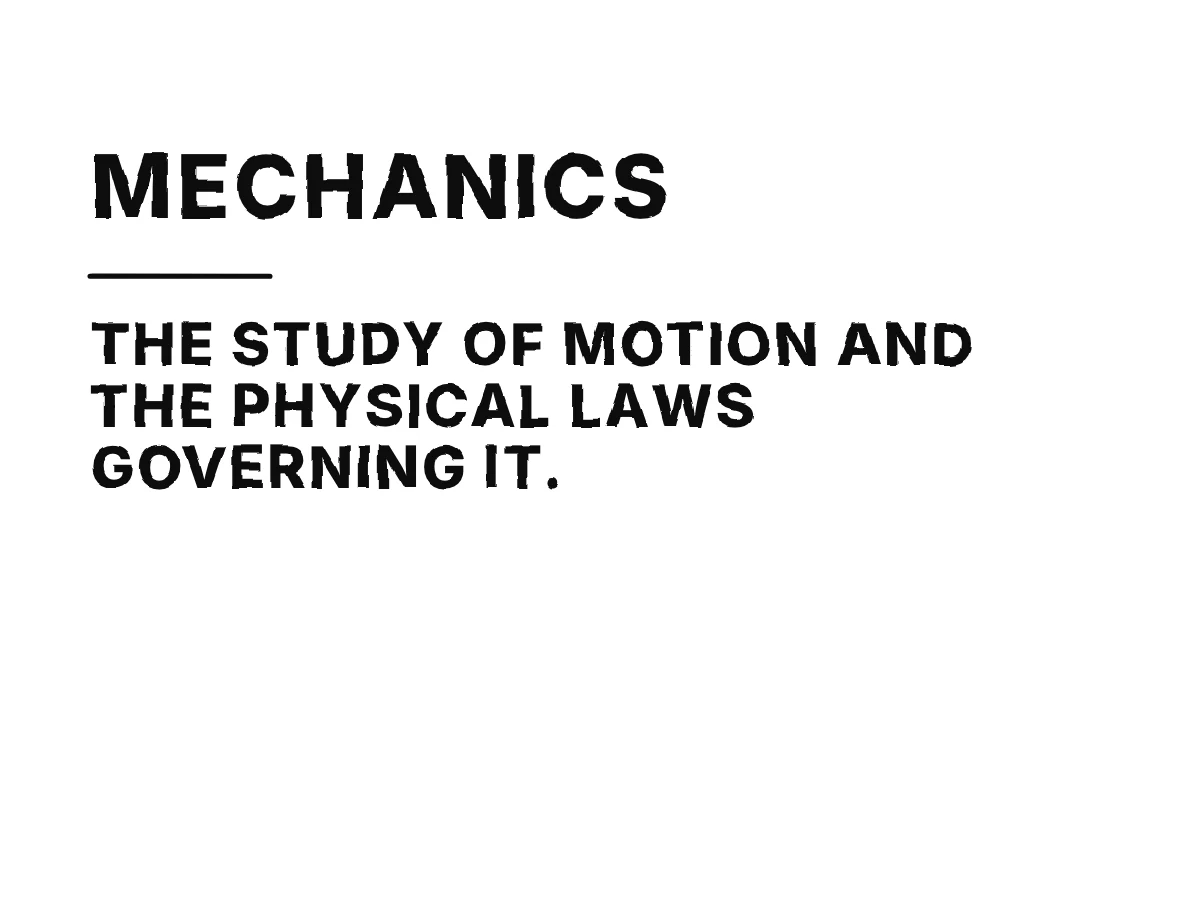
Mechanics
Einstein begins by questioning a seemingly harmless definition: mechanics describes how bodies change their positions in space as time passes. Mechanics is the study of motion and the physical laws governing it. But before that definition can be useful, we must know what counts as a position, what “in space” means, and how time is measured. As we have already seen, a position needs a reference body. The falling stone makes the cost of leaving that body unnamed immediately visible.
Paths Depend on Reference
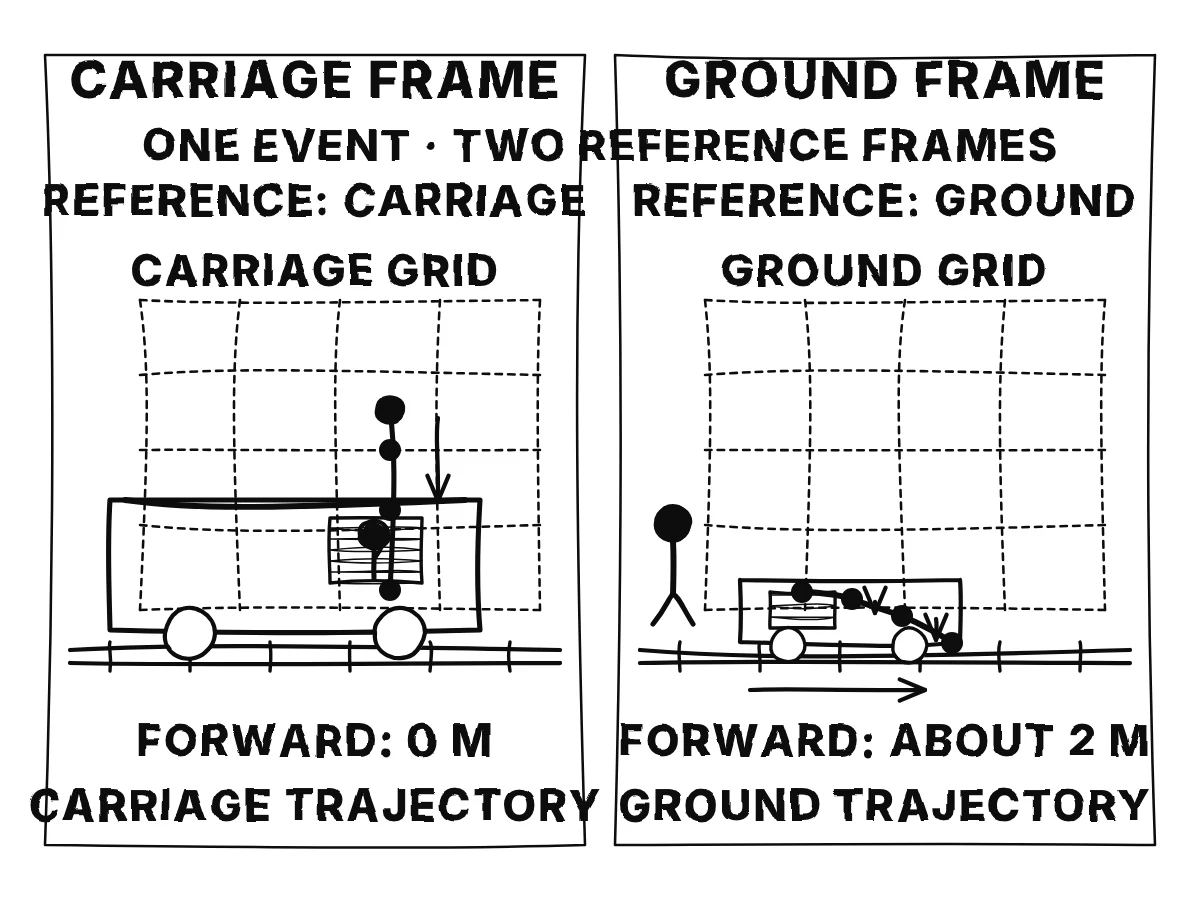
Picture a railway carriage moving uniformly along a straight stretch of track. At its window, a passenger holds a stone, then releases it without giving it a push. Ignore air resistance, and imagine that the carriage continues smoothly at the same speed. To the passenger, the stone drops along a straight vertical line beside the carriage. Now picture a pedestrian standing beside the track and watching exactly the same release. For that observer, the stone moves forward as it descends, tracing a parabola: a curve that bends increasingly downward.
Nothing has happened twice, and neither observer needs to have made a mistake. The passenger compares the stone with the carriage, which continues moving forward alongside it. The pedestrian compares the stone with the ground, so the stone’s forward travel remains part of the description. A parabola is the curved path produced here by steady horizontal motion combined with an increasingly rapid downward fall. The straight path and the curved path belong to the same event, described against different reference bodies.
To picture the difference, imagine marking the stone’s position at several successive instants. On a transparent sheet attached to the carriage, the marks would lie one below another. On a sheet fixed beside the track, they would advance horizontally as well as downward, making a descending curve. If the marks represent equal time intervals, their horizontal spacing on the ground-fixed sheet is equal, while the downward gaps grow. That growing downward separation records the stone’s acceleration under gravity. Changing the reference body changes the pattern of positions, not the stone that is falling.
Suppose, for a simple illustration, that the carriage travels 2 metres during the stone’s fall. Relative to the ground, the stone also travels about 2 metres forward before reaching the ground. Relative to the carriage, it has no forward displacement, under our ideal assumptions. Asking whether its path is “really” straight or “really” curved therefore leaves out something essential. It is rather like asking whether a marker moves on your phone screen without saying whether the map stays fixed or scrolls along with you. We need to know what the motion is being compared with.
Einstein’s remedy is to replace the vague phrase “motion in space” with motion relative to a specified, practically rigid reference body. For mathematical work, we attach a coordinate system to that body. Imagine the carriage carrying its own invisible grid, while the ground carries another grid that does not travel with the train. The stone’s positions in the carriage grid form a straight line; its positions in the ground grid form a parabola. There is no trajectory, or path of motion, standing on its own independently of such a choice. A trajectory is always a trajectory relative to something specified.
A Physical Test for Straightness
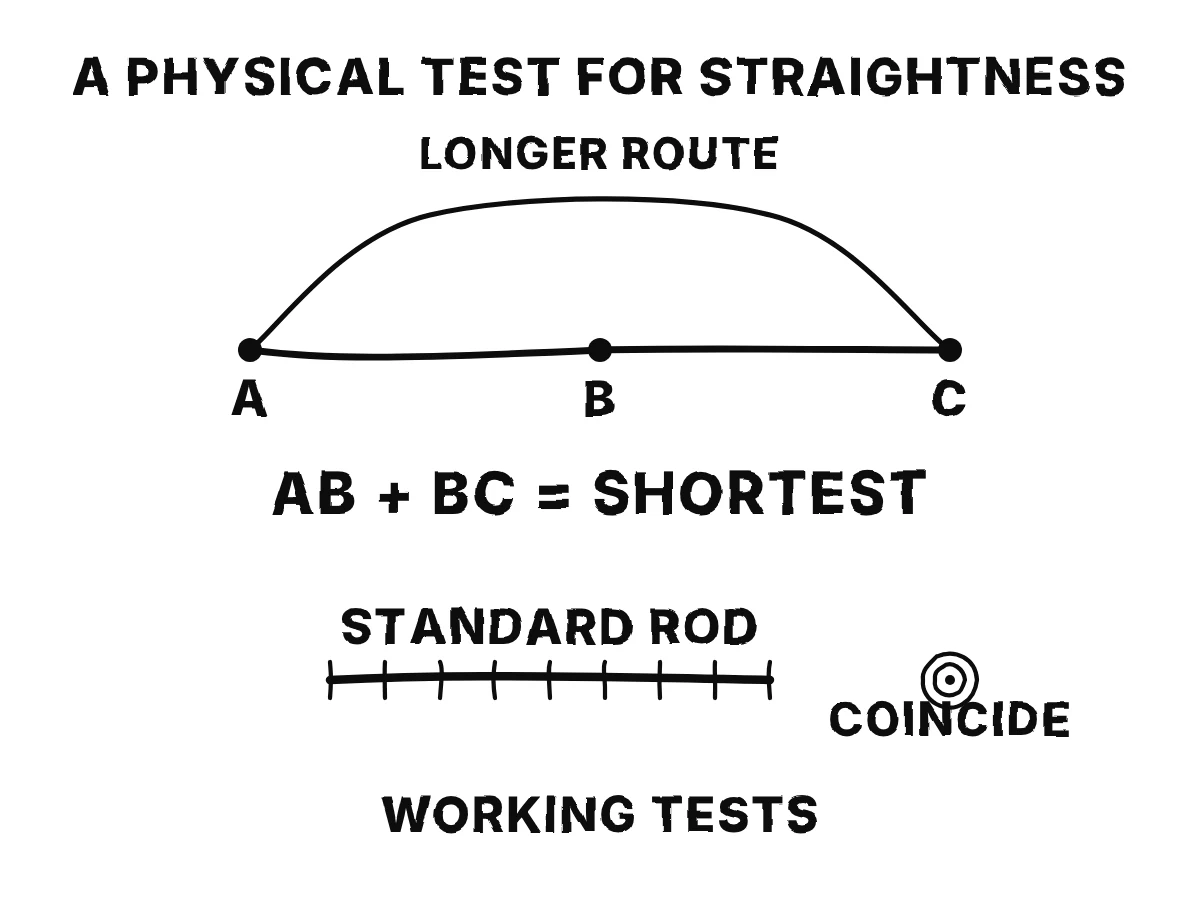
The practical qualifications behind those grids are worth keeping in view. In the accompanying notes, Einstein connects a straight line with a physical test: with two points A and C fixed, choose an intermediate point B so that the distance from A to B, plus the distance from B to C, is as small as possible. A detour makes that total longer; placing the intermediate point along the direct connection makes it shortest. He also notes that a distance need not contain a whole number of standard rods: subdivisions of the rod handle the remainder without introducing a new measuring principle. And for the present purpose, ordinary agreement about whether things coincide at a place is sufficient. These are working physical foundations, not claims that every question about geometry and measurement has been settled forever.
Positions Need Times
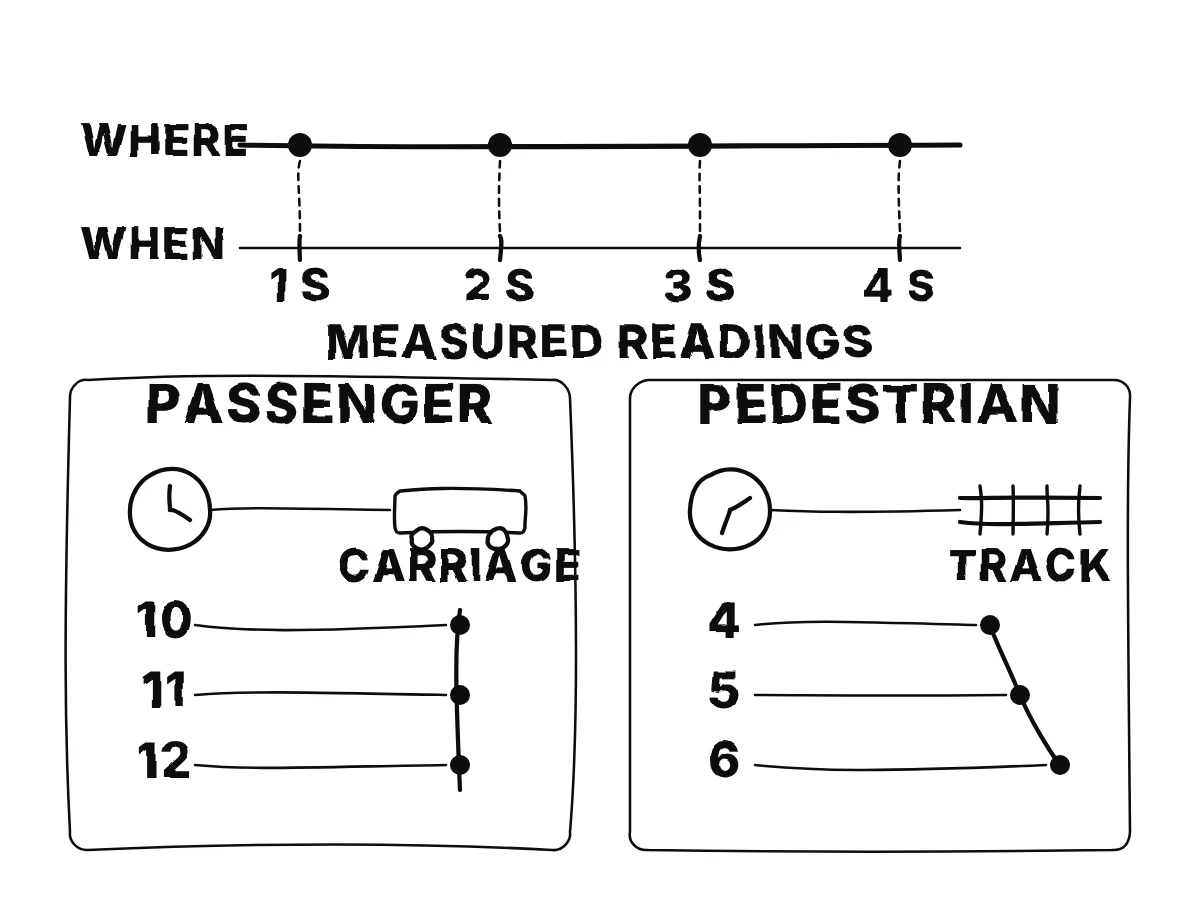
Even after choosing the reference body, a drawn path does not completely describe motion. Two balls can follow the same line, with one descending slowly and the other quickly. We must also specify when the moving body occupies each position along its path. A modern slow-motion recording makes this distinction easy to see: the traced curve tells you where, while the frame times help tell you when. The sequence of positions together with their times is what turns a shape into a description of motion.
For the railway example, Einstein imagines two clocks made exactly alike. The passenger holds one, and the pedestrian holds the other. At each tick, each observer records where the stone is relative to that observer’s reference body. The passenger’s notes associate clock readings with positions beside the carriage; the pedestrian’s notes associate clock readings with positions beside the track. Time here must be given an observational meaning, through readings that could in principle be obtained by measurement. It cannot remain merely a word inserted into the definition of mechanics.
Signals Arrive Later
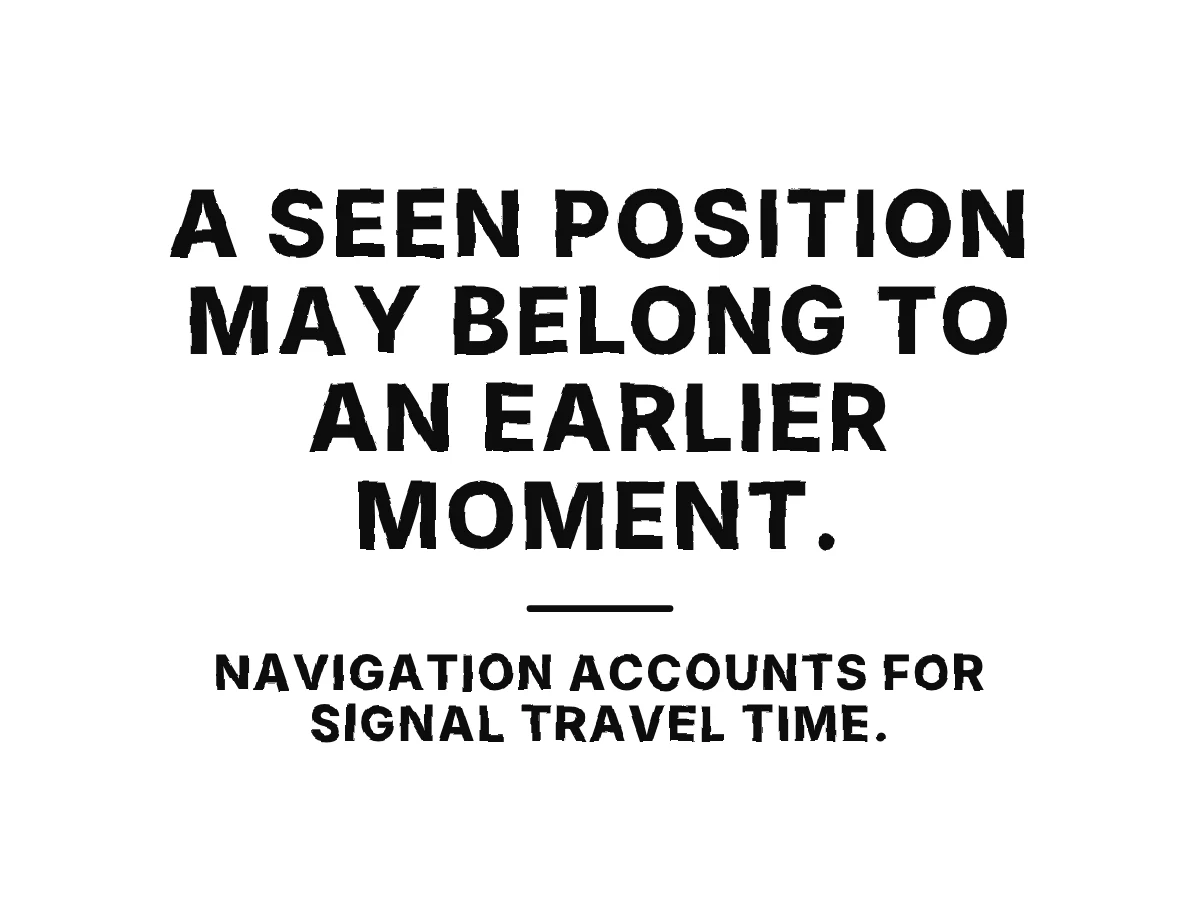
There is a deliberate simplification in this procedure. Light takes time to travel from the stone to an observer, so seeing a position and the stone’s being at that position are not automatically the same instant. Einstein temporarily sets aside the resulting observational inaccuracy, and he also leaves a further difficulty about time for later examination. Satellite navigation makes the first issue concrete today: a positioning signal arrives after it was transmitted, and its travel time must be taken into account. Our classroom account of the falling stone is therefore a classical starting point, not the final treatment of clocks and observation. Einstein also cautions in his notes that general relativity will eventually require refinements and changes to the underlying spatial picture.
We began this course by asking how geometry becomes a statement about measurable things, and then learned to give a place by reference to a body. The falling stone completes that foundation: to describe motion, name the reference body and connect its measured positions with measured times.
Describing Motion
Where it is in the book: § 3. Raum und Zeit in der klassischen Mechanik. · pages 5–7 (estimated) · Wenn ich ohne schwere Bedenken und eingehende Erläuterungen die Aufgabe der Mechanik so formuliere: „Die Mechanik hat zu beschreiben, wie…
Questions
Why can the passenger describe the stone's path as straight while the pedestrian describes it as curved?
They compare the same motion with different reference bodies.
The passenger sees the fall before its forward motion begins.
The pedestrian's position makes gravity act differently.
Show the answer
Answer: They compare the same motion with different reference bodies.. The passenger compares the stone with the moving carriage; the pedestrian compares it with the ground. Changing the reference body changes the pattern of positions, not the falling stone.
On a ground-fixed sheet, positions are marked at equal time intervals during the fall. What pattern should you expect?
Growing horizontal gaps and equal downward gaps.
Equal horizontal gaps and growing downward gaps.
Equal horizontal gaps and equal downward gaps.
Show the answer
Answer: Equal horizontal gaps and growing downward gaps.. The horizontal motion is steady, while the downward fall becomes increasingly rapid. Equal time intervals therefore give equal horizontal spacing but growing downward separation.
Why is a drawn path not a complete description of motion?
It cannot show positions relative to a reference body.
It must show both observers agreeing on its shape.
It does not say when the body occupies each position.
Show the answer
Answer: It does not say when the body occupies each position.. Two bodies can follow the same line at different rates. Positions must be paired with observable clock readings to describe how the motion unfolds.
What simplification is made when observers record the stone's position at each clock tick?
The delay caused by light's travel is neglected.
The clocks replace the need for a reference body.
The stone's downward acceleration is neglected.
Show the answer
Answer: The delay caused by light's travel is neglected.. Light takes time to reach an observer, so seeing a position is not automatically simultaneous with the stone's being there. This observational inaccuracy is temporarily set aside.
Practice
A stone is released without a push from a uniformly moving railway carriage. Ignore air resistance. Someone asks whether its path is really a straight line or really a parabola. Explain what is missing from the question and give the two descriptions. from the book
Show the answer
Hint: First name the body relative to which the positions are described.
Answer: The question leaves the reference body unspecified. Relative to the carriage, the stone follows a straight vertical line; relative to the ground, it follows a parabola. Neither is the uniquely real path with the reference body left unstated.
Suppose you have drawn the stone's entire path relative to the ground. Explain what you must add to make this a description of motion, and how the pedestrian could obtain that information.
Show the answer
Hint: Ask what the drawing cannot tell you about a slow fall versus a quick fall.
Answer: You must say when the stone occupies each position along the path. The pedestrian can record the stone's position relative to the ground at each clock tick, pairing measured positions with clock readings. In this classical account, the delay from light's travel is temporarily neglected.
Two points A and C are fixed on a rigid body. You may choose an intermediate point B. Explain how the sum of the distances AB and BC can be used to identify a straight connection rather than a detour.
Show the answer
Hint: Consider which choice of B makes AB plus BC as small as possible.
Answer: Choose B so that AB plus BC is as small as possible. Placing B along the direct connection gives the shortest total, whereas a detour makes it longer. This gives the straight line a physical test in terms of distances.
7 min · 1261 words
How it was made
Level
2: Wzory z objaśnieniami. Każdy wzór pozostaje i jest wyjaśniany krok po kroku.
Lecturer
Demonstrator
Drawings
Graphic ink · how many: many
With
questions, places in the book, worked examples
Voice
Oliver (Inworld)
Told in
English
Examples for
a curious adult with school physics; add one modern instance per idea, such as GPS satellite clocks
Text written by
GPT-6.1 (OpenAI)
Made
Made in 20 min for $1.46 (check 3× $0.01, director 3× $0.01, map 1× $0.01, narration 2× $0.01, narration check 2× $0.01, scene 116× $0.56, study 6× $0.05, writer 3× $0.07, narration (Inworld) 3× $0.73) Model calls only, at our cost, without the markup a customer pays. Time from the first call to the last file.
The lectures retell the German text of Project Gutenberg #77850, the 1917 Vieweg edition. The author died in 1955; the work is in the public domain. The retelling, the drawings and the voice are made by AI and checked against the book by a second model; nothing was edited by hand. How AI is used.
The lectures are free to read, share and quote with a link to this page.
Your own hard book, the same way
Upload a textbook or any difficult book. The first five minutes are free.